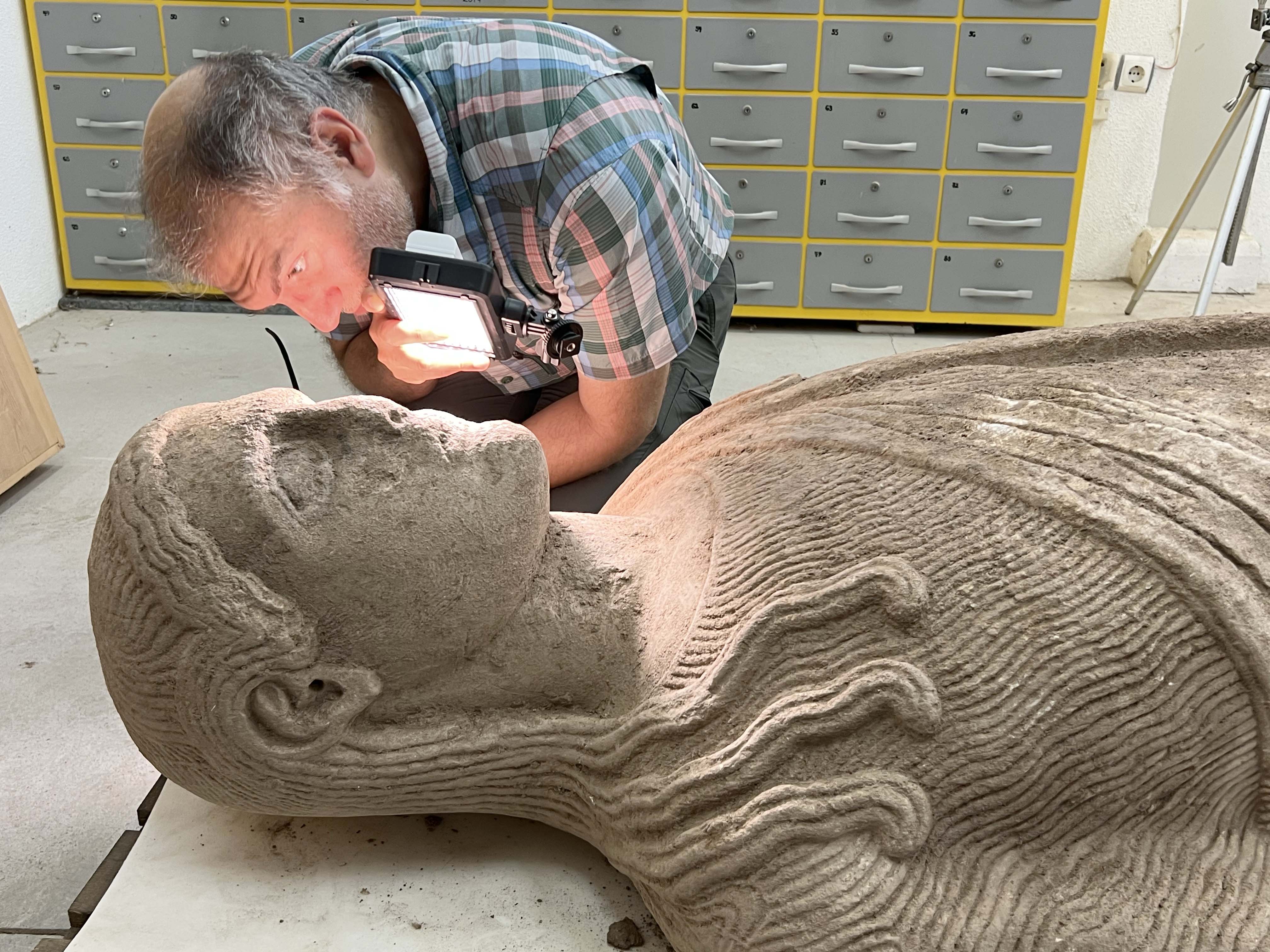
Researchers with the Harvard-Cornell Archaeological Exploration of Sardis uncovered a marble statue estimated at nearly 2,500 years old during excavations in late May 2026. The sculpture, broken into two main pieces, had been placed face down as paving stones in a Roman colonnaded avenue at the site in western Turkey.
Field director Nicholas Cahill, professor of Greek and Roman art and archaeology at the University of Wisconsin-Madison, said monumental sculptures of this period are rarely found anywhere in the Mediterranean. The statue stands over seven feet tall and depicts a young man wearing a chiton, a diagonally wrapped mantle, and a distinctive garment with fine horizontal folds that has few parallels in ancient sculpture.
Conservators lifted the fragments on July 13 and transported them to the expedition's conservation lab for ongoing analysis. Initial cleaning revealed sideburns and coiffed hair, confirming the figure as male. The bolt-upright stance and archaic hairstyle resemble 6th-century B.C. Greek kouroi, but prominent veins and anatomical details point to a later date, likely the 470s to 450s B.C., the early Classical period in Greece.
During this era Sardis was no longer an independent Lydian capital but a major provincial center under Achaemenid Persian rule. The statue shows no Persian influence; instead it combines archaic Lydian dress with contemporary Greek sculptural techniques. Cahill said the work reflects an artist with a complex understanding of multiple cultural traditions, deliberately referencing Lydian styles from a century earlier.
The Lydian empire, which controlled western Turkey from the mid-7th to mid-6th century B.C., left little written record. Most historical knowledge comes from Greek and Roman sources that portrayed Lydians as eastern barbarians, while archaeological evidence reveals Sardis as a center of luxury, perfumes, and fine clothing. This statue adds rare physical evidence of Lydian self-representation.
The statue's original placement and purpose remain unknown. One possibility is that it stood at the sanctuary of Cybele, the native mother goddess described in literary sources as one of Sardis's most important sanctuaries. Wealthy citizens or leaders often placed their likenesses in divine sanctuaries to worship in perpetuity and draw legitimization from the deity, explained Susanne Ebbinghaus, curator of ancient art at the Harvard Art Museums.
The conservation team is working to clean the statue while preserving any remaining paint flecks for color analysis. When conservation is complete, the fragments will be joined and the statue displayed in a Turkish archaeological museum alongside other Sardis finds. The Harvard-Cornell excavation at Sardis, a UNESCO World Heritage Site since 2025, began in 1958 under George M.A. Hanfmann.
Mystery statue unearthed at Sardis archaeological dig
This is an independent summary. The complete reporting, supporting context and any primary documents remain with Harvard Gazette.