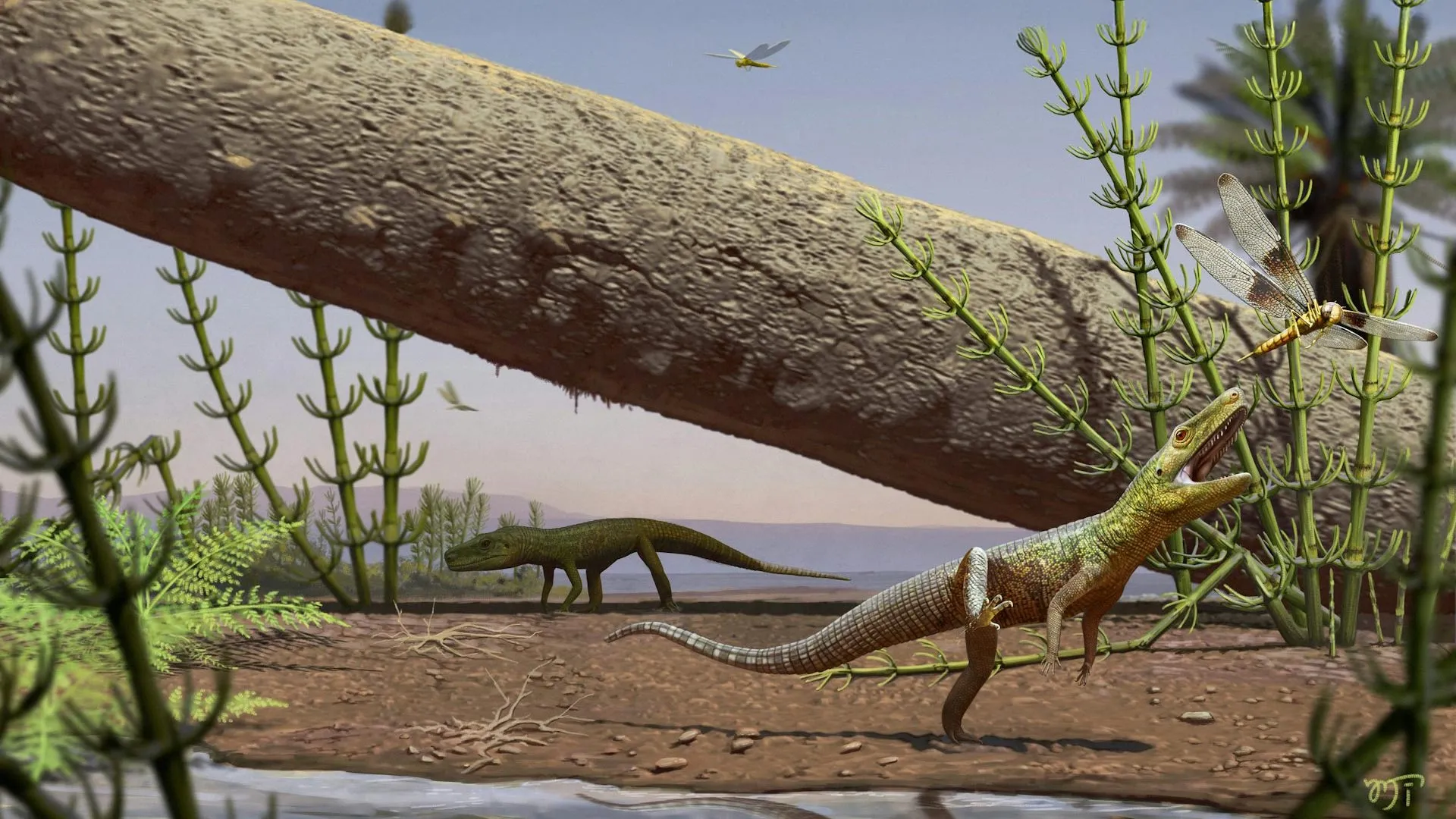
Researchers have described a new reptile species, Silescelida acristata, from a 240-million-year-old fossil found in Rio Grande do Sul, Brazil. The animal lived during the Middle Triassic, a period when ecosystems were recovering from the Permian–Triassic mass extinction.
The fossil, recovered from rocks in the UNESCO Quarta Colônia Geopark near Dona Francisca, preserves mainly limb bones. Analysis of the femur reveals a semi-erect leg posture, with limbs positioned more under the body than sprawled to the sides, a trait associated with more efficient locomotion.
Phylogenetic analysis places Silescelida acristata close to the Euparkeriidae, a poorly understood family of archosauriforms previously known mostly from Africa, Asia, and Europe. Its presence in South America indicates this group had a wider global distribution during the Triassic than previously documented.
The specimen has an unusual history: a key fragment confirming its provenance was misplaced in a university collection for over two decades before being rediscovered in 2022 at the Pontifical Catholic University of Rio Grande do Sul. The genus name references this long silence, while the species name notes the absence of a femoral crest found in most relatives.
The study, published in Scientific Reports, was conducted by researchers from the Federal University of Santa Maria, the Federal University of Rio Grande do Sul, and the Pontifical Catholic University of Rio Grande do Sul. They emphasize that even fragmentary fossils can yield significant data on locomotion, evolutionary relationships, and biogeography.
The find reinforces the importance of southern Brazil's Triassic rock formations for understanding how archosauriforms diversified after the end-Permian extinction and gave rise to the archosaur lineage that includes crocodiles, dinosaurs, and birds.
240-million-year-old reptile fossil reveals a lost chapter before dinosaurs and crocodiles
This is an independent summary. The complete reporting, supporting context and any primary documents remain with ScienceDaily.