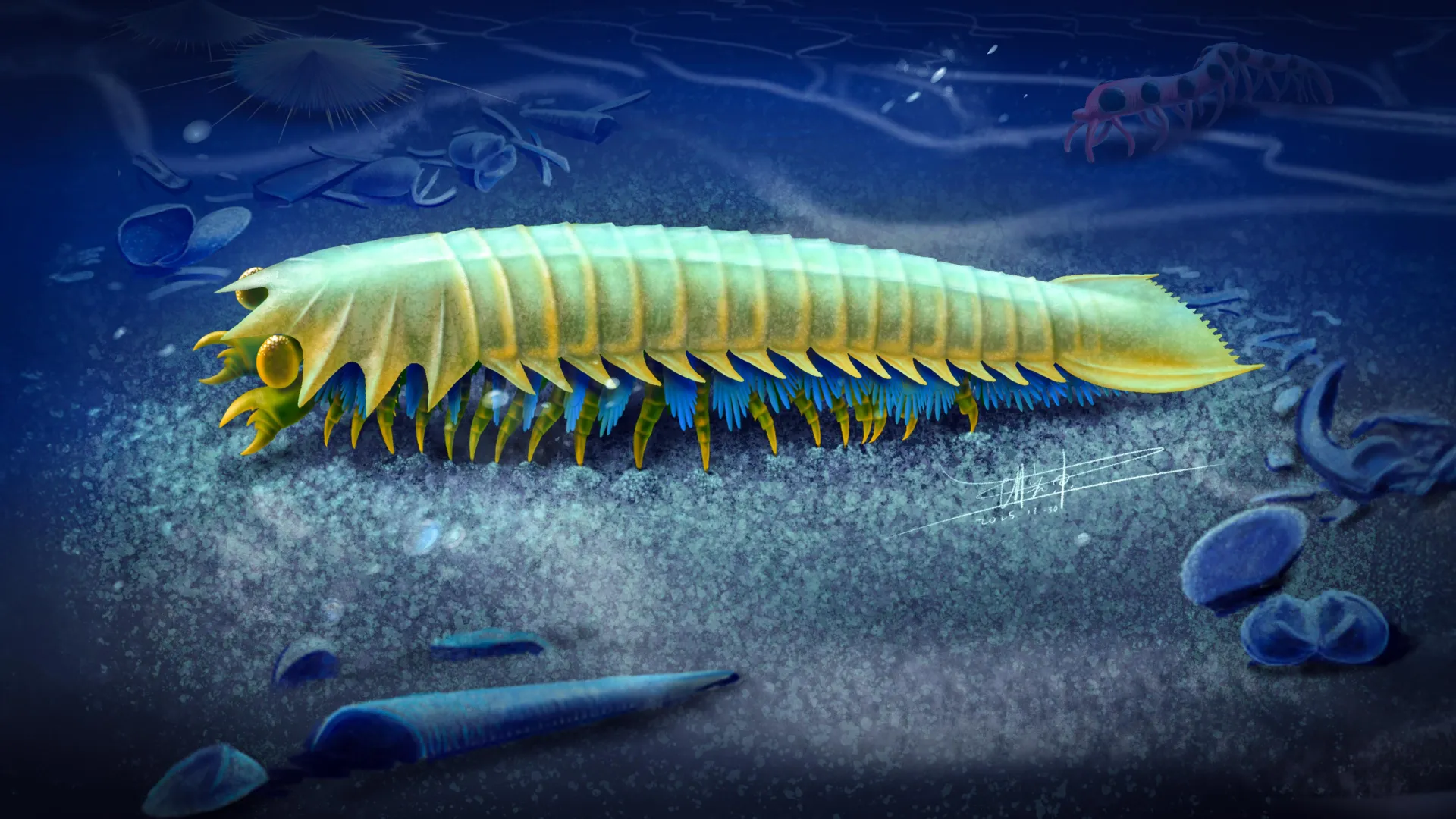
Scientists from Yunnan University and the University of Leicester have identified the earliest known evidence of the appendages that eventually became spider fangs in a 518-million-year-old fossil. The study, published in Nature, examines Urokodia, a small marine animal from the early Cambrian Period.
Urokodia measured roughly 2–3 centimeters in length and was discovered at the Chengjiang fossil site in Yunnan Province, southern China. The site, whose discovery marks its 42nd anniversary, preserves more than 200 types of animals from over 500 million years ago.
The creature had large stalked eyes, a segmented skeleton, and jointed limbs beneath a narrow body, bearing little obvious resemblance to modern spiders or scorpions. However, it belongs to the broader evolutionary lineage of chelicerates, the group that includes spiders, scorpions, ticks, and horseshoe crabs.
Using X-ray tomography, researchers found that much of Urokodia's soft anatomy remained preserved in a mummified state within the rock. Most importantly, the scans revealed two pincer-like appendages positioned just behind the eyes, identified as an early form of chelicerae.
Chelicerae are the defining feature of chelicerates; in modern species they function as pincers or fangs that grip, pierce, or stab prey. The fossil also preserves structures on the legs that may have served as book gills for underwater respiration, similar to those still found in horseshoe crabs.
Professor Yu Liu of Yunnan University, who led the research, said the team noticed the pincer-like limbs at the front of the animal during X-ray analysis and recognized the fossil as a distant ancestor of living chelicerates. Professor Mark Williams of the University of Leicester noted that the Chengjiang fossils provide insight into how life was evolving at the dawn of animals.
Chelicerates have become one of the most successful animal groups in both marine and terrestrial environments. The study was supported by a grant from the Department of Science and Technology of Yunnan Province and the Yunnan Revitalization Talent Support Program.
518-million-year-old creature reveals the origins of spider fangs
This is an independent summary. The complete reporting, supporting context and any primary documents remain with ScienceDaily.