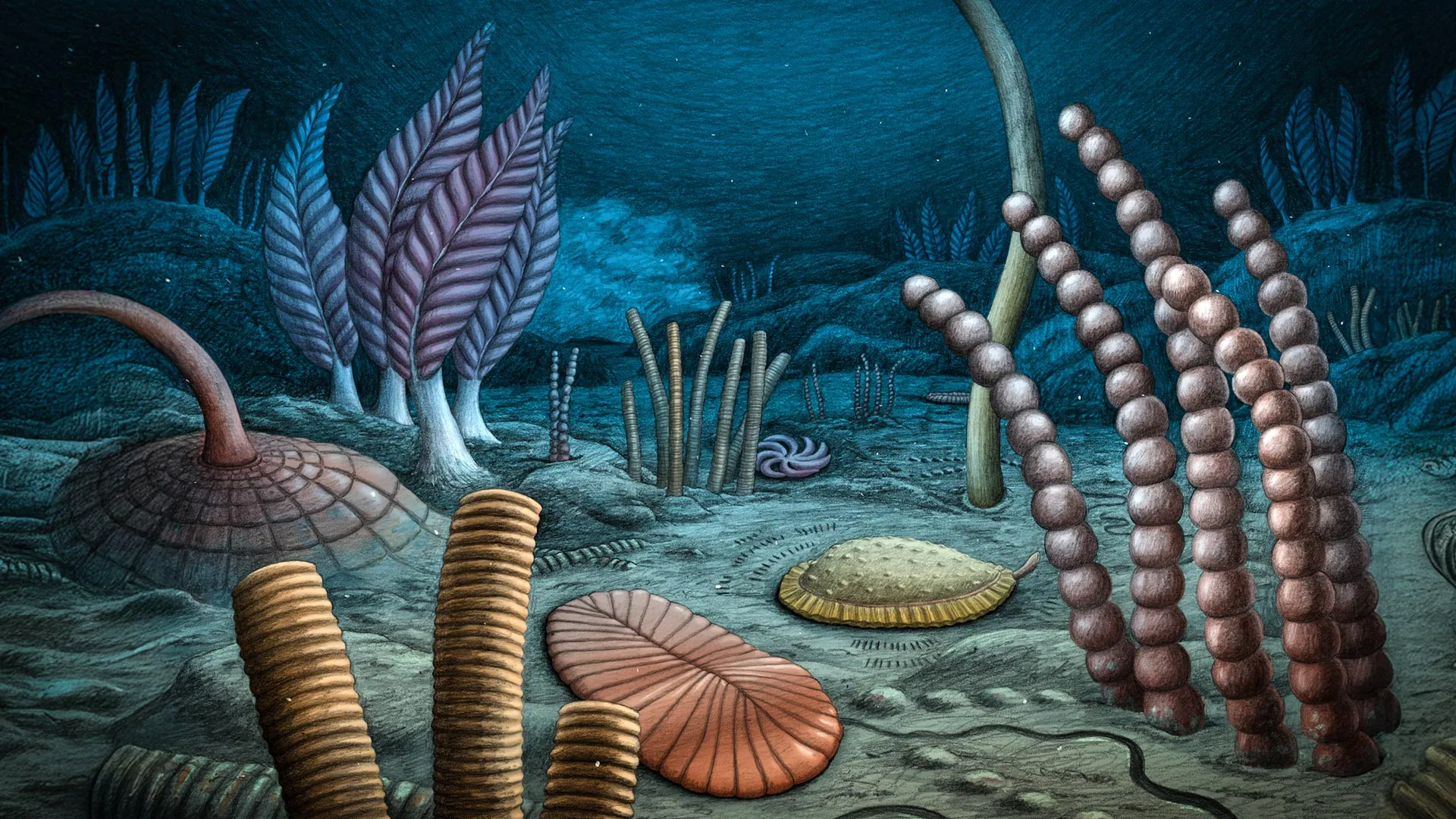
Researchers have uncovered an exceptionally diverse fossil site in Canada's Mackenzie Mountains, on the traditional lands of the Sahtú Dene and Métis, dating to approximately 567 million years ago. The discovery, led by scientists at the American Museum of Natural History and Dartmouth and published in Science Advances, adds more than 100 specimens to the Ediacaran record, including six taxonomic groups never before documented in North America.
The fossils belong to the White Sea assemblage, a grouping of Ediacaran organisms previously known from Europe, Asia, and Australia but absent from the North American record until now. Their age places them 5–10 million years earlier than other White Sea fossils, overlapping with the older Avalon assemblage and narrowing a gap in the fossil timeline.
Among the finds are Dickinsonia, a flat, mobile organism that likely absorbed nutrients across its lower surface; Funisia, a tubular, cluster-dwelling form that provides the oldest known evidence of sexual reproduction via broadcast spawning; and Kimberella, a bilaterally symmetric creature that moved with a muscular foot and scraped food from the seafloor. The site also preserves Eoandromeda, a possible comb jelly with eight spirally arranged arms.
Sedimentary context indicates these organisms lived in deeper marine environments than typically associated with the White Sea assemblage. The researchers propose that the stable conditions of the deep ocean — consistent temperature and oxygen levels — may have fostered early animal diversification before later expansion into shallower waters, a pattern opposite to that seen in later evolutionary history.
The fossil-bearing strata are capped by hundreds of feet of rock that may contain additional material, suggesting the site will yield further insights. Specimens will be housed permanently at the Prince of Wales Northern Heritage Centre in Yellowknife. The work was supported by NASA Exobiology and U.S. National Science Foundation grants.
567-million-year-old fossils rewrite the dawn of animal life
This is an independent summary. The complete reporting, supporting context and any primary documents remain with ScienceDaily.