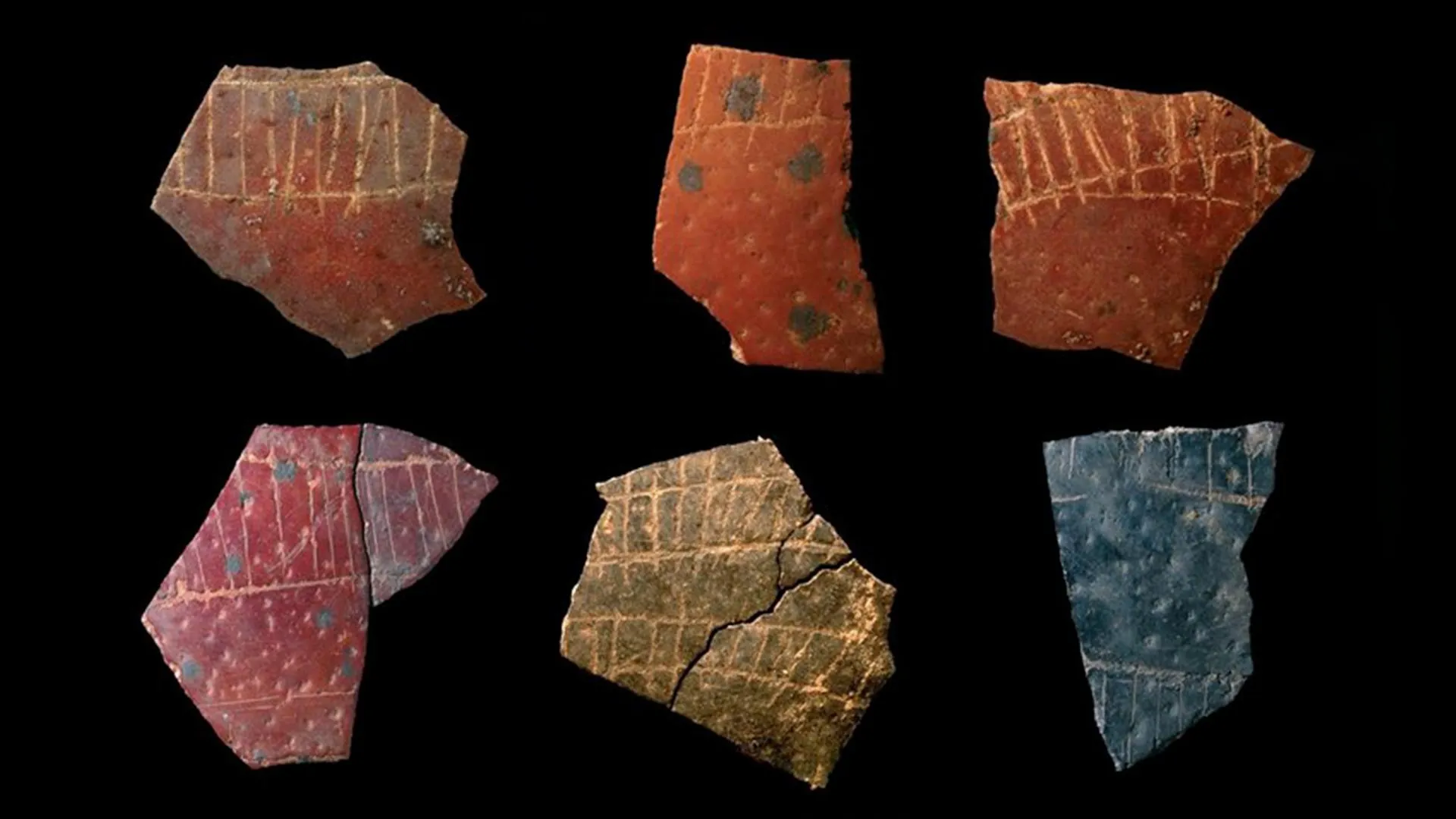
Archaeologists have analyzed hundreds of engraved ostrich eggshell fragments recovered from Diepkloof and Klipdrift rock shelters in South Africa and Apollo 11 in Namibia, dating to approximately 60,000 years ago. The fragments are associated with the Howiesons Poort cultural phase and were likely used as water containers by groups of Homo sapiens.
A study led by researchers at the University of Bologna applied geometric and statistical techniques to 112 fragments, reconstructing the directions, angles, and paths of the engraved lines. The analysis found that more than 80% of the configurations contained consistent spatial patterns, including angles close to 90 degrees, sets of parallel lines, hatched bands, grids, and diamond-shaped motifs.
The designs show evidence of rotation, translation, repetition, and embedding — the ability to build hierarchical levels of signs within the same surface. According to Professor Silvia Ferrara, who coordinated the study, the engravings reflect a visual grammar in embryo, indicating that the makers organized lines according to recurring principles rather than improvising.
First author Valentina Decembrini notes that the patterns suggest visuo-spatial planning, as if the engravers held an overall image of the figure in mind before carving. The capacity to arrange shapes and lines in organized configurations may represent an important sign of emerging abstract thought.
The research, published in PLOS One under the title "Earliest Geometries: A Cognitive Investigation of Howiesons Poort Engraved Ostrich Eggshells," was conducted as part of the FIS Advanced project SAPIENCE. The authors emphasize that the significance lies in the mental abilities required to create visual designs according to consistent rules, a trait that underpins later symbolic systems and writing.
The study does not assign specific meanings to individual markings, focusing instead on the cognitive implications of the geometric regularities observed. Researchers caution that the sample represents a subset of preserved fragments and that the full range of engraving practices from this period remains unknown.
60,000-year-old ostrich eggshell engravings reveal a surprisingly sophisticated human mind
This is an independent summary. The complete reporting, supporting context and any primary documents remain with ScienceDaily.