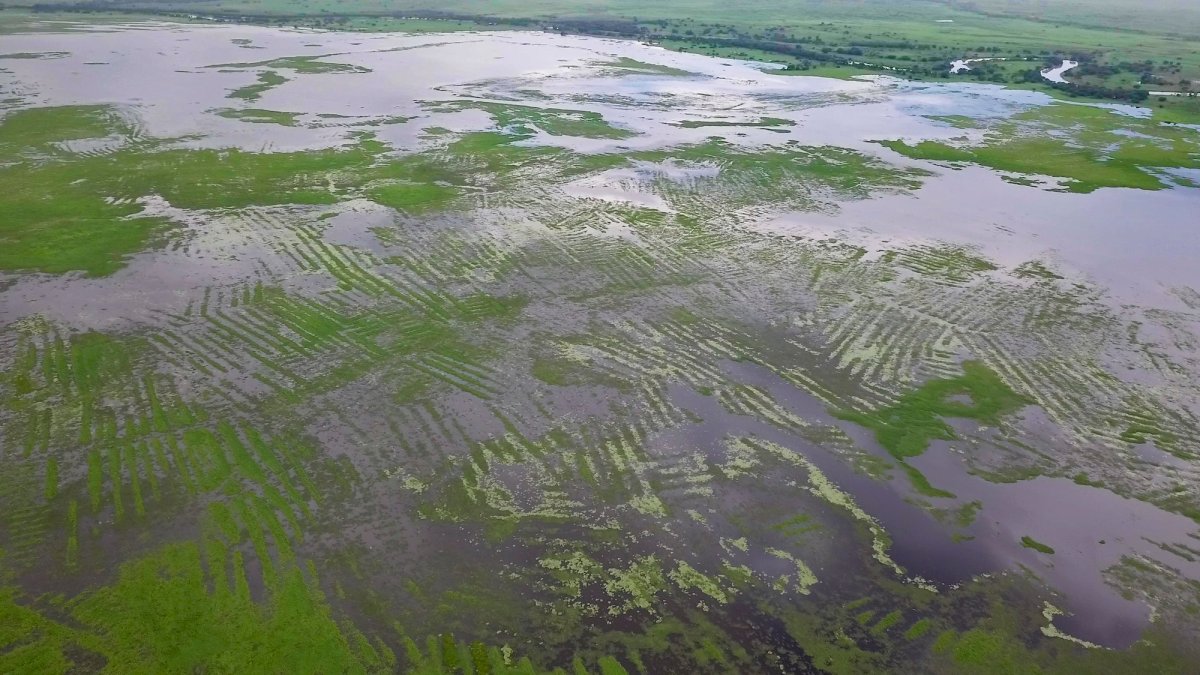
Archaeologists have long assumed that the massive network of canals and raised farming ridges in Colombia's La Mojana wetlands required a hierarchical chiefdom to organize construction. The system covers an area comparable to Grand Canyon National Park and is visible from aircraft, with construction beginning in the first centuries BCE and continuing until roughly the 11th century CE.
A study published in Communications Sustainability challenges that view. An international team led by archaeologist Jasmine Vieri of the University of Cambridge analyzed satellite imagery of a 1,235-acre section near San Marcos, mapping 1,600 ridges and 63 raised housing platforms.
Using population estimates of 1,600 residents and a conservative workforce of 800 adults, researchers from the Colombian Institute of Anthropology and History and Spain's University of Santiago de Compostela modeled the labor required. They factored in earth volumes, local geology, period technology, and indigenous working traditions.
The models indicate that cooperative family groups could have built the canal-ridge systems without centralized oversight. Vieri said one system could have been completed in less than two months, roughly half a dry season, representing a far lower labor investment than previously assumed.
No archaeological evidence supports the existence of a structured chiefdom in the region during the system's construction, despite earlier finds of ceramics and goldwork suggesting smaller formative societies. The fields operated for approximately 1,000 years before populations gradually shifted to higher altitudes for unclear reasons.
The findings have modern relevance. Colombia's recent water management strategy relies on dykes to block flooding, but the Caregato dyke has breached multiple times since 2021, causing damage and drought cycles. Study author Fernando Montejo Gaitán of ICANH said policymakers have lacked data showing that sustainable, locally organized solutions are feasible.
Co-author Marcos Martinon-Torres of the University of Cambridge argued that assumptions of top-down planning risk obscuring the agency of pre-Hispanic populations. He said these societies worked with natural hydrology rather than attempting to obstruct it, a strategy that remains applicable today.
The research demonstrates that large-scale hydraulic engineering can emerge from collective action without state coercion, offering both a historical correction and a potential model for contemporary water management in the region.
Ancient South American families built massive waterways by themselves
This is an independent summary. The complete reporting, supporting context and any primary documents remain with Popular Science.