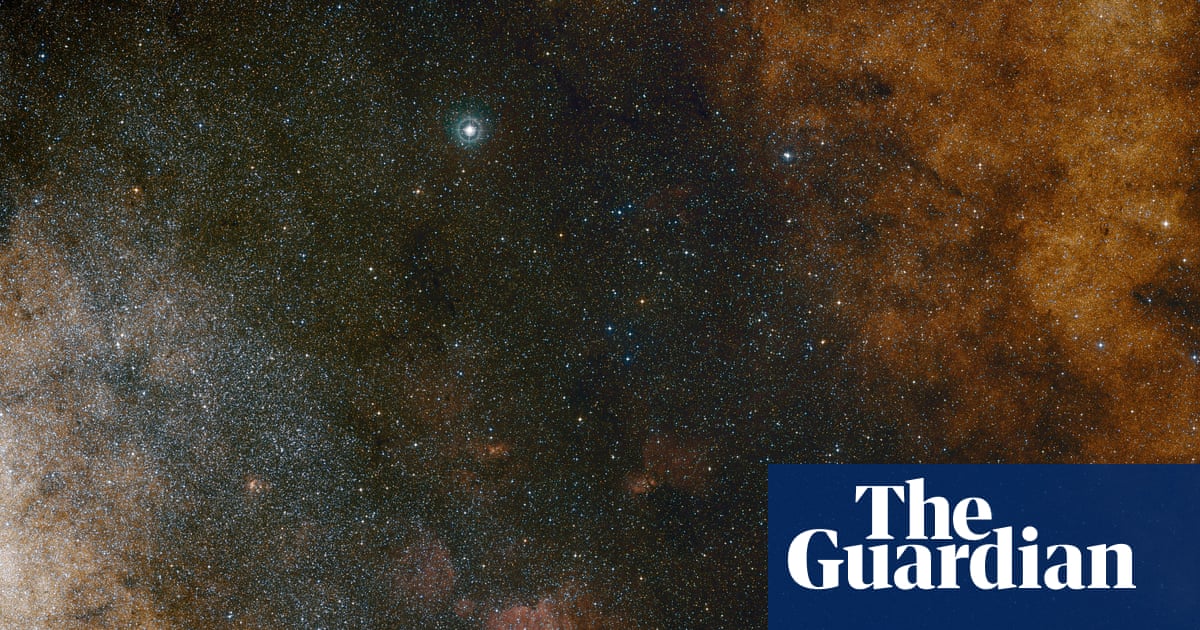
Astronomers using the European Southern Observatory's Very Large Telescope Interferometer in Chile have identified the fastest known star in the Milky Way. Designated S301, the star travels at roughly 25,000 kilometres per second, about 8% of the speed of light, as it orbits the supermassive black hole Sagittarius A* at the galaxy's centre.
S301 completes an orbit every 8.7 years and at its closest approach passes within 12 times the Earth-Sun distance of the black hole, a proximity unprecedented among known stars. The star's orbit is also highly eccentric, bringing it much closer to Sagittarius A* than other tracked stars in the region.
Researchers at the Max Planck Institute for Extraterrestrial Physics traced S301's path back to 2017 using VLTI data. They plan to continue tracking it through its next closest passage in 2031, aiming to gather enough orbital data to measure the black hole's spin directly.
According to general relativity, a spinning black hole drags spacetime around it, subtly warping the orbits of nearby objects. This frame-dragging effect is only detectable for stars on very tight, fast orbits around a rapidly rotating black hole. S301's combination of speed, proximity, and orbital shape makes it uniquely suited for such a measurement.
Previously, estimating the spin of Sagittarius A* was thought to require decades of observations of multiple stars. The discovery of S301 could shorten that timeline to roughly ten years, providing a key test of Einstein's theory in the strongest gravitational environment available for study.
The star is not expected to cross the black hole's event horizon. Its orbit remains stable despite the extreme gravitational forces, behaving similarly to a planet orbiting the Sun but at vastly higher velocities and closer range.
Independent astrophysicist Ziri Younsi of University College London described the discovery as a potential gamechanger for understanding the evolution of the Milky Way, noting that a direct spin measurement would constrain models of how the central black hole grew over cosmic time.
The findings were published in the journal Nature. Continued monitoring with the VLTI and future instruments will determine whether S301's orbit yields the precise data needed to quantify the black hole's rotation.
Astronomers detect fastest known star in Milky Way
This is an independent summary. The complete reporting, supporting context and any primary documents remain with The Guardian.