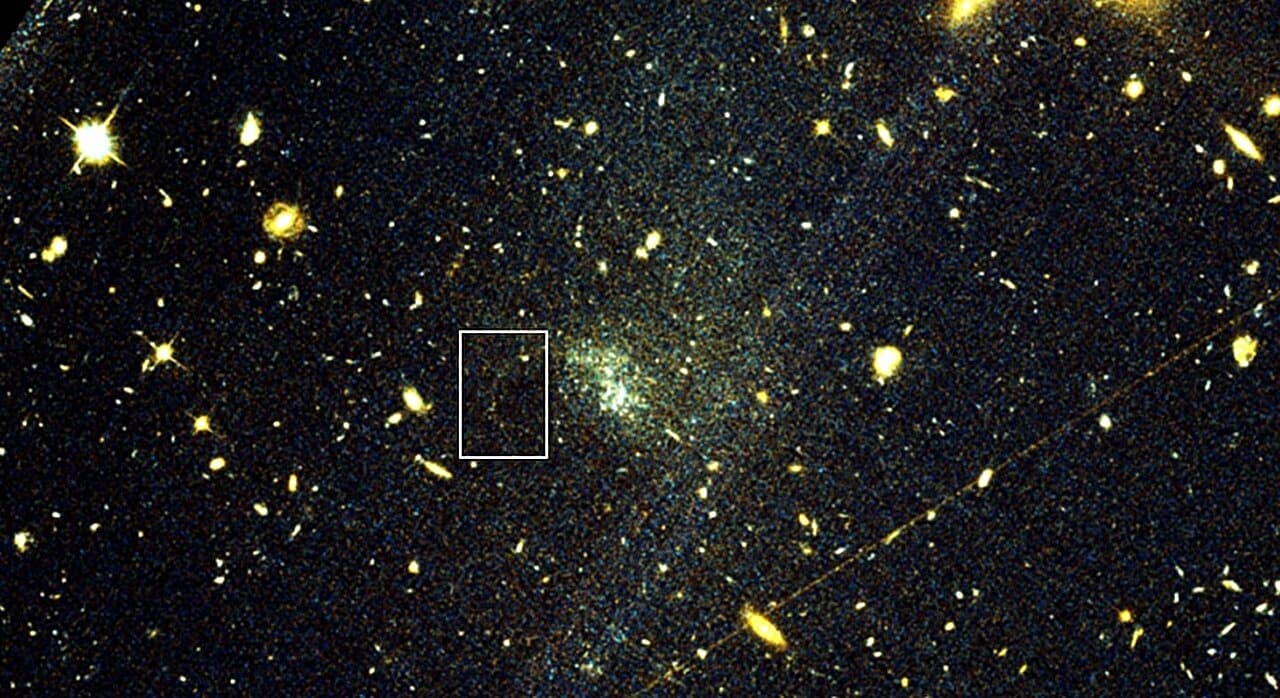
Astronomers have identified a stellar stream associated with a globular cluster in the ultra-diffuse galaxy UGC 9050-Dw1, marking the first such detection outside the Milky Way.
Stellar streams form as stars gradually escape a globular cluster under the gravitational pull of their host galaxy, preserving a record of the gravitational field in their shape and position.
Detecting these faint structures beyond the Milky Way is difficult because the streams consist of very dim sources, and ultra-diffuse galaxies themselves have extremely low surface brightness.
Using observations from the Hubble Space Telescope, researchers modeled the stream's structure to infer the mass distribution of UGC 9050-Dw1.
The analysis indicates a significant dark matter content, consistent with earlier estimates for this galaxy and with general expectations for ultra-diffuse systems.
The key advance is methodological: a technique previously applied only within the Milky Way has now been validated in another galaxy.
Because dark matter does not emit or absorb detectable light, its presence is usually inferred from its gravitational influence on visible matter; stellar streams offer an independent dynamical tracer.
The authors anticipate that upcoming surveys with the Euclid and Nancy Grace Roman space telescopes will uncover many more such streams, enabling comparative studies of dark matter across different galaxy types.
Впервые за пределами Млечного Пути найден звёздный поток, который поможет картировать тёмную материю
This is an independent summary. The complete reporting, supporting context and any primary documents remain with iXBT.