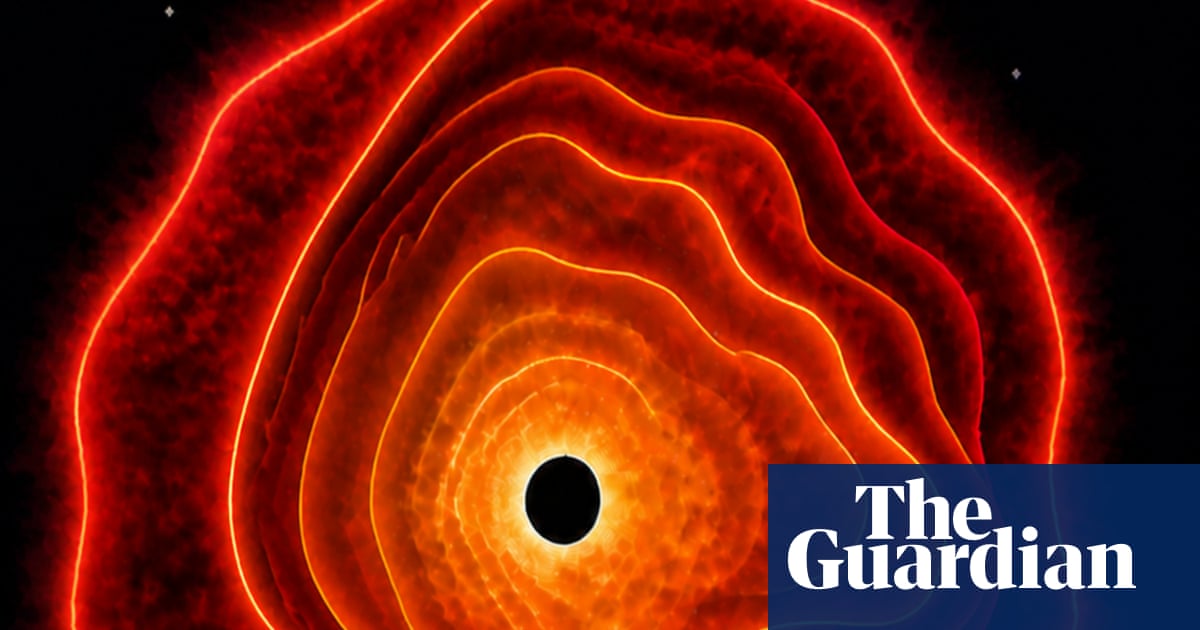
Astronomers report the discovery of a new class of cosmic object, termed a "black hole star," located billions of light-years away in the constellation Cetus. The object, designated MoM-BH*-1, appears as an extremely bright red spot in deep-field images from NASA's James Webb Space Telescope (JWST). Its light cuts off abruptly below a certain wavelength, a spectral feature with no match among known object classes.
The international team, led by Dr. Rohan Naidu of the Kavli Institute for Astrophysics and Space Research at MIT, analyzed the object's energy output and structure. They found it releases roughly 100 billion times more energy than any known star can produce through nuclear fusion, aligning instead with black hole accretion processes. Computer simulations indicate the object is a black hole enveloped in dense shrouds of gas that reprocess its radiation, causing it to glow like a colossal red star the size of the solar system.
The object is estimated to have formed about 660 million years after the Big Bang. The researchers were originally using JWST to hunt for the most distant galaxies, having previously identified a galaxy formed 280 million years after the Big Bang. Their attention turned to the population of "Little Red Dots" (LRDs) that appear ubiquitously in JWST deep images. The new findings, published in Nature, suggest many LRDs may be similar black hole stars.
If confirmed, these objects could represent a long-sought early phase in the growth of supermassive black holes, which reside at the centers of nearly all galaxies, including the Milky Way. Supermassive black holes are thought to regulate star formation and galactic evolution. Naidu said black hole stars may be the "nascent, swaddled phase" that seeds these giants, potentially governing when stars form and cease, with implications for planet formation and the emergence of life.
The identification rests on the object's unique spectral energy distribution and the modeling of its gas shroud. Researchers caution that further observations are needed to confirm the physical model and determine how common such objects are in the early universe. The team plans additional JWST spectroscopy to test the black hole star hypothesis across the LRD population.
Astronomers discover a new kind of cosmic object – a black hole ‘star’
This is an independent summary. The complete reporting, supporting context and any primary documents remain with The Guardian.