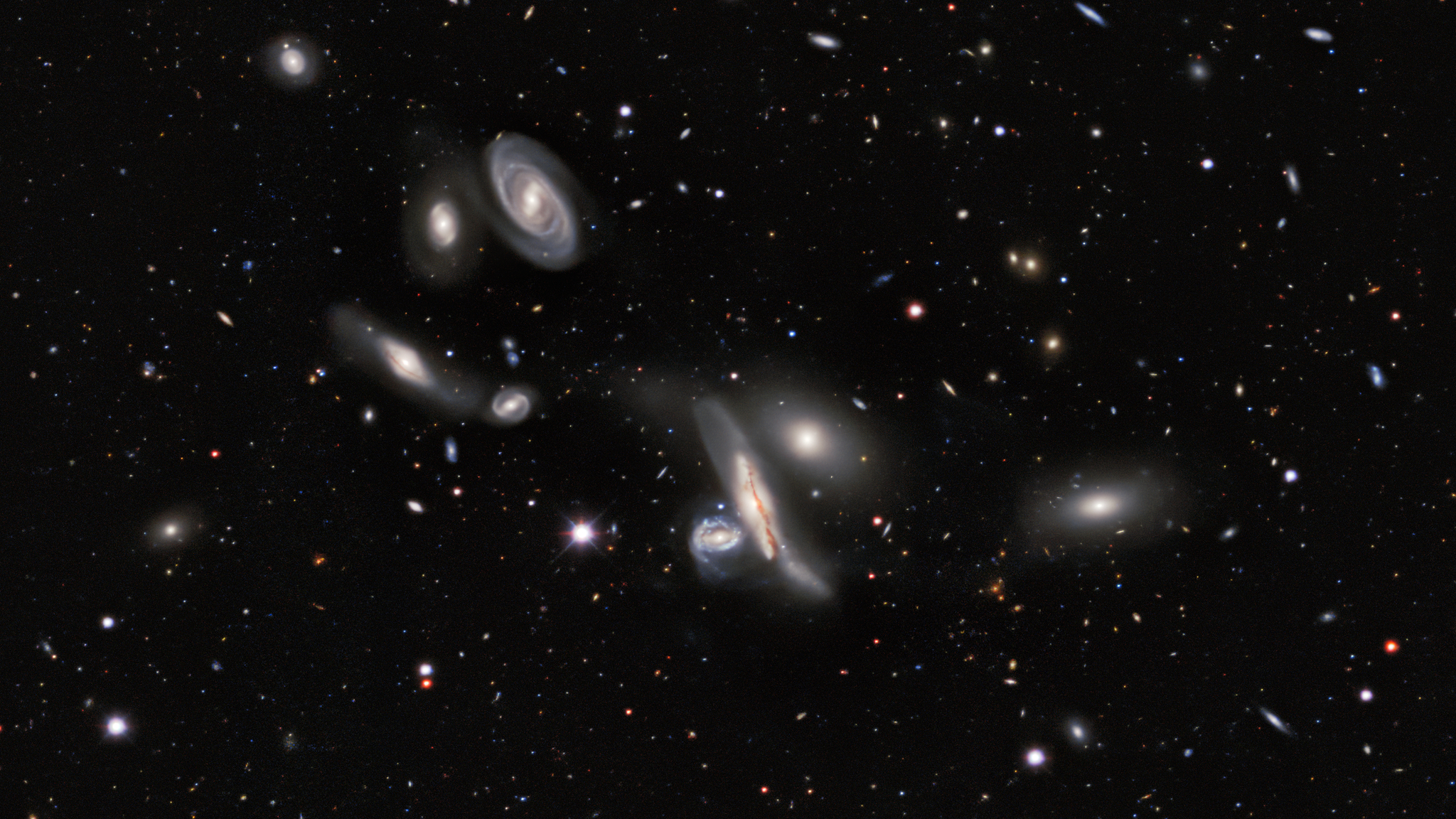
Astronomers have published the largest two-dimensional map of the universe to date, cataloging roughly 4 billion stars, galaxies, black holes, asteroids and other celestial objects. The map spans about three-quarters of the night sky in high resolution across visible and near-infrared wavelengths, avoiding regions obscured by dust and gas.
The dataset was assembled over 13 years using three ground-based sky surveys. Observations came from the Dark Energy Camera on the NSF's Victor M. Blanco 4-meter Telescope in Chile, the NSF Nicholas U. Mayall 4-meter Telescope at Kitt Peak National Observatory in Arizona, and the University of Arizona's Bok 2.3-meter Telescope, also at Kitt Peak. Years of data from NASA's Wide-field Infrared Survey Explorer (WISE) satellite supplemented the ground-based observations.
Because the map is too large to display as a single image, the team provides a free Legacy Survey Sky Browser webpage for interactive exploration. The data are openly available to other scientific investigators and are expected to help guide observations by facilities such as the Vera C. Rubin Observatory and the Nancy Grace Roman Space Telescope.
Previous versions of the survey have already supported at least 1,800 scientific papers, according to NSF's NOIRLab. Researchers can use the map to search for rare phenomena such as gravitational lenses, track transient events like supernovae, and investigate dark matter and dark energy.
The imaging surveys also laid the groundwork for the Dark Energy Spectroscopic Instrument (DESI) project, which is building a three-dimensional map of the cosmos by measuring object distances. DESI completed its first five-year survey in April 2026, with early results suggesting dark energy may be weakening over time; improved results from that survey are expected in 2027, and DESI operations are planned to continue through 2028.
Astronomers created the largest-ever 2D map of the universe, charting 4 billion objects in the night sky
This is an independent summary. The complete reporting, supporting context and any primary documents remain with Live Science.