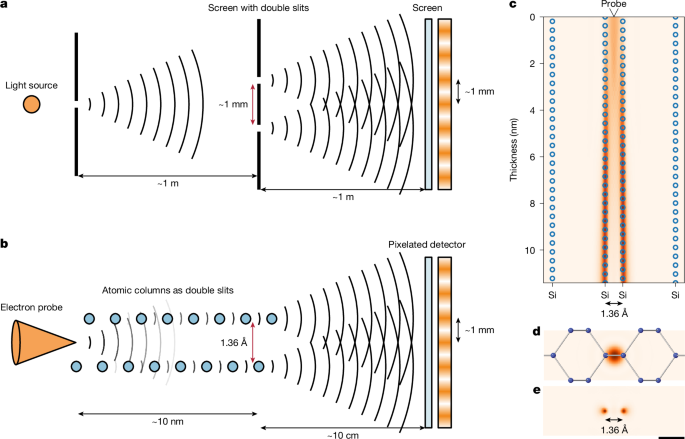
Scientists have performed a double-slit interference experiment at the atomic scale using a focused electron probe inside a crystal. The experiment, reported in Nature, used scanning transmission electron microscopy (STEM) to delocalize an electron beam over two adjacent silicon atomic columns in the [110] orientation, which are separated by 1.36 angstroms.
The two atomic columns function as the 'slits' in this analog of Thomas Young's classic light experiment, generating measurable interference fringes. The researchers observed that these fringes persist across a temperature range from 300 Kelvin to 900 Kelvin.
At finite temperatures, the atomic columns vibrate strongly due to thermal energy. The persistence of the fringes at high temperatures indicates that only a subset of phonon modes degrades the interference visibility.
The study found that correlated thermal vibrations between neighboring atoms preserve quantum coherence that would otherwise be destroyed by independent atomic motion. This correlation allows the interference pattern to survive despite significant thermal vibration.
By quantitatively analyzing the preserved fringe visibility, the researchers gained direct experimental access to vibrational correlations between the pair of atomic columns. These correlations map to the anisotropic stiffness of the specific atomic bond connecting them.
The technique provides a way to probe low-energy phonon dynamics that influence thermal transport in materials. The approach effectively recasts the crystal lattice itself as an atomic-scale interferometer.
This platform enables direct visualization of local atomic arrangements and their correlated dynamics. The authors suggest it opens routes to examine lattice dynamics at the single-bond level, offering a new tool for studying microscopic structure and dynamics.
Atomic-scale double-slit interferometry with a focused electron probe
This is an independent summary. The complete reporting, supporting context and any primary documents remain with Nature.