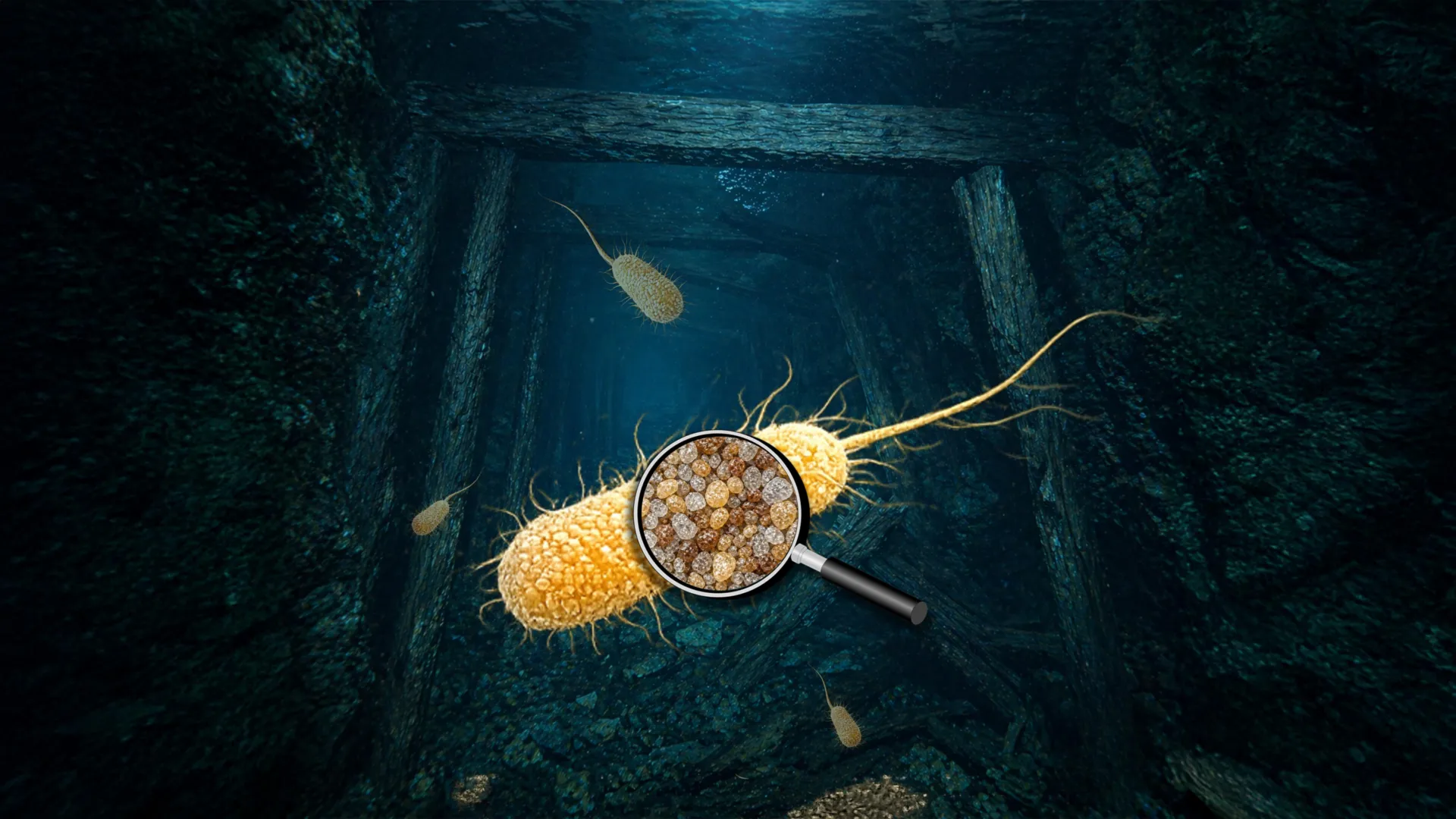
Researchers at the Helmholtz-Zentrum Dresden-Rossendorf (HZDR), working with Wismut GmbH and the University of Granada, have demonstrated that bacteria naturally present in flooded uranium mine water can convert dissolved uranium into an unusually stable chemical compound. In laboratory experiments that replicated the oxygen-free conditions found at roughly 2,000 meters depth, the microbial community was supplied with glycerol as a carbon source. Over 130 days, the concentration of uranium remaining dissolved in the water fell to about five percent of the starting level.
Advanced microscopy and spectroscopy at the Rossendorf Beamline of the European Synchrotron Radiation Facility, along with complementary analyses at the University of Granada, revealed that the uranium had accumulated in the bacterial cell walls. Surprisingly, a high proportion of the uranium was present as pentavalent uranium, an oxidation state usually considered transient and unstable. The pentavalent uranium combined with iron and oxygen to form FeU(V)O4, a compound first identified in 2020 in Croatian soils contaminated by uranium ammunition and shown to persist for more than 25 years.
When dried bacterial biomass containing the compound was exposed to atmospheric oxygen, the amount of FeU(V)O4 increased rather than decreased, indicating stability under oxidizing conditions. This suggests that bacterial activity can transform mobile, toxic uranium into a form far less likely to migrate through groundwater. The study, published in Nature Communications, marks the first observation of bacteria mediating the formation of this stable pentavalent uranium compound in a natural setting.
Dr. Evelyn Krawczyk-Bärsch of HZDR's Terrestrial Microbiology group noted that the bacteria metabolically utilize dissolved uranium when glycerol is available. Lead author Dr. Antonio M. Newman-Portela emphasized that the experiments were designed to maintain the native microbial community under realistic anaerobic conditions. The researchers caution that further work is needed to determine whether the process can be harnessed effectively for environmental remediation.
Future studies will investigate the specific uranium-binding bacteria and the biochemical and geochemical mechanisms driving the transformation. A deeper understanding of these pathways could inform strategies for cleaning up uranium-contaminated sites, though practical application remains uncertain at this stage.
Scientists discover bacteria that lock toxic uranium into a stable form
This is an independent summary. The complete reporting, supporting context and any primary documents remain with ScienceDaily.