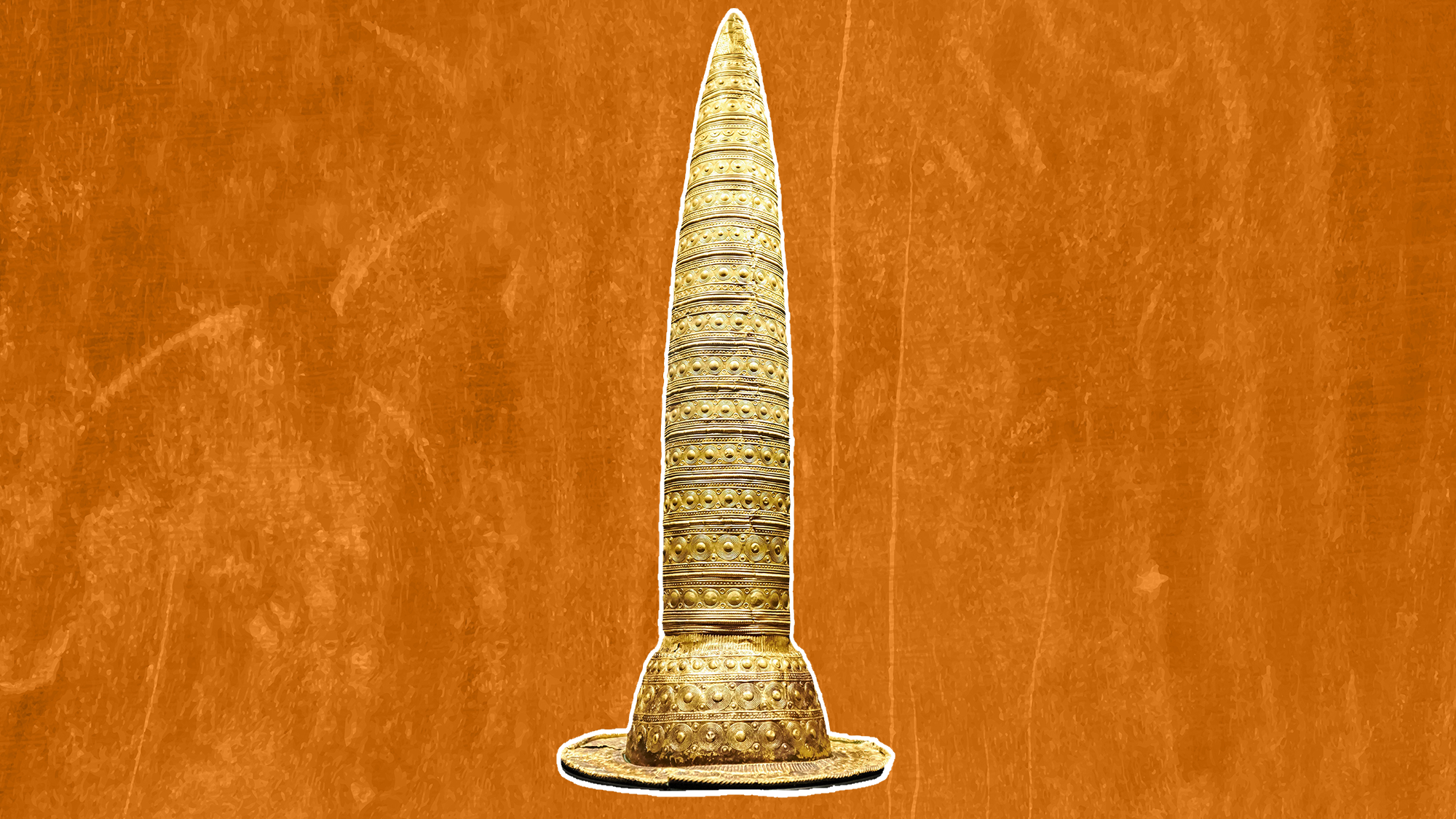
The Berlin Gold Hat, a conical headdress hammered from a single sheet of gold around 1000 to 800 B.C., is one of only four such artifacts known from Bronze Age Central and Western Europe. Standing roughly 74 centimeters tall and weighing about 480 grams, the hat is decorated with bands of concentric circles, disks, and ovals. It entered the collection of the Museum of Prehistory and Early History in Berlin in 1996 via the antiquities market, so its exact findspot is unknown, though the other three examples were discovered in southern Germany and western France.
Archaeologist Wilfried Menghin analyzed the hat's decorative bands in a 2008 study and concluded they represent numerical values forming a calendrical system. Each band encodes a specific count, and combinations of bands allow calculation of lunar months and solar years as well as conversion between the two cycles. The system also enables the prediction of lunar eclipses.
Museum director Matthias Wemhoff has described the wearer as a priest who possessed "secret and very special knowledge," likely appearing at sunrise on a mountaintop where the gold would catch the first rays. A wool or felt lining would have stabilized the hat during wear, though no traces of such lining survive. A flat bronze band with a bronze wire borders the brim.
No written records of a Bronze Age sun cult exist in Europe, but other artifacts such as the Trundholm Sun Chariot and the Nebra Sky Disk demonstrate the importance of celestial observation in these societies. The Berlin Gold Hat provides the most direct evidence yet that specific individuals could track and predict astronomical cycles.
Researchers emphasize that the hat's calendrical function is inferred from the arrangement and repetition of its motifs, not from accompanying texts. The artifact's market origin limits archaeological context, but its technical sophistication is widely acknowledged.
The hat remains on display in Berlin, where it continues to be studied as a rare example of Bronze Age goldsmithing and scientific knowledge combined in a single ceremonial object.
Berlin gold hat: A 3,000-year-old ceremonial headdress that a cult used to track the sun, moon and lunar eclipses
This is an independent summary. The complete reporting, supporting context and any primary documents remain with Live Science.