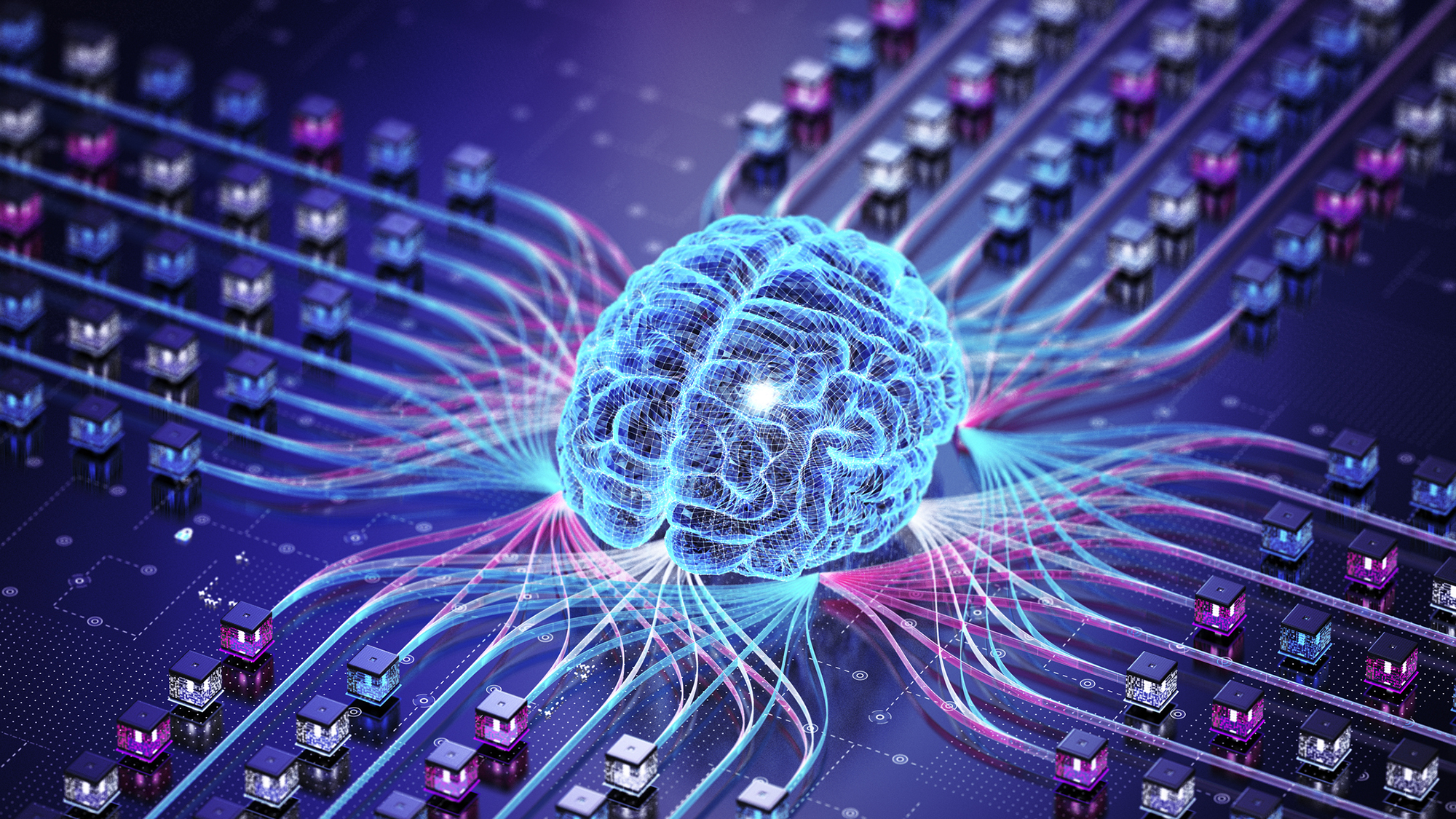
Researchers at Northwestern University have developed an artificial intelligence chip modeled on the human cerebellum, the brain region responsible for instinctive motor control and balance. The device uses memtransistors — components that merge memory and processing — made from atomically thin molybdenum disulfide to replicate the cerebellum's ability to ignore routine inputs and react only to unexpected events.
In simulated tests using electrocardiogram data, the cerebellum-inspired network detected arrhythmias within one-fifth of a heartbeat with 98% accuracy, operating more than twice as fast as a standard transformer model while requiring roughly 10,000 times fewer calculations. The findings were published July 10 in Nature Communications.
Unlike conventional AI hardware that continuously analyzes all incoming data, the new architecture exploits competing excitatory and inhibitory signals that balance each other until an anomaly shifts the equilibrium. This event-driven approach avoids the von Neumann bottleneck of shuttling data between separate memory and processor units.
Study co-author Mark Hersam, a professor of materials science and engineering, said the cerebellum is "excellent at ignoring the expected and reserving its resources for reacting to the unexpected," which translates into lower energy consumption. The memtransistors switch between excitatory and inhibitory modes by reversing voltage direction across an asymmetric electrode structure.
The researchers envision the technology enabling low-power, always-on anomaly detection at the network edge — in wearable health monitors, autonomous vehicles, robotics, and cybersecurity systems — without relying on cloud-connected data centers. The International Energy Agency projects global data center electricity demand could reach 945 terawatt-hours by 2030, driven largely by AI workloads.
Hersam cautioned that the memtransistors have not yet been scaled to the size and speed of commercial silicon chips, though the materials and device physics support comparable scaling in principle. Real-world performance will depend on future fabrication advances.
The next research phase aims to mimic the cerebellum's adaptive learning — its ability to stop treating repeated events as novel — which would further improve efficiency in long-term deployments.
New AI chip mimics the human brain's capacity for split-second motor control — it solved problems using 10,000 times fewer calculations
This is an independent summary. The complete reporting, supporting context and any primary documents remain with Live Science.