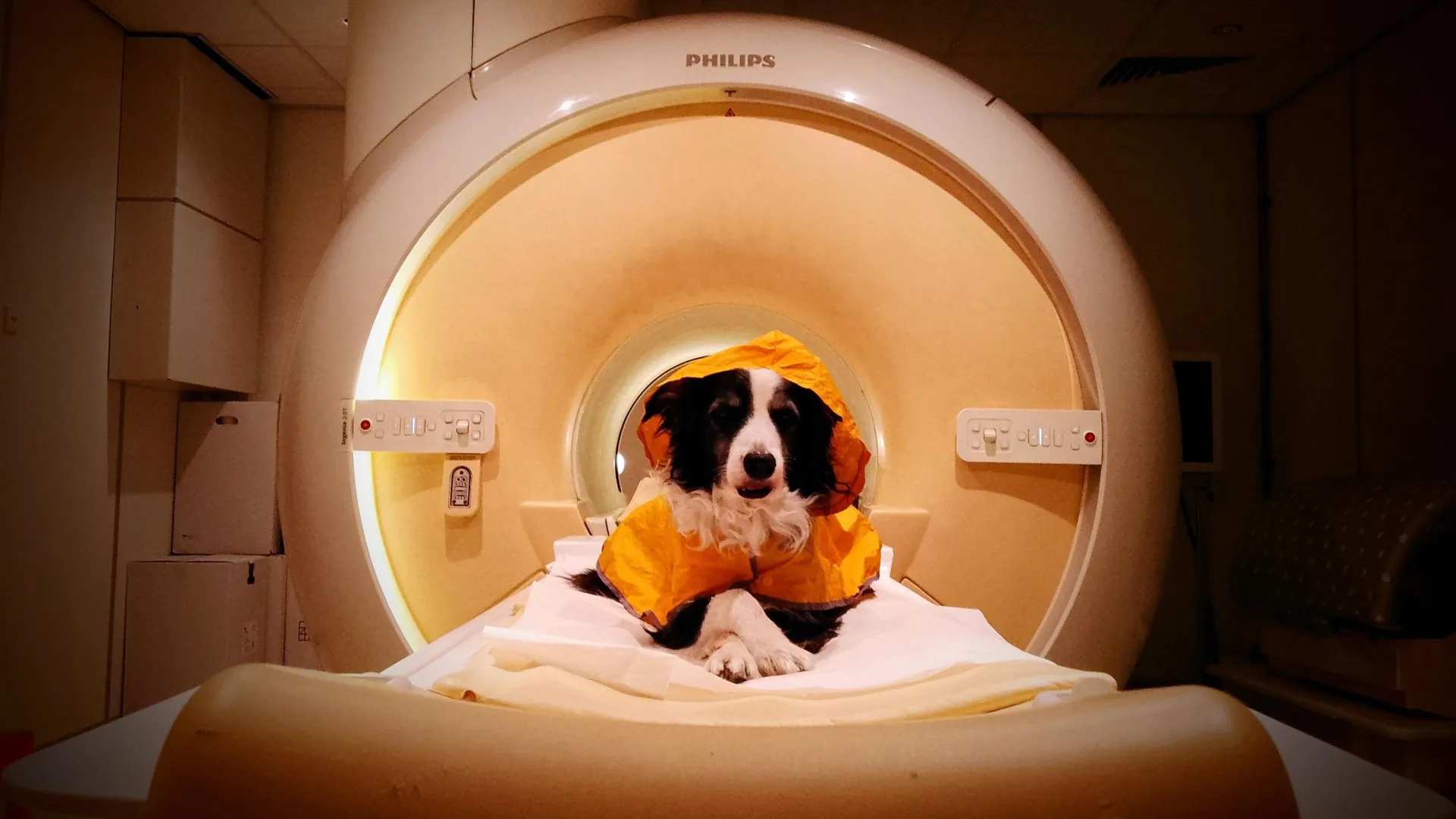
Researchers at the University of Vienna used functional MRI to measure brain activity in awake pet dogs while they viewed photographs of unfamiliar human faces expressing happiness, anger, fear, and sadness. Eight dogs participated in a first experiment comparing happy and neutral faces, and 12 dogs took part in a second experiment that included all four expressions.
When dogs saw happy faces, activity increased in the temporal cortex, associated with higher-level cognitive processing, and in the caudate nucleus, a region linked to reward. The caudate response suggests that smiles carry emotional significance for dogs beyond simple visual recognition.
Machine-learning analysis of whole-brain patterns showed that the network involving the temporal cortex and caudate nucleus responded distinctively to happy faces, making it straightforward to separate those responses from reactions to the three negative expressions.
Crucially, the analysis also revealed different neural patterns for fear compared with anger and sadness. The authors say this is the first evidence that dogs differentiate among specific negative human facial expressions rather than grouping them into a single negative category.
The researchers caution that still images capture only a fraction of real-world communication, which also includes body language, tone of voice, and scent. All study animals were family pets; free-ranging dogs with different social experiences might process human signals differently.
Senior author Laura Cuaya notes that dogs followed a separate evolutionary path from primates yet developed comparable social abilities through domestication. Future work will examine how dogs integrate multiple brain signals and how their processing compares with human emotion perception.
Dogs can tell fear from sadness — and scientists saw it in their brains
This is an independent summary. The complete reporting, supporting context and any primary documents remain with ScienceDaily.