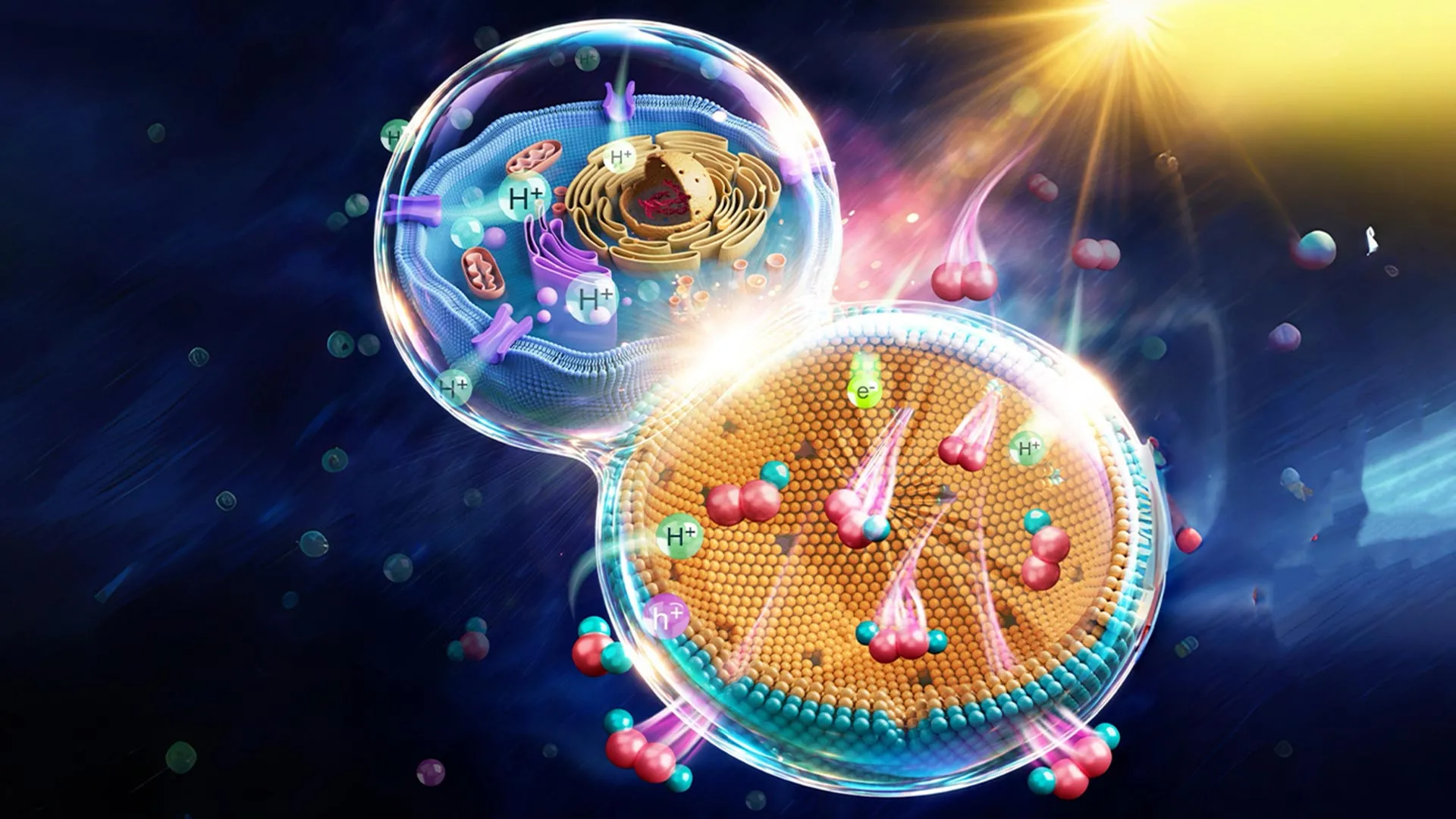
Researchers at the Dalian Institute of Chemical Physics and Inner Mongolia University have built a hollow nanoreactor that imitates two key features of living cells to make hydrogen peroxide from water and oxygen using visible light. The work appears in the Journal of the American Chemical Society.
The nanoreactor consists of a cadmium sulfide core surrounded by a porous polydopamine shell that contains a dynamic catechol/o-benzoquinone redox pair. This chemical pair acts as a proton relay, repeatedly accepting and releasing protons to accelerate proton-coupled electron transfer, a process in which proton and electron movements are tightly linked.
The second biomimetic element is the nanoreactor's compartmentalized architecture: a nanoscale hollow cavity enclosed by the porous shell. This confined space allows reactants to accumulate, supports molecular diffusion, and traps incoming photons so that light-driven reactions proceed more effectively.
Together, these features help balance the rates of oxygen reduction and water oxidation, the two half-reactions required for hydrogen peroxide production. Under visible-light illumination in aqueous solution, the system achieved a photosynthesis rate of 3.24 mmol g⁻¹ h⁻¹ and a solar-to-chemical conversion efficiency of 1.2%.
The researchers probed the mechanism with in situ spectroscopy, photochemical analysis, finite element simulations, and theoretical calculations. These methods confirmed a Z-scheme heterojunction-based photocatalytic pathway driven by the cell-inspired design.
To demonstrate practicality, the team embedded the nanoreactors in a sodium alginate hydrogel matrix, creating solid, recyclable photocatalysts that continuously synthesized hydrogen peroxide under natural sunlight while maintaining stable performance.
The study offers a strategy for engineering biomimetic nanoreactors that replicate sophisticated cellular functions, with potential applications in artificial photosynthesis, energy catalysis, and synthetic chemistry.
Cell-inspired nanoreactor turns sunlight into hydrogen peroxide
This is an independent summary. The complete reporting, supporting context and any primary documents remain with ScienceDaily.