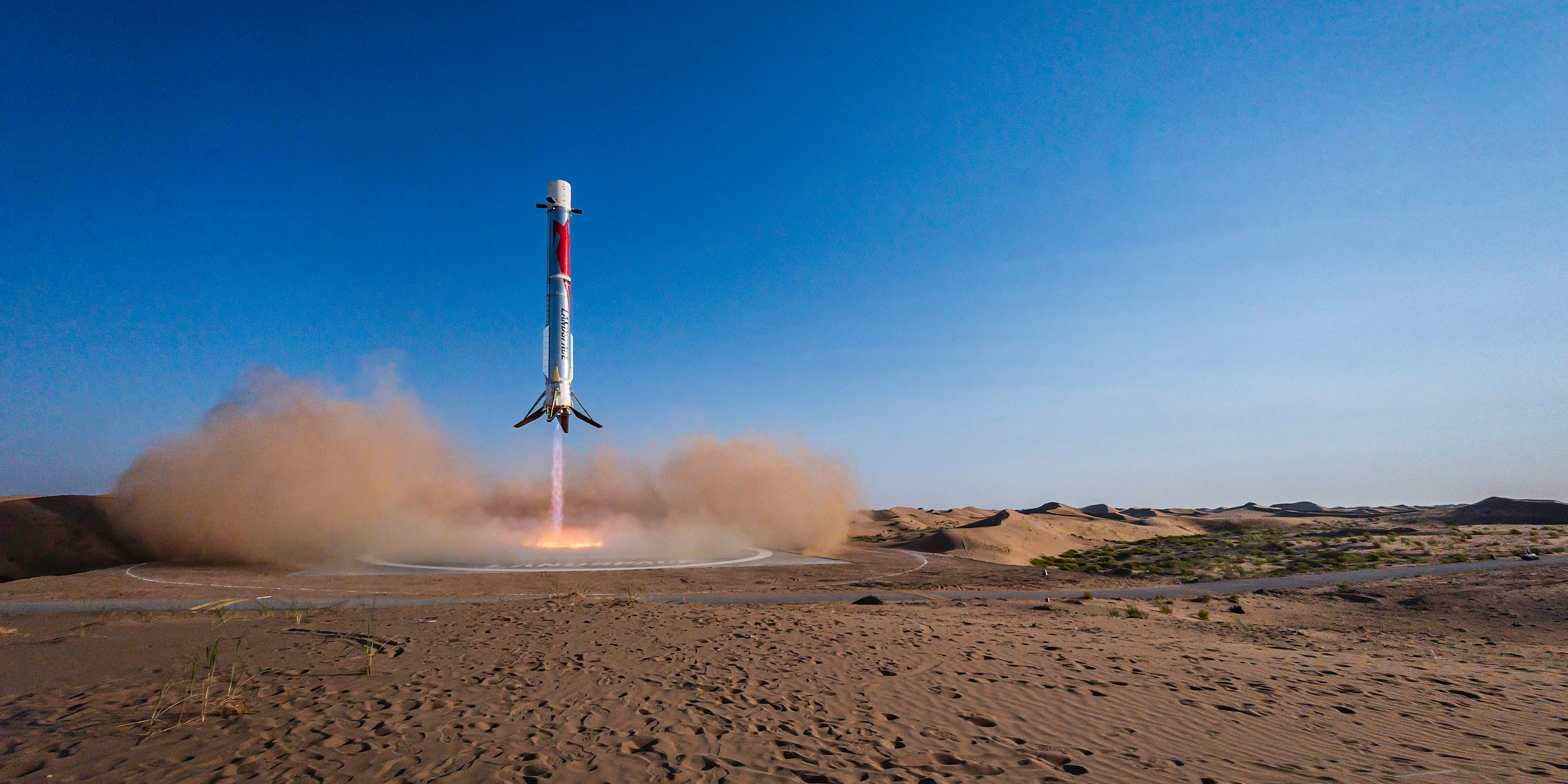
Chinese aerospace startup LandSpace successfully landed the first stage of its Zhuque-3 rocket on solid ground on August 19, marking the first time China has recovered an orbital-class booster on land. The 66.1-meter stainless-steel rocket lifted off at 7:35 a.m. from the Dongfeng Commercial Space Innovation Pilot Zone in Inner Mongolia and placed an internet satellite into its designated orbit.
The booster, powered by nine liquid oxygen-methane engines, descended and landed approximately 390 kilometers downrange in Minqin, Gansu province. A previous recovery attempt by LandSpace in December 2023 failed due to a combustion issue; engineers subsequently improved the landing propulsion system and added protective structures.
With this achievement, China becomes the second nation after the United States to demonstrate booster recovery on both land and at sea. U.S. companies SpaceX and Blue Origin have previously landed boosters on land, while SpaceX also recovers boosters at sea using drone ships. China's first sea recovery, using a net-capture method, was completed last month.
The booster typically accounts for 70% or more of a rocket's hardware cost. Researchers estimate that reusing a common nine-engine booster could save 20 million to 50 million yuan ($2.9 million to $7.4 million) per launch. LandSpace projects that per-launch costs could fall by about 45% after five flights, with the Zhuque-3 first stage designed for at least 20 reuses.
China is pursuing large low Earth orbit satellite constellations requiring frequent, affordable launches. The country currently operates a few hundred satellites but plans to deploy tens of thousands. Reducing launch costs is seen as essential to meeting this demand.
Zhang Liang, a reusable rocket researcher at Sun Yat-sen University, noted that the cost advantage of reusable rockets depends on achieving a high launch cadence, and China currently faces a shortage of launch facilities. LandSpace intends to refurbish and relaunch the recovered booster as soon as possible.
Over the past decade, policy changes have encouraged private companies to enter a space sector once dominated by state-owned enterprises. The China National Space Administration released a two-year action plan in November 2025 to expand access to testing facilities and strengthen international cooperation, and the space sector is a strategic priority in the 15th Five-Year Plan.
China’s First Booster Landing Marks Leap Toward Reusable Rockets
This is an independent summary. The complete reporting, supporting context and any primary documents remain with Sixth Tone.