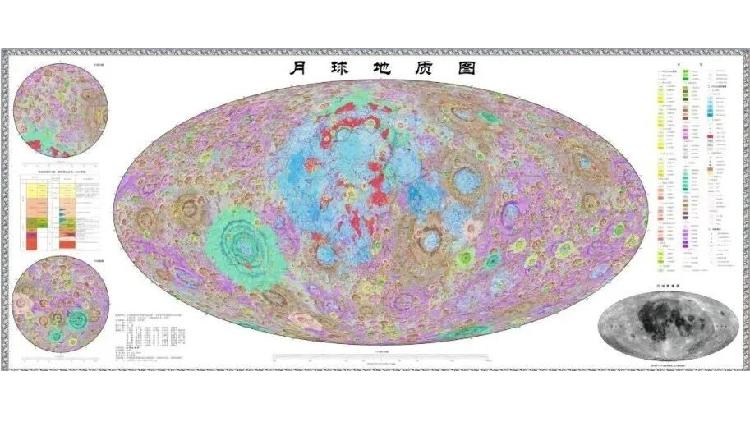
Chinese scientists have completed a new geological map of the entire Moon at a scale of 1:5,000,000, the China National Space Administration announced. The map was compiled by researchers from the Chinese Academy of Sciences' Institute of Geochemistry and other institutions.
It incorporates the latest findings from China's Chang'e lunar exploration program, including data from the Chang'e-4 and Chang'e-5 missions. The new map replaces the previous global lunar geological map, which was based on earlier international and Chinese datasets.
The updated map identifies 12,341 impact craters, 81 impact basins, 17 rock types and 14 structural features across the lunar surface. It classifies geological units by age, morphology and composition with greater detail than earlier versions.
Researchers used a combination of orbital remote sensing data, sample analysis from returned lunar material and crater counting techniques to define unit boundaries and ages. The map integrates topographic, compositional and structural information into a single unified framework.
The 1:5,000,000 scale provides a balance between global coverage and regional detail, making it suitable for both scientific research and mission planning. Previous global maps were typically at 1:2,500,000 or 1:10,000,000 scales with less comprehensive unit classification.
The map will be made available to the international scientific community through the China National Space Administration's data sharing platforms. It is expected to support future lunar exploration missions, including site selection for landing and sample return.
Scientists involved in the project said the map reflects advances in China's lunar remote sensing capabilities and sample analysis techniques developed over the past decade. The work builds on geological mapping standards established by the International Astronomical Union and the United States Geological Survey.
The completion of the map marks a milestone in China's lunar science program, which has progressed from orbital observation to landing, roving and sample return since the first Chang'e mission launched in 2007.
China releases updated geological map of the entire moon
This is an independent summary. The complete reporting, supporting context and any primary documents remain with CGTN.