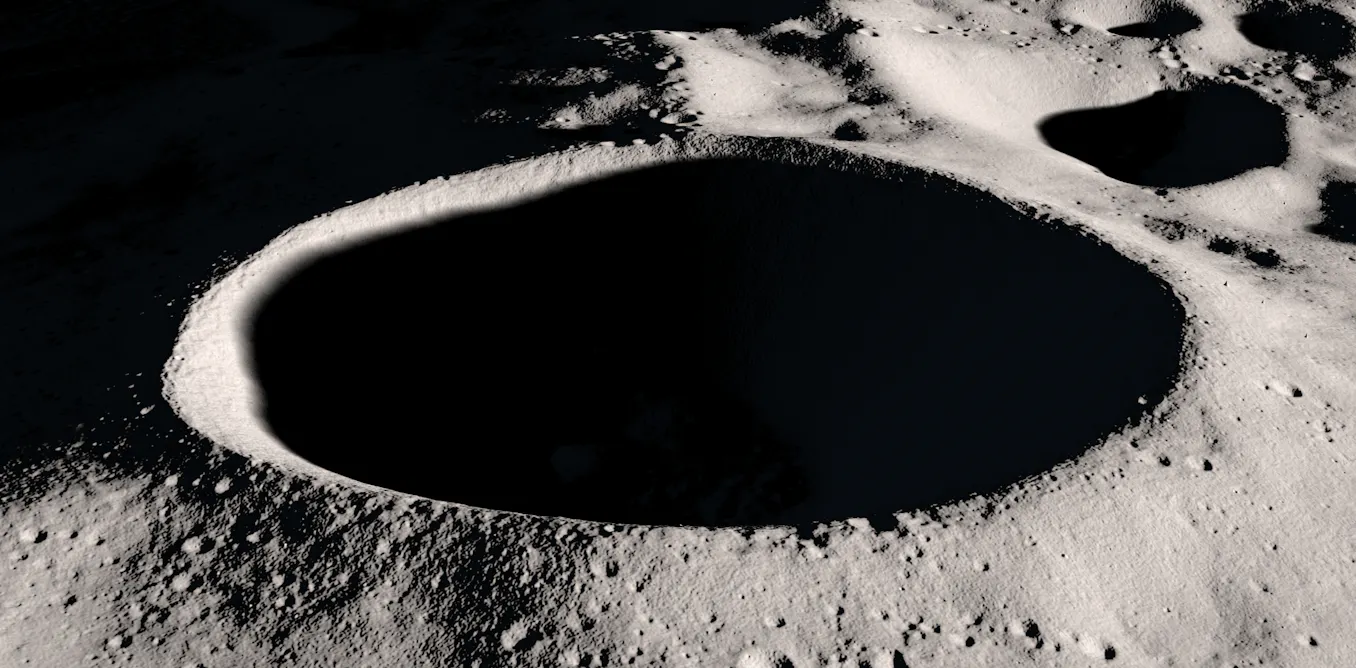
China's Chang'e-7 lunar mission is expected to launch later this month, targeting the Moon's south pole region near Shackleton crater. The mission consists of an orbiter, lander, rover, and a novel hopping vehicle designed to leap across broken terrain and descend into permanently shadowed craters where temperatures remain below –200°C.
The Queqiao-2 relay satellite, launched in March 2024, is already in position to support communications between Earth and the lunar surface during the mission. A recent failure involving a different Chinese rocket has introduced some uncertainty over the exact launch date.
Scientists have known for nearly two decades that water exists on the Moon, but the quantity, depth, and form of accessible water ice inside permanently shadowed craters remain unknown. The hopper will carry instruments to determine where water ice is located, its concentration, and whether it can realistically be extracted for future use.
This approach marks a shift from general lunar exploration to assessing resource usability. The follow-on Chang'e-8 mission, potentially launching in 2028, aims to demonstrate how identified resources might be utilized, supporting the long-term goal of constructing the International Lunar Research Station jointly led by China and Russia.
NASA is pursuing the same objective of sustainable lunar operations through its Commercial Lunar Payload Services (CLPS) programme, which contracts private companies for lunar delivery and mobility services. Intuitive Machines' IM-2 mission attempted similar goals with a drill, mass spectrometer, and hopping vehicle, but the lander tipped over and powered down after one day.
Both programmes face identical physical challenges at the lunar south pole: permanent darkness, extreme cold, rugged terrain, and communications difficulties. The different architectural choices — a coordinated state mission versus a commercial marketplace model — represent parallel experiments in solving these problems.
Richard de Grijs, professor of astrophysics at Macquarie University and author of the analysis, notes that learning to live and work on the Moon may be one of the great technological challenges of the 21st century, just as reaching it defined the 20th.
The mission's primary scientific value lies in resolving specific unknowns about lunar water ice distribution and accessibility, which are prerequisites for any sustained human presence on the Moon.
China is launching a Moon mission to find water ice. It’s unlike anything NASA has done
This is an independent summary. The complete reporting, supporting context and any primary documents remain with The Conversation.