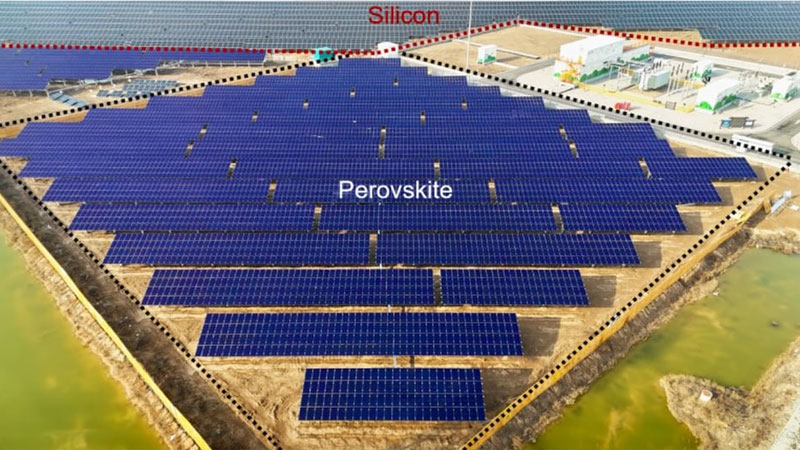
Researchers from Nanjing University in China, working with colleagues from Canada, have completed what they describe as the world's first field trial of a utility-scale solar power plant built with perovskite photovoltaic modules.
The installation was deployed outdoors and operated side-by-side with a conventional silicon reference system, allowing direct comparison under identical weather and irradiance conditions.
According to the research team, the perovskite array produced a higher energy yield than the silicon benchmark during the test period.
Perovskite solar cells have long shown high efficiency in laboratory settings, but their performance at scale and durability outdoors have remained key questions for commercialization.
The field trial also highlighted practical advantages of the technology, including the modules' lower weight and a simpler manufacturing process compared with crystalline silicon panels.
Lower weight reduces structural requirements for mounting systems, while simpler fabrication could lower production costs if stability and scaling challenges are resolved.
The researchers did not disclose the exact capacity of the test plant, the specific perovskite composition used, or the duration of the monitoring period in the available summary.
Long-term operational stability under heat, humidity, and ultraviolet exposure remains the primary hurdle before perovskite photovoltaics can enter widespread commercial deployment.
В Китае впервые в мире испытали солнечную электростанцию на перовскитных панелях — она сходу превзошла «кремниевую»
This is an independent summary. The complete reporting, supporting context and any primary documents remain with 3DNews.