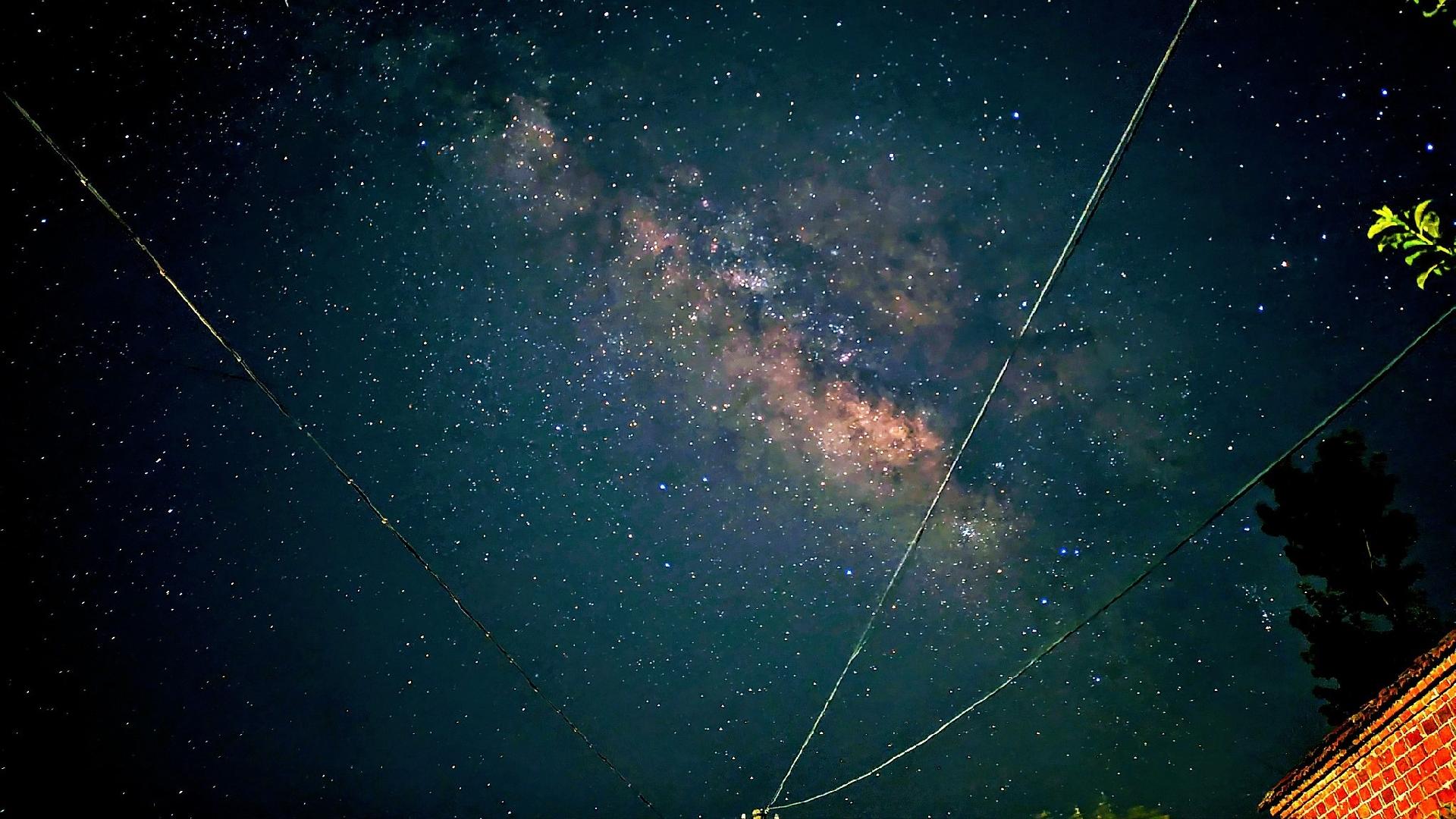
A team of Chinese astronomers has identified wavy ripples extending across the outer gas disk of the Milky Way. The discovery is based on an analysis of spectral data tracing neutral atomic hydrogen, the primary component of the galaxy's outer disk.
The observations show that the disk does not follow a smooth, flat curve as previously assumed. Instead, it exhibits large-scale vertical oscillations, creating a corrugated structure across vast distances.
Researchers measured the three-dimensional positions and velocities of hydrogen gas clouds in the outer regions of the galaxy. The data reveal a regular pattern of waves moving above and below the galactic mid-plane.
The wavelength and amplitude of these ripples suggest they are a persistent, global feature of the disk rather than a local disturbance. The team notes that the mechanism driving these oscillations remains an open question.
Possible explanations include gravitational interactions with satellite galaxies, the infall of intergalactic gas, or internal dynamical processes such as spiral arm perturbations. Further modeling and observations are needed to distinguish between these scenarios.
The finding adds to a growing body of evidence that galactic disks are more dynamic and structurally complex than classical models suggest. Similar wave-like patterns have been detected in the stellar disk closer to the Sun.
This research was conducted using data from radio telescopes capable of mapping the 21-centimeter emission line of neutral hydrogen. The results have been published in a peer-reviewed astronomy journal.
Astronomers say the discovery will help refine models of the Milky Way's formation, evolution, and dark matter distribution.
Milky Way's outer disk isn't the smooth curve we thought
This is an independent summary. The complete reporting, supporting context and any primary documents remain with CGTN.