Researchers at the Institute of High Energy Physics (IHEP) under the Chinese Academy of Sciences (CAS) have confirmed the existence of the glueball, a particle composed entirely of gluons.
Gluons are the force-carrier particles that bind quarks together via the strong nuclear force; while the Standard Model predicts that gluons can bind to each other to form glueballs, experimental confirmation has remained elusive for decades.
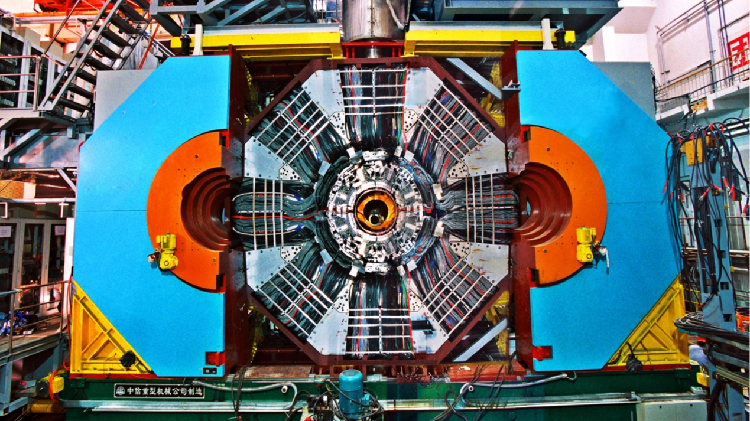
The finding is based on data collected from the Beijing Spectrometer III (BESIII) experiment at the Beijing Electron-Positron Collider II (BEPCII).
Scientists analyzed the decay patterns of the particle known as X(2370), identifying its quantum numbers and production rates as consistent with the lightest glueball state predicted by lattice quantum chromodynamics calculations.
The result achieves a statistical significance exceeding five standard deviations, meeting the threshold for a discovery in particle physics.
IHEP stated that the confirmation opens a new avenue for studying the strong interaction and the non-perturbative regime of quantum chromodynamics.
Further experimental verification from other facilities is expected to follow.
The research marks the culmination of approximately 15 years of dedicated effort at the BESIII experiment.
Chinese researchers confirm elusive glueball particle
This is an independent summary. The complete reporting, supporting context and any primary documents remain with CGTN.