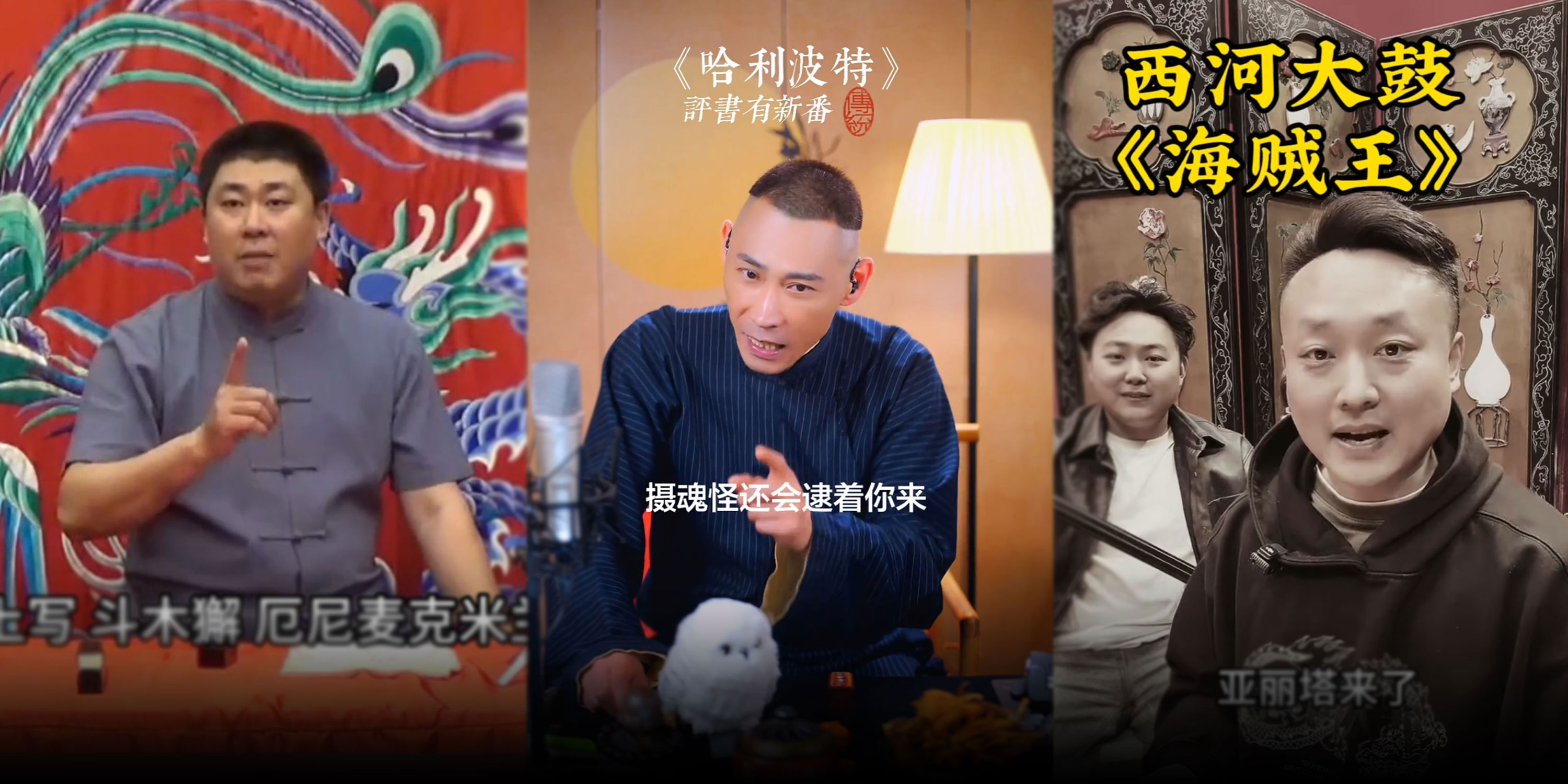
Performers of quyi, the umbrella term for China's traditional storytelling arts, are adapting globally popular franchises to reach younger audiences on short-video platforms. On Douyin, the Chinese version of TikTok, pingshu artist Qi Jingchuan now narrates the Harry Potter series and Japanese manga such as Naruto and One Piece instead of the historical epics and martial arts tales that once defined the form. Qi, who has performed pingshu for more than a decade, said he turned to modern narratives after struggling to attract listeners beyond an older demographic accustomed to free radio broadcasts.
In his livestreams, Qi retains pingshu's core techniques — narration, character portrayal, and commentary — while localizing characters and inserting contemporary references. Albus Dumbledore becomes "Grandpa Deng," a figure resembling a Chinese martial arts master, while Lord Voldemort adopts the flair of a Peking opera villain. Qi also weaves in internet slang, at one point suggesting Harry's Nimbus 2000 broomstick should be called a Su7, referencing a Xiaomi electric car model. The shift increased his nightly viewership from 20,000–30,000 to around 200,000 for his Naruto adaptation, with audience ages now spanning 20 to 50 and overseas Chinese viewers tuning in from the United Kingdom, New Zealand, and the United States.
Other quyi performers are pursuing similar strategies. Liu Hechun, a Xihe Dagu artist with the crosstalk company Deyunshe, adapts One Piece by opening with dramatic scenes and replacing foreign names with culturally resonant Chinese equivalents; the naval officer Helmeppo becomes "Meng Yanei," evoking the archetypal spoiled official's son from the classic novel Water Margin. Liu said the art's signature drum patterns, alternation between speaking and singing, and character introduction methods remain unchanged. Peng Xicai, a veteran performer, noted a parallel trend in Suzhou embroidery, where artisans are stitching anime characters and bubble tea logos alongside traditional motifs.
The trend builds on earlier experiments, such as staging Shakespeare's Othello as Pu opera or Hamlet as Peking and Yue opera under the title "The Prince's Revenge." However, each traditional form has distinct rhythms and conventions, making the balance between adaptation and preservation a continual challenge. Zhao Luping, associate professor of journalism at East China Normal University, said the fusion of ancient art forms with digital-era content could sustain the vitality of this heritage, noting that even heavily franchised stories like Harry Potter can still capture young audiences when retold as pingshu.
Copyright concerns accompany the growing popularity of these adaptations. Wang Yu, a lawyer at Beijing Yingke Law Firm in Shenzhen, said directly retelling an original story or quoting dialogue requires permission from the rights holder. Even entirely original expression that retains the same plot, character development, and sequence of events may constitute an unauthorized adaptation. The legal risk is lower when performers create original stories with only limited references to existing intellectual property, provided they credit the original author and title and the quotation does not materially affect the original work's commercial exploitation.
In response, some artists are seeking formal authorization. Qi has begun approaching copyright holders and production companies to secure rights for his adaptations. Liu views the use of popular franchises as a first step — a bridge to draw audiences toward the traditional art form itself. The ultimate goal, he said, is for young viewers to remain engaged with traditional Chinese tales or other stories even after the familiar pop-culture scaffolding is removed.
China’s Classic Storytellers Recapture the Magic With Harry Potter
This is an independent summary. The complete reporting, supporting context and any primary documents remain with Sixth Tone.