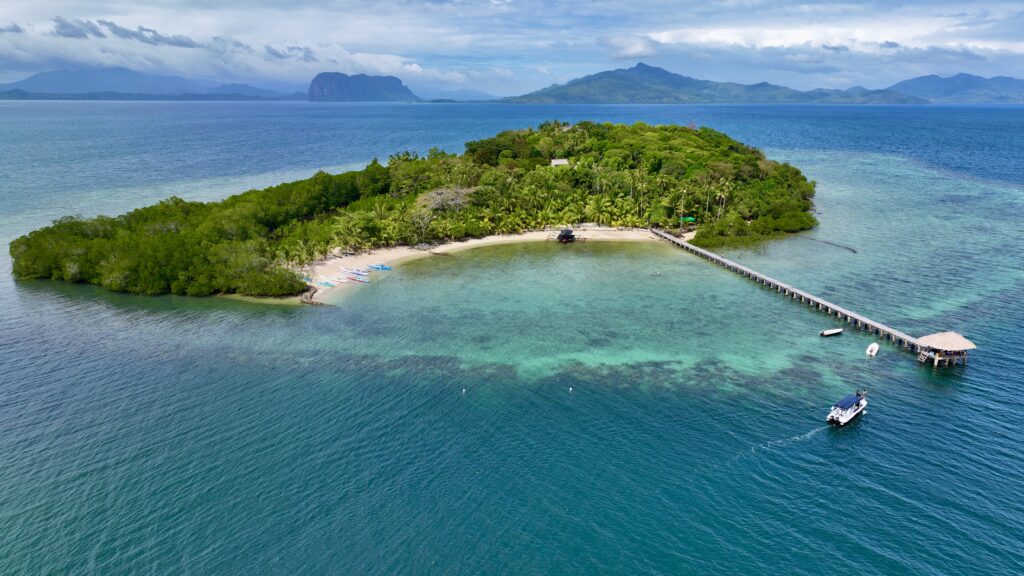
In 2011, Frédéric and Chris Tardieu retired from Marseille, France, to Pangatalan, a 4.5-hectare island in Shark Fin Bay off Palawan's northeast coast. They found reefs shattered by decades of dynamite fishing, mangroves cleared for charcoal, and fish populations collapsed, threatening food security for surrounding villages.
The couple founded the Sulubaaï Environmental Foundation in 2012 and began restoration by planting nearly 80,000 indigenous trees, including 12,000 mangrove propagules. They developed the Sulu Reef Prosthesis, concrete support structures made on-site without chemicals that provide scaffolding for natural coral recolonization, installing over 250 modules and transplanting 2,500 corals.
With local government support, the Foundation established Pangatalan's first 45-hectare marine protected area in 2015. After five years of protection, monitoring showed fish species within the MPA were on average 21% larger, 71% more abundant, and more diverse than outside populations. Fish biomass tripled, and sharks, previously absent, began returning.
Mission Blue designated Pangatalan a Hope Spot, recognizing its ecological importance within the Coral Triangle, home to over 1,700 reef fish species, five of seven marine turtle species, and more than 460 reef-building coral species. The Foundation received the first SMILO accreditation in 2018, validating the restoration model.
The Sea Academy program, launched with support from the French Global Environment Facility and Blancpain, engaged surrounding communities in conservation planning. What began as a single protected area expanded into a network of eight MPAs — six in Shark Fin Bay and two in neighboring Taytay Bay — created within ten years. Combined MPAs and buffer zones cover hundreds of hectares where destructive fishing is prohibited.
Local fishers, MPA rangers, and government agents received dive training for monitoring and enforcement. Fisherfolk associations established community banking schemes and explored alternative livelihoods. A fish restocking program with partner Ecocean released 1,424 fish across 21 species in 2023 using post-larvae capture, culture, and release methods that increase survival by 85%.
Acoustic monitoring in 2022 revealed an average of two dynamite explosions per day in Shark Fin Bay before community MPAs were established. The combination of protected areas, community surveillance, and environmental education dramatically reduced destructive fishing. Environmental education reached over 1,000 students and teachers across three villages through annual courses, a student-created marine storybook, and school mural contests.
Blancpain funded the Blancpain x Sulubaaï Marine Research Center in Sandoval village near the five Shark Fin Bay MPAs, enhancing scientific monitoring using photogrammetry, acoustics, and environmental DNA analysis. The Foundation is developing community-based tourism where visitors participate in conservation, generating local employment as guides and boat operators while channeling revenue toward conservation operations.
Sulubaaï Environmental Foundation Transforms Coral Reef Restoration from One Island to Eight Marine Protected Areas
This is an independent summary. The complete reporting, supporting context and any primary documents remain with Happy Eco News.