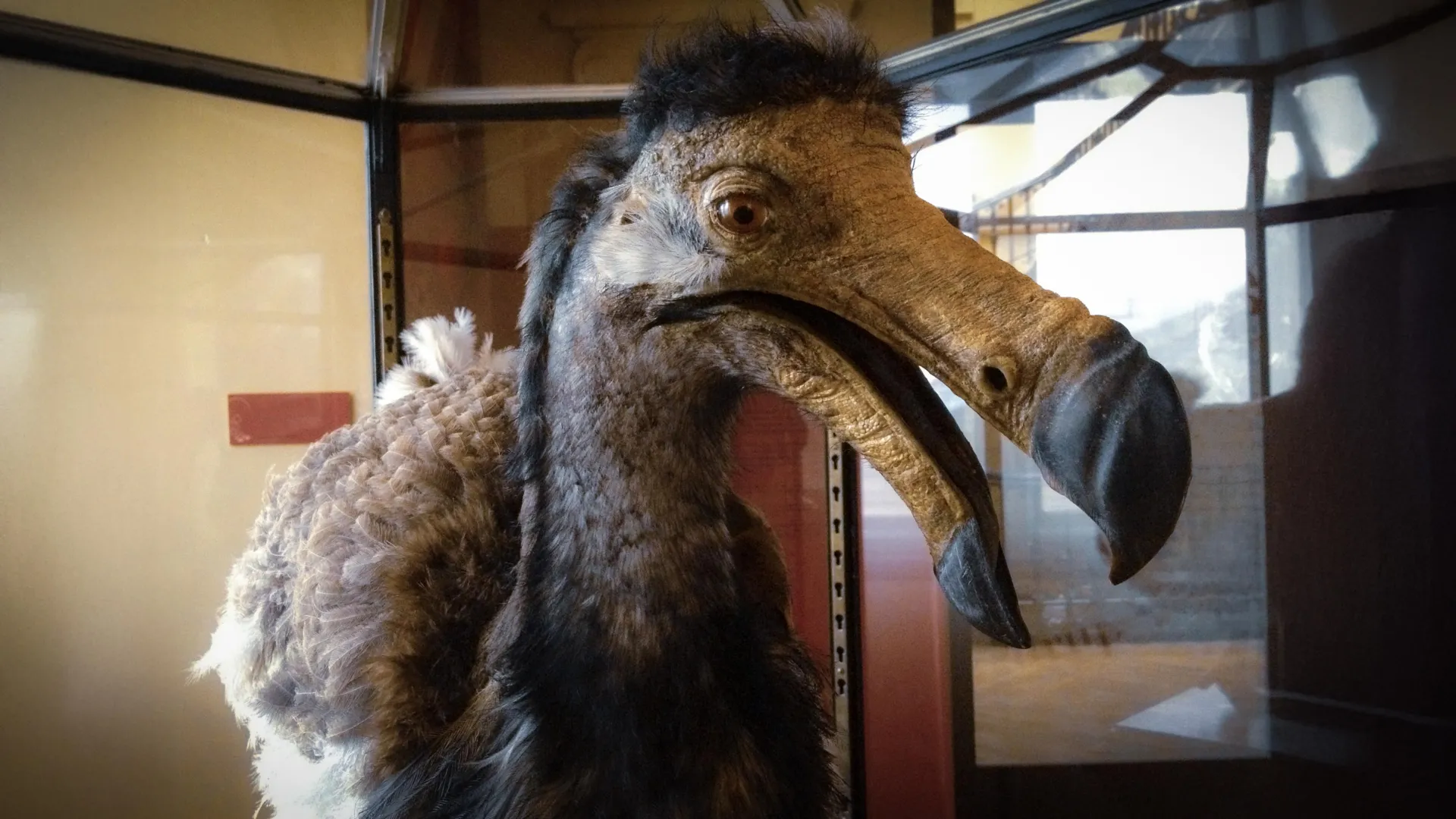
Researchers at the University of Lethbridge led an international team that used high-resolution CT scans of the world's two complete dodo skulls to reconstruct the brain cavity and inner anatomy. One skull resides at the Natural History Museum Denmark in Copenhagen, the other at the Oxford University Museum of Natural History. The scans produced detailed three-dimensional models without damaging the specimens.
By comparing the digital endocasts with those of living pigeons and doves — the dodo's closest relatives — the team identified several distinctive sensory traits. The anatomy suggests the dodo had a stronger sense of smell than modern pigeons and a large upper beak well suited for gathering tactile information from its environment.
The brain-case morphology also indicates the bird may not have been strictly diurnal. Instead, its activity patterns could have extended into dawn and dusk, a behavior known as crepuscular activity. These features together offer new clues about how the dodo located food and navigated the forests of Mauritius before its extinction in the late 17th century.
The study, published in the Zoological Journal of the Linnean Society, draws on CT data from three dodo skulls, including the two complete specimens. Having both complete skulls allowed researchers to distinguish species-typical features from individual variation, strengthening the comparative analysis.
Co-author Peter Andrew Hosner, Associate Professor and Curator of Birds at the Natural History Museum Denmark, said the dodo's behavior and foraging ecology have been debated for centuries. The new evidence does not support the long-standing portrayal of the bird as cognitively reduced or clumsy, but rather points to a distinct set of sensory adaptations evolved over millions of years on an isolated island.
Christy Anna Hipsley, Associate Professor at the same museum and another co-author, described the work as detective work: the brain left impressions on the inside of the skull, and digitally reconstructing those spaces lets scientists infer how the dodo sensed and interacted with its world. The researchers caution that skull anatomy alone cannot determine exact behavior, but it provides a stronger evidence-based framework than previous speculation.
The Copenhagen skull was scanned during preparations for a new museum building and permanent galleries scheduled to open in 2027. The imaging opportunity arose from that logistical circumstance, not from a targeted excavation or new discovery in the field.
The dodo bird had a secret sensory world scientists are only now discovering
This is an independent summary. The complete reporting, supporting context and any primary documents remain with ScienceDaily.