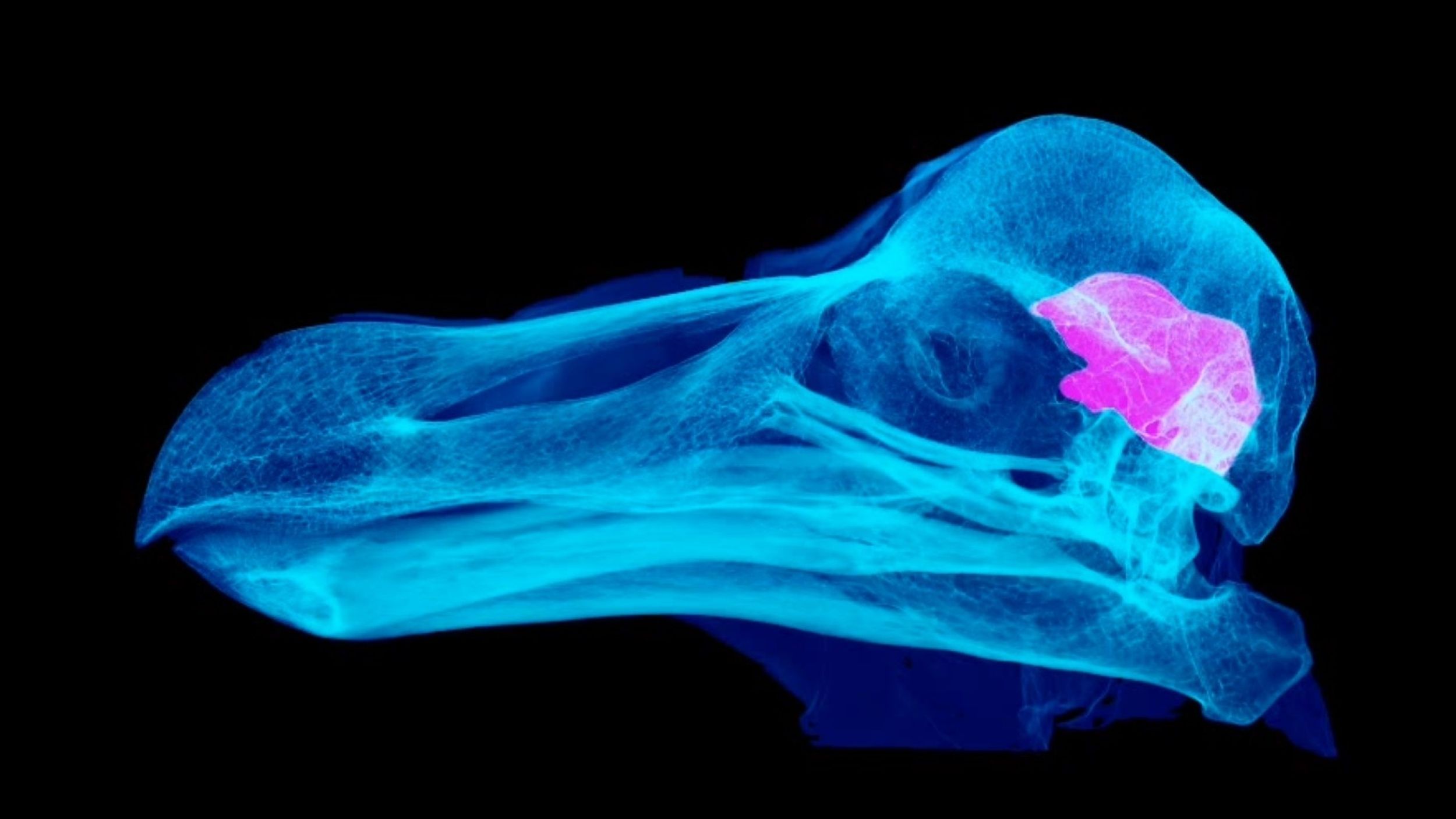
Researchers at the University of Lethbridge and collaborating institutions used computed tomography scans of dodo skulls to reconstruct the size and shape of the bird's brain. The study, published August 5 in the Zoological Journal of the Linnean Society, found that the dodo's brain scaled with body size as expected for its taxonomic group of pigeons and doves, showing no evidence of inferior intelligence compared to living relatives.
The most striking difference was in the optic lobe, the brain region that processes visual information. In the dodo this lobe was extremely reduced, comparable to that of some nocturnal birds. Lead author Sara Citron, a doctoral candidate in behavior and evolution, said the reduction suggests the species was not relying on sight, a situation that typically occurs only when light is unavailable.
The team compared dodo endocasts with those of 36 living pigeon and dove species and the extinct Rodrigues solitaire, a close relative. Unlike the dodo, the solitaire's brain matched expectations for a giant pigeon, underscoring that the dodo's visual reduction was unusual within its lineage.
An enhanced olfactory region in the dodo brain further supports the hypothesis that the bird was crepuscular or nocturnal, relying on smell rather than vision to navigate and forage. No historical accounts describe dodos active at night, but Citron noted that reliable behavioral records are almost entirely absent; most contemporary descriptions focus on taste or the ease of capture.
Earlier research had already challenged the "dumb dodo" stereotype. A 2016 study concluded dodos were likely as intelligent as modern pigeons, which can solve problems and understand abstract concepts. A 2024 study suggested they were fast and powerful rather than slow and bumbling.
The perception of stupidity likely arose because dodos, having evolved without mammalian predators, showed no fear of humans. Sailors exploited this by capturing a bird and letting it call out, which drew others to investigate — a strategy that works in a predator-free environment but proved fatal after human arrival.
Citron emphasized that the dodo's extinction resulted from introduced species such as rats, pigs, cats, and dogs destroying eggs and habitat, not from any evolutionary inadequacy. She argued that dismissing endangered species as "stupid" because they cannot cope with rapid human-driven change repeats the same mischaracterization applied to the dodo.
The nocturnal interpretation remains speculative because direct behavioral observations are lacking. The researchers caution that brain anatomy provides clues, not proof, and further evidence would be needed to confirm the dodo's activity patterns.
Nocturnal dodo? Study suggests we were very wrong about Mauritius' iconic flightless bird
This is an independent summary. The complete reporting, supporting context and any primary documents remain with Live Science.