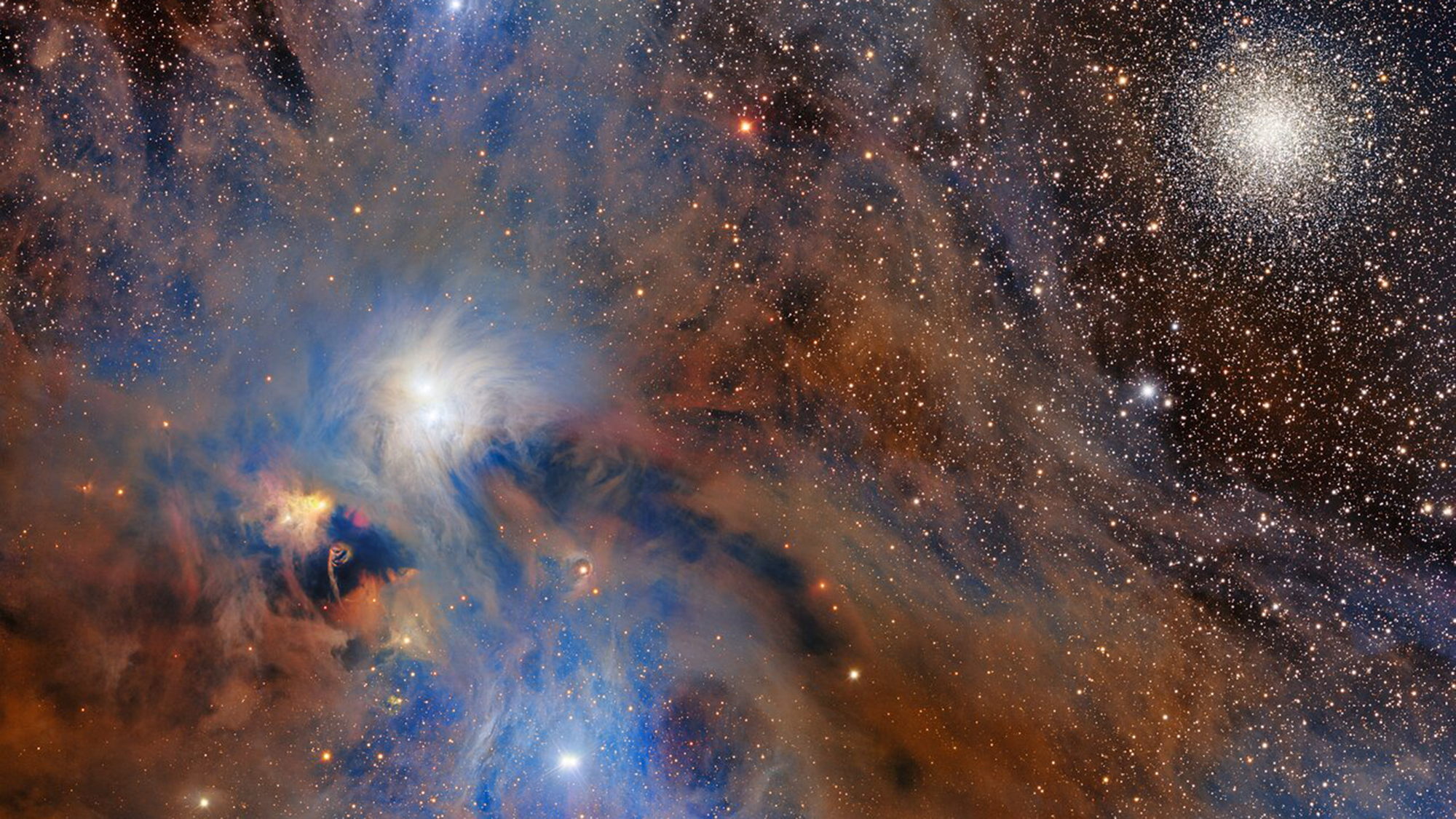
Astronomers have released a new wide-field image of the Corona Australis Molecular Cloud, one of the closest active star-forming regions to the solar system at about 430 light-years away. The image was taken with the 570-megapixel Dark Energy Camera (DECam) on the National Science Foundation's Victor M. Blanco 4-meter Telescope at Cerro Tololo Inter-American Observatory in Chile.
The photograph reveals glowing nebulae, dark dust lanes, and the Chandelier Cluster (NGC 6723) within a single field of view. On the left side of the frame, the nebula NGC 6729 shows a blue reflection nebula where dust scatters starlight and an orange emission nebula where ultraviolet radiation from young stars ionizes surrounding gas.
At the center of NGC 6729 lies R Coronae Australis, a binary star system with an orbital period of 43 to 47 years. Temperatures in the molecular cloud reach around minus 440 degrees Fahrenheit (minus 260 degrees Celsius), cold enough for dense pockets of gas and dust to collapse and form new stars.
On the upper right of the image, the globular cluster NGC 6723 sits approximately 29,000 light-years from Earth. It contains hundreds of thousands of stars that formed billions of years ago, with some nearly as old as the universe itself. Astronomers suspect the cluster hosts several stellar populations of similar age, indicating a complex evolutionary history.
The DECam's 74 detectors and 1-meter-wide lens make it one of the world's most powerful wide-field astronomical instruments. Its ability to capture both a nearby star-forming region and a distant ancient cluster in one exposure illustrates the instrument's survey capability.
NGC 6729 and NGC 6723 are popular targets for astronomers and astrophotographers due to their relative proximity, though they are best observed from the Southern Hemisphere below the constellation Sagittarius. A backyard telescope can resolve the region under dark skies.
The image was shared on July 16, 2026, as part of the Dark Energy Survey's ongoing data releases. Researchers continue to study the region to understand star formation processes and the dynamical history of globular clusters.
No new scientific findings or peer-reviewed results are announced alongside the image; it serves as a visual record of the region's structure and the instrument's performance.
'Starry Night' telescope photo captures some of the oldest stars in the universe — Space photo of the week
This is an independent summary. The complete reporting, supporting context and any primary documents remain with Live Science.