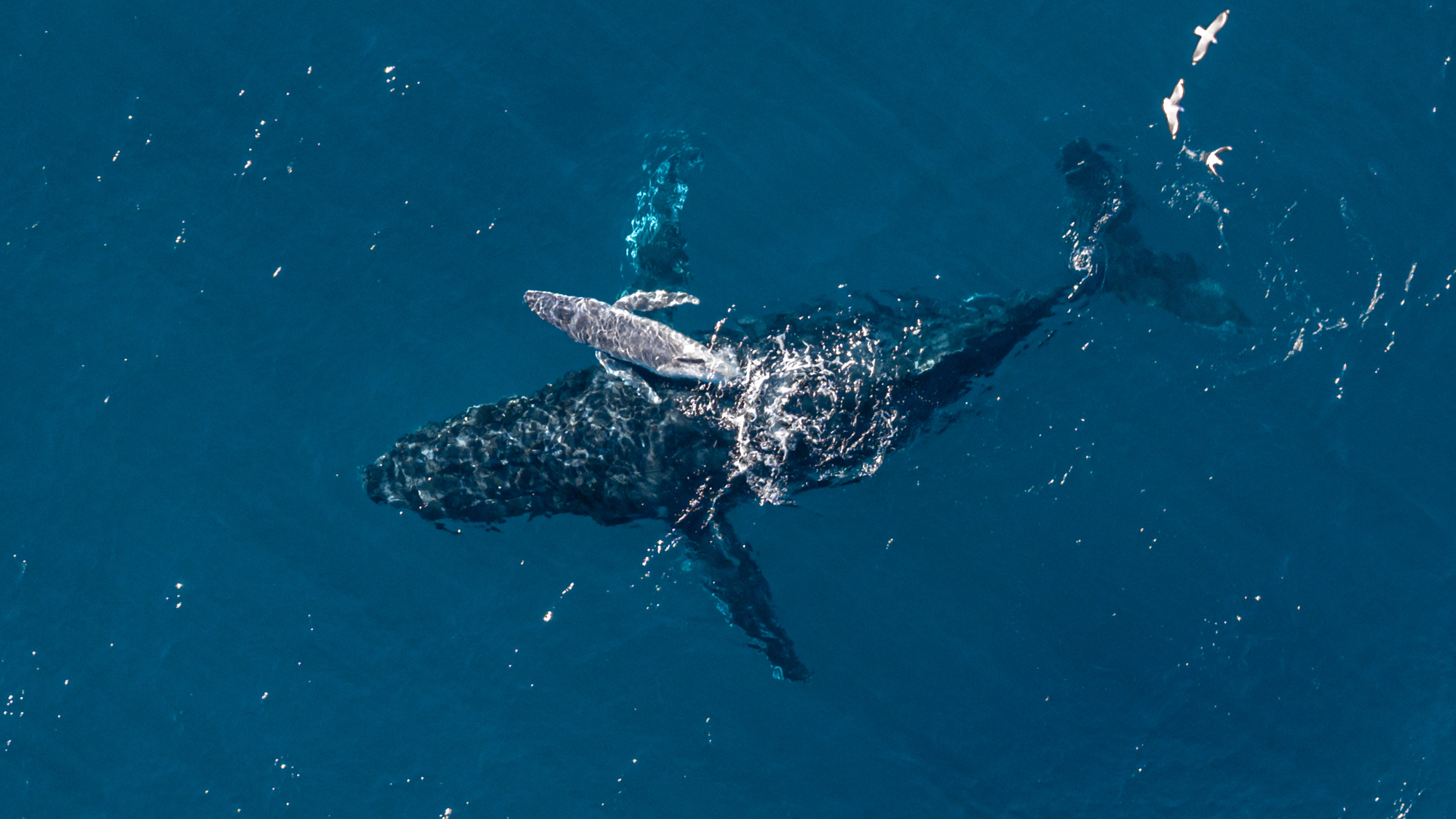
Commercial drone pilot Alexander Forrest captured footage of a humpback whale giving birth off the north coast of New South Wales, Australia, on July 28. Forrest was conducting aerial observations of migrating humpback whales for the Organisation for the Rescue and Research of Cetaceans in Australia (ORRCA), a nonprofit focused on marine mammal rescue and conservation.
The drone video shows the female whale swimming behind her pod before giving birth approximately 700 meters from shore near Kingscliff. The newborn calf surfaces in blood-reddened water for its first breath, after which the mother turns to reunite with it. ORRCA stated this is only the fourth time a humpback whale birth has been filmed in any format, and the first known complete drone recording of the event.
Forrest noted the mother whale was isolated from her pod during the birth, a detail biologists plan to compare with other documented cetacean births. For example, 2023 drone footage of a sperm whale birth showed the mother surrounded by a protective circle of ten adult females who assisted the calf to the surface.
The footage will be analyzed for a peer-reviewed scientific report. Researchers aim to learn more about where humpbacks give birth, the mechanics of the process, and the critical early interactions between mother and calf. Humpback calves typically remain with their mothers for 11 months, gaining up to 45 kilograms per day on nutrient-rich milk before undertaking their first migration.
The Australian humpback population has recovered to nearly 50,000 individuals along the New South Wales coast, a significant conservation achievement after the species neared extinction. Forrest described the birth as a symbol of that recovery. Scientists continue to study the species' long migrations of up to 8,000 kilometers between polar feeding grounds and tropical breeding areas.
'It's incredibly rare to see a moment like this in the ocean': Camera drone captures moment humpback whale gives birth off Australian coast
This is an independent summary. The complete reporting, supporting context and any primary documents remain with Live Science.