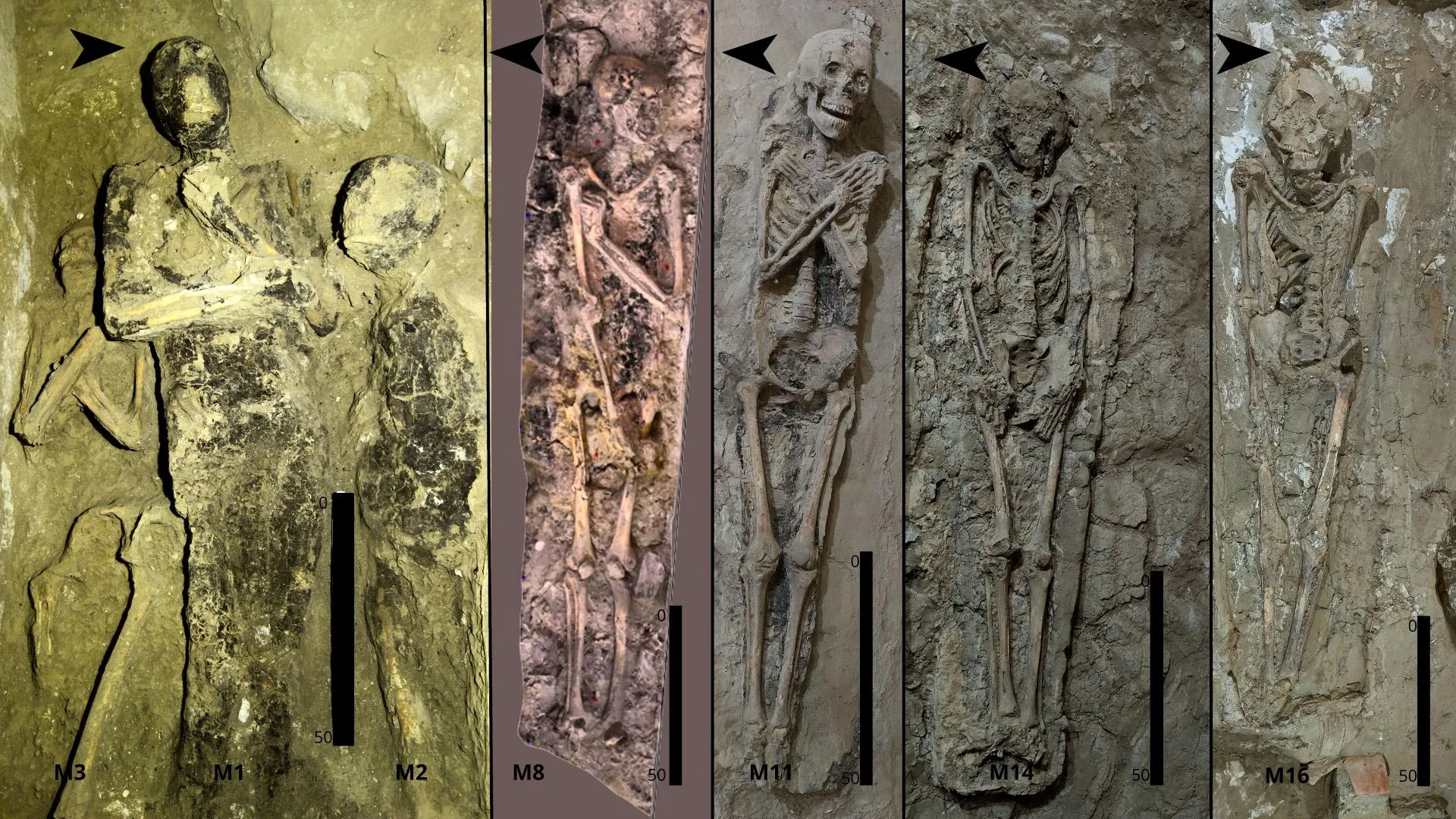
Researchers from the University of La Laguna have documented a structured pattern of burial reuse in chamber three of Theban Tomb 209, located in the Theban Necropolis across the Nile from Luxor. The tomb was constructed during the Twenty-fifth Dynasty (754–656 BCE) and remained in use until the Ptolemaic period (305–30 BCE). Excavation and detailed recording of body positions, orientations, and associated objects revealed nine distinct funerary deposits containing 16 mummified individuals, a mummified dog, and a disturbed deposit with remains of at least four more people.
The earliest burials featured high-status individuals placed in coffins with funerary nets, amulets, and imported goods such as Phoenician amphorae. These bodies were spaced apart with arms typically extended. Over time, burial practices shifted: during the late Twenty-fifth Dynasty and Persian period (around 680–404 BCE), new interments filled remaining spaces, increasing density. By the Ptolemaic period, two-thirds of burials showed vertical stacking of carefully mummified bodies without coffins, some accompanied by upright jars suggesting a specific ritual.
A striking arrangement in the southeastern chamber held four mummies and a dog placed in vertical superposition. The dog lay directly atop a man and a woman, which researchers suggest may reflect a close relationship or a ritual role as a psychopomp guiding the dead. Later burials also adopted the Osirian position with arms crossed over the chest, indicating continuing evolution of funerary tradition rather than its breakdown.
The team argues that each new deposition adapted to existing remains, demonstrating a "funerary memory" that guided spatial decisions across generations. Flooding, fires, and repeated human entry disturbed some deposits, limiting precise sequencing in certain areas. Despite these complications, the overall pattern challenges interpretations of crowded tombs as disordered, offering a framework for re-evaluating similar sites.
The study, published in Frontiers in Environmental Archaeology, applies archaeothanatological analysis to reconstruct how the chamber was conceptually reconfigured over roughly seven centuries. Researchers emphasize that the findings reflect social behaviors and changing beliefs about death, not merely practical space management.
16 mummies and a dog reveal a hidden order inside an ancient Egyptian tomb
This is an independent summary. The complete reporting, supporting context and any primary documents remain with ScienceDaily.