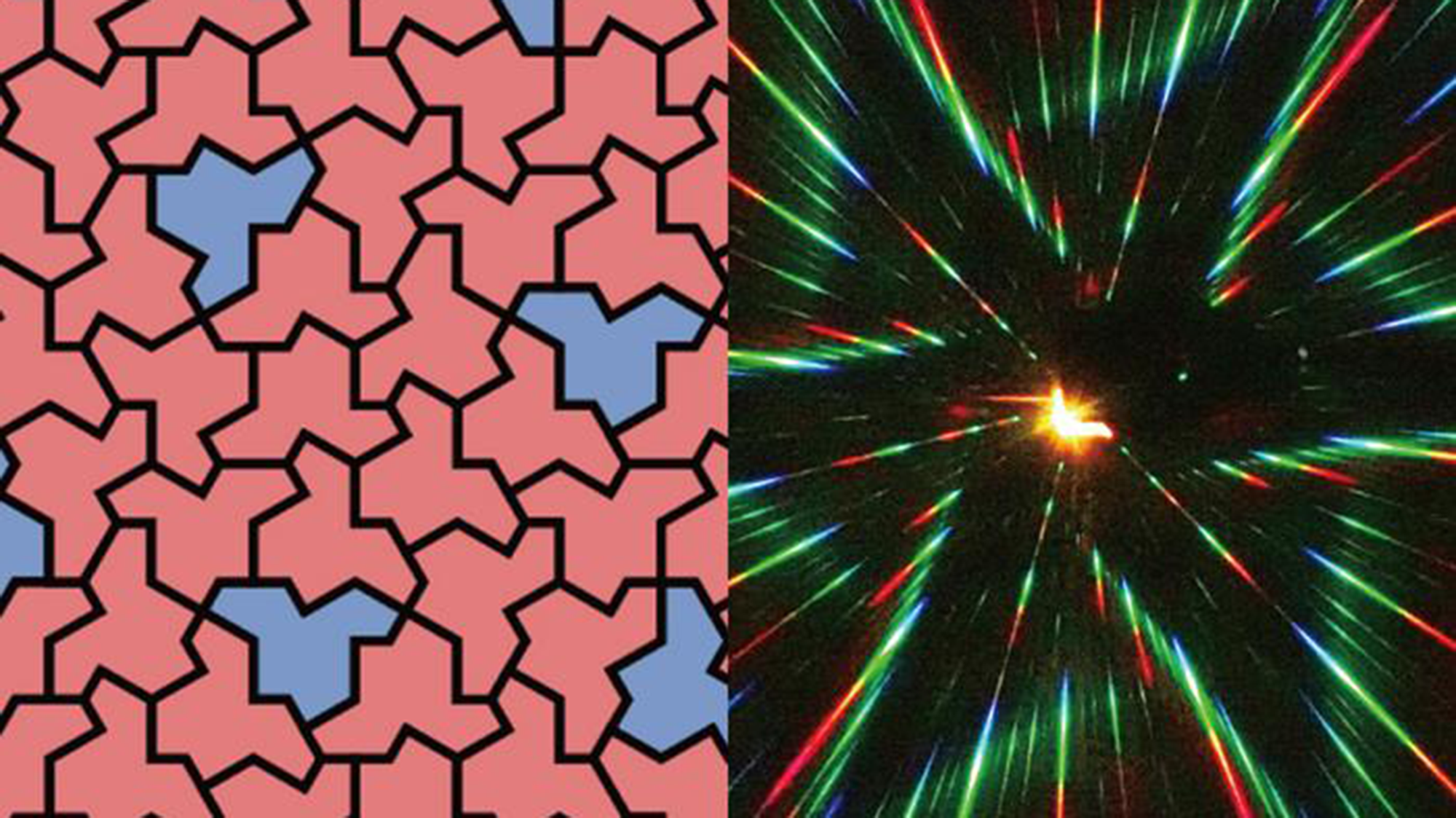
Researchers at the University of Tokyo fabricated a photonic crystal using the 13-sided aperiodic monotile known as the 'hat' or 'einstein' tile, which covers a plane infinitely without repeating. The team used electron-beam lithography and etching to create hundreds of thousands of 100-nanometer-radius holes in a silicon nitride film, arranged according to the tile's non-repeating pattern across a chip roughly half a millimeter wide.
When illuminated with a laser, the structure scattered light into a stable pinwheel pattern of bright Bragg peaks, confirming long-range order characteristic of a quasicrystal. The positions of these peaks remained constant regardless of where the laser struck the chip, demonstrating that the aperiodic arrangement produces predictable diffraction.
Because the hat tile lacks mirror symmetry, the resulting photonic crystal is chiral. The researchers observed that the diffraction pattern responded differently to left- and right-circularly polarized light, a circular polarization dependence that ordinary symmetric quasicrystals cannot produce. Lead author Yuto Moritake noted this effect was unexpected and arises directly from the tile's geometric asymmetry.
The study, published in Nature Communications on July 29, 2026, marks the first experimental demonstration of chiral diffraction from an aperiodic monotile structure. Moritake's group specializes in photonic crystals for controlling light in integrated optical devices, and the work began after Moritake encountered the hat tile in a popular science book in 2024.
The team aims to adapt this aperiodic patterning to guide light within photonic chips rather than only scattering it from the surface. Such structures could eventually be used in optical communications and optical computing, where light replaces electricity for information transmission and processing.
The hat tile solved the decades-old 'einstein problem' — whether a single shape could tile a plane aperiodically — when it was discovered in 2023 by David Smith and collaborators. Previous aperiodic tilings, such as Roger Penrose's 1970s two-tile system, required multiple shapes. The name 'einstein' derives from the German 'ein stein,' meaning 'one stone.'
Crystal made from 13-sided 'einstein' shape bends light in ways nobody imagined
This is an independent summary. The complete reporting, supporting context and any primary documents remain with Live Science.