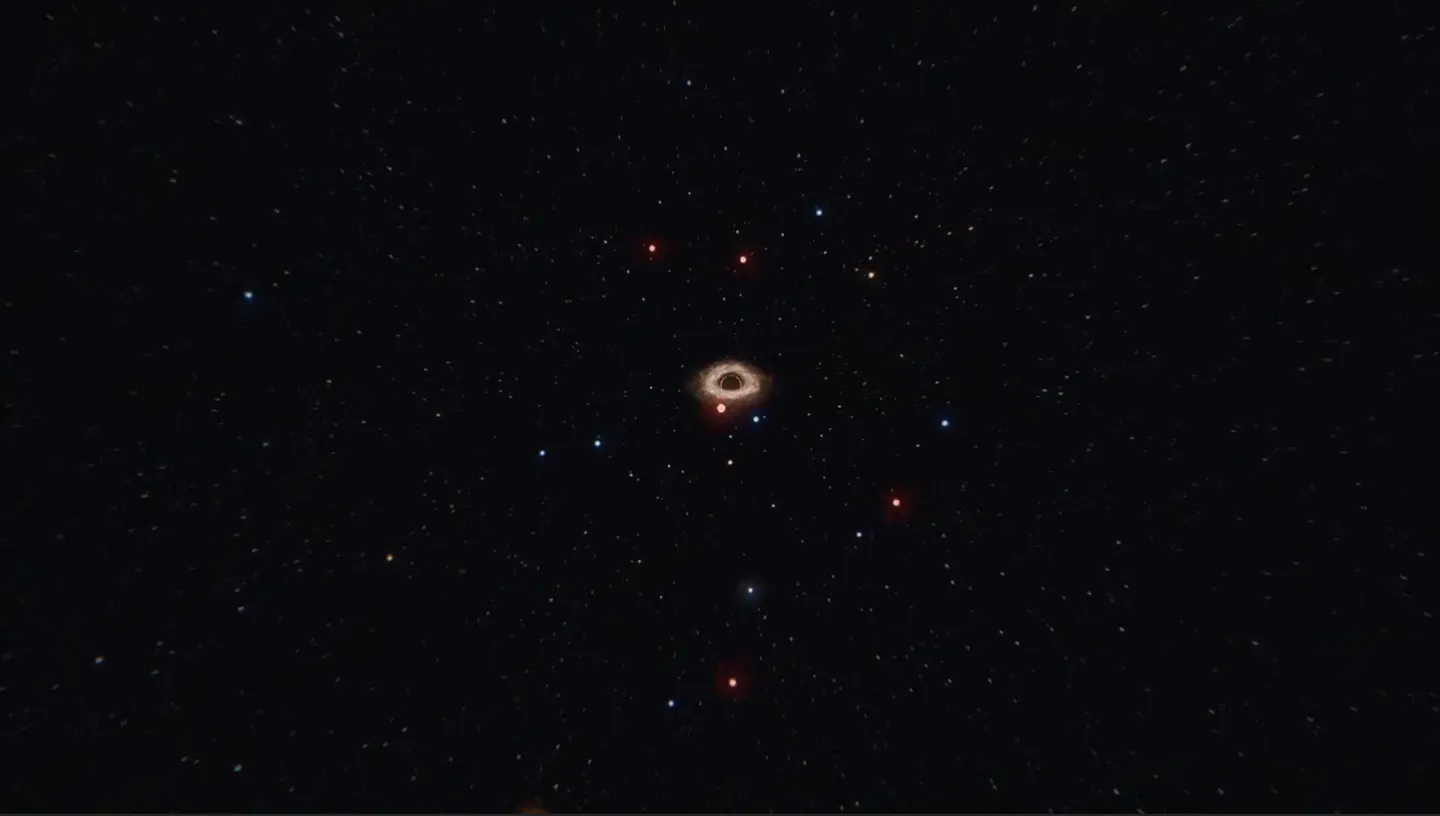
Astronomers using the European Southern Observatory's Very Large Telescope Interferometer have identified a star, designated S301, that moves faster and passes closer to the Milky Way's central supermassive black hole than any other known star. The discovery, reported in Nature by the GRAVITY+ collaboration, is based on observations from 2023 combined with archival data back to 2017 to map the star's 8.7-year orbit.
S301 reaches speeds of about 25,000 kilometers per second, roughly 8 percent of the speed of light, at its closest approach of 1.7 billion kilometers from Sagittarius A*. That distance is slightly larger than the orbital radius of Saturn around the Sun. The star is approximately 50 percent larger than the Sun.
The extreme proximity and velocity make S301 a sensitive probe of the black hole's spin. As Sagittarius A* rotates, its gravity should subtly warp the star's elongated orbit over time, an effect predicted by general relativity. By monitoring the orbit for roughly the next 15 years, researchers expect to collect enough data to calculate the spin directly.
Previous measurements of the black hole's mass, about 4 million solar masses, relied on stellar orbits farther out. Spin, however, requires a star much closer to the event horizon. A precise spin value would indicate how the black hole grew: a fast spin suggests steady accretion of material, while a slower spin points to chaotic feeding. Spin also influences the black hole's jets and winds, affecting the surrounding galaxy.
Existing spin estimates for other black holes come from X-ray emissions of nearby gas or from gravitational waves produced in mergers. Those methods depend on modeling and assumptions that leave room for debate. Researchers not involved in the study, including Christopher Reynolds of the University of Maryland, say S301 offers a more direct geometric measurement.
A definitive spin measurement would also test general relativity's prediction that a black hole's spin cannot exceed a theoretical maximum. Scientists do not expect a violation, but the observation provides a new way to check the theory in the strongest gravitational field available for study.
The GRAVITY+ instrument achieves its sensitivity by combining light from multiple telescopes, detecting objects 4 billion times fainter than the naked-eye limit. Continued monitoring of S301's orbit is planned to refine the spin measurement and further constrain models of black hole growth and relativistic effects.
A record-breaking star could reveal how the Milky Way’s giant black hole spins
This is an independent summary. The complete reporting, supporting context and any primary documents remain with Science News.