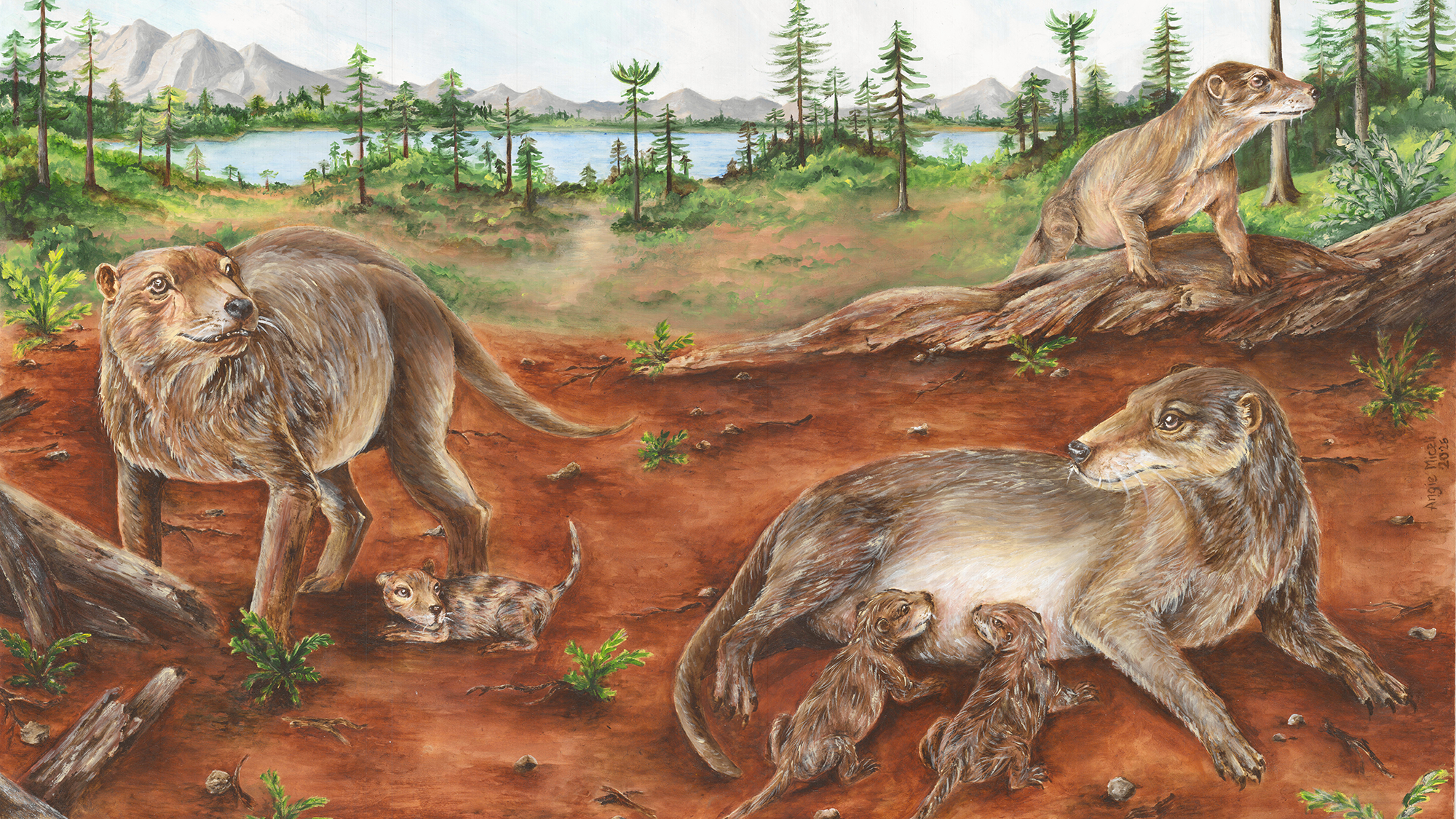
A study published August 13 in Frontiers in Mammal Science reports evidence that Chiniquodon theotonicus, a dog-sized carnivorous cynodont from the Middle Triassic of northwestern Argentina, likely gave birth to live young. Cynodonts are the clade that includes mammals and their extinct ancestors, originating about 260 million years ago.
Lead author Leandro Gaetano of Argentina's National Scientific and Technical Research Council identified a distinctive growth ring, known as a neonatal line, in a fossilized limb bone. In living terrestrial vertebrates, this line of disorganized bone forms when growth rapidly accelerates after birth or hatching.
By measuring the neonatal line and adult bone dimensions, the team estimated the individual weighed about 12 kilograms at death and 1.7 kilograms at birth, roughly 14 percent of adult mass. They compared this ratio to 1,869 living mammal species, 2,619 non-avian reptiles, and 782 birds.
Reptiles of comparable adult weight (8 to 14.5 kilograms) produce hatchlings only 0.1 to 0.6 percent of adult mass. Birds of similar size (8 to 21.5 kilograms) produce hatchlings at 1.3 to 4.5 percent. Mammals in the 8 to 15 kilogram range, such as the bay duiker antelope, have newborns around 14 to 20 percent of adult mass, closely matching the fossil estimate.
The similarity suggests C. theotonicus bore live young rather than laying eggs. If confirmed, viviparity would appear in the mammalian lineage 90 to 95 million years earlier than previous estimates, predating the split between marsupial and placental ancestors.
Paleobiologist Emily Rayfield of the University of Bristol, not involved in the study, called the finding suggestive but not definitive, noting that more evidence is needed. Gaetano agrees the neonatal line is not a "smoking gun" but argues it fits a growing pattern of mammal-like traits appearing earlier in cynodonts, including possible whiskers, hair, and lactation.
The researchers propose that live birth may have been advantageous in the harsh, arid Triassic ecosystems following the end-Permian extinction, protecting embryos from predation and environmental stress. However, they emphasize that further fossil discoveries are required to confirm a broad evolutionary shift toward viviparity in early cynodonts.
Mammal ancestors may have given live birth 90 million years earlier than we thought, rewriting evolutionary timelines
This is an independent summary. The complete reporting, supporting context and any primary documents remain with Live Science.