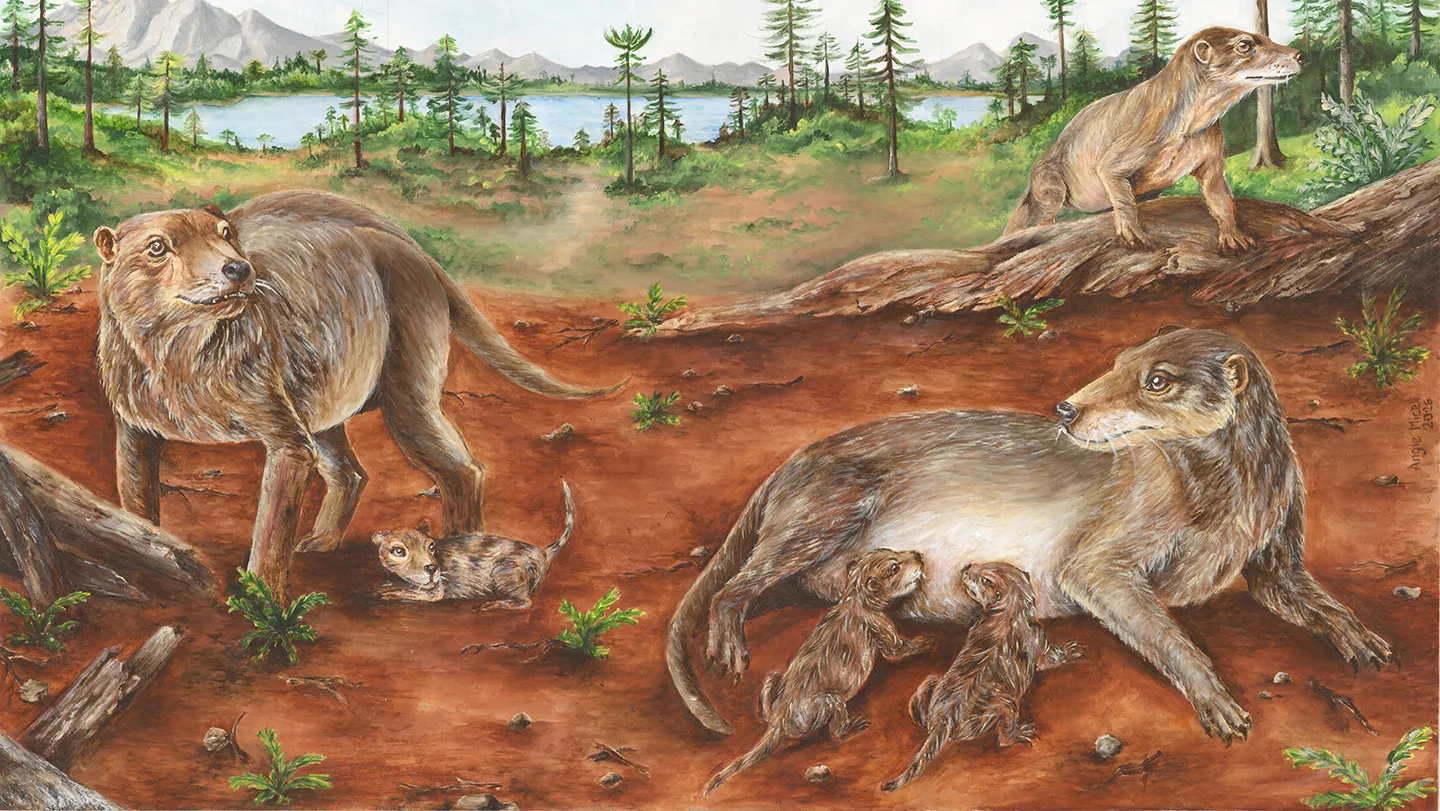
Researchers analyzing a fossil of the cynodont species Chiniquodon theotonicus, which lived about 236 million years ago in what is now northwestern Argentina, have found evidence that the animal gave birth to live young rather than laying eggs. The study, published in Frontiers in Mammal Science, examines microscopic growth rings in the creature's femur bone.
A distinct dark ring, known as a neonatal line, marks the transition from prenatal to postnatal bone tissue, indicating the metabolic stress of birth. By measuring bone growth before and after this line, the team estimated the animal weighed approximately 1.7 kilograms at birth and about 12 kilograms as an adult.
This newborn-to-adult body mass ratio of roughly 14 percent is characteristic of modern placental mammals, which give birth to relatively large, developed offspring. By contrast, egg-laying animals such as reptiles, birds, and monotremes, as well as marsupials, typically have ratios well below 5 percent.
When the researchers plotted the cynodont's ratio against thousands of living species, Chiniquodon grouped closely with placental mammals like the bay duiker, a small African antelope. This comparison strongly suggests the cynodont was viviparous, pushing the earliest evidence for live birth in the mammalian lineage back by about 90 million years.
Previously, viviparity was thought to have arisen with the emergence of therian mammals around 160 million years ago. The new finding raises the question of whether live birth evolved once, much earlier in the cynodont line, or evolved independently at least twice.
Other experts caution that more fossil evidence is needed to resolve this. Fossils of the dicynodont Lystrosaurus from about 250 million years ago show clear evidence of egg-laying, and the cynodont Kayentatherium wellesi from roughly 196 million years ago appears to have produced large clutches of 38 young, a pattern more consistent with eggs.
The researchers acknowledge that embryonic tissues are rarely fossilized, making it difficult to test competing hypotheses. Further discoveries of similarly preserved cynodont specimens will be necessary to determine whether viviparity was widespread among early mammal ancestors or an isolated occurrence in this lineage.
These mammal ancestors birthed live young far earlier than thought
This is an independent summary. The complete reporting, supporting context and any primary documents remain with Science News.