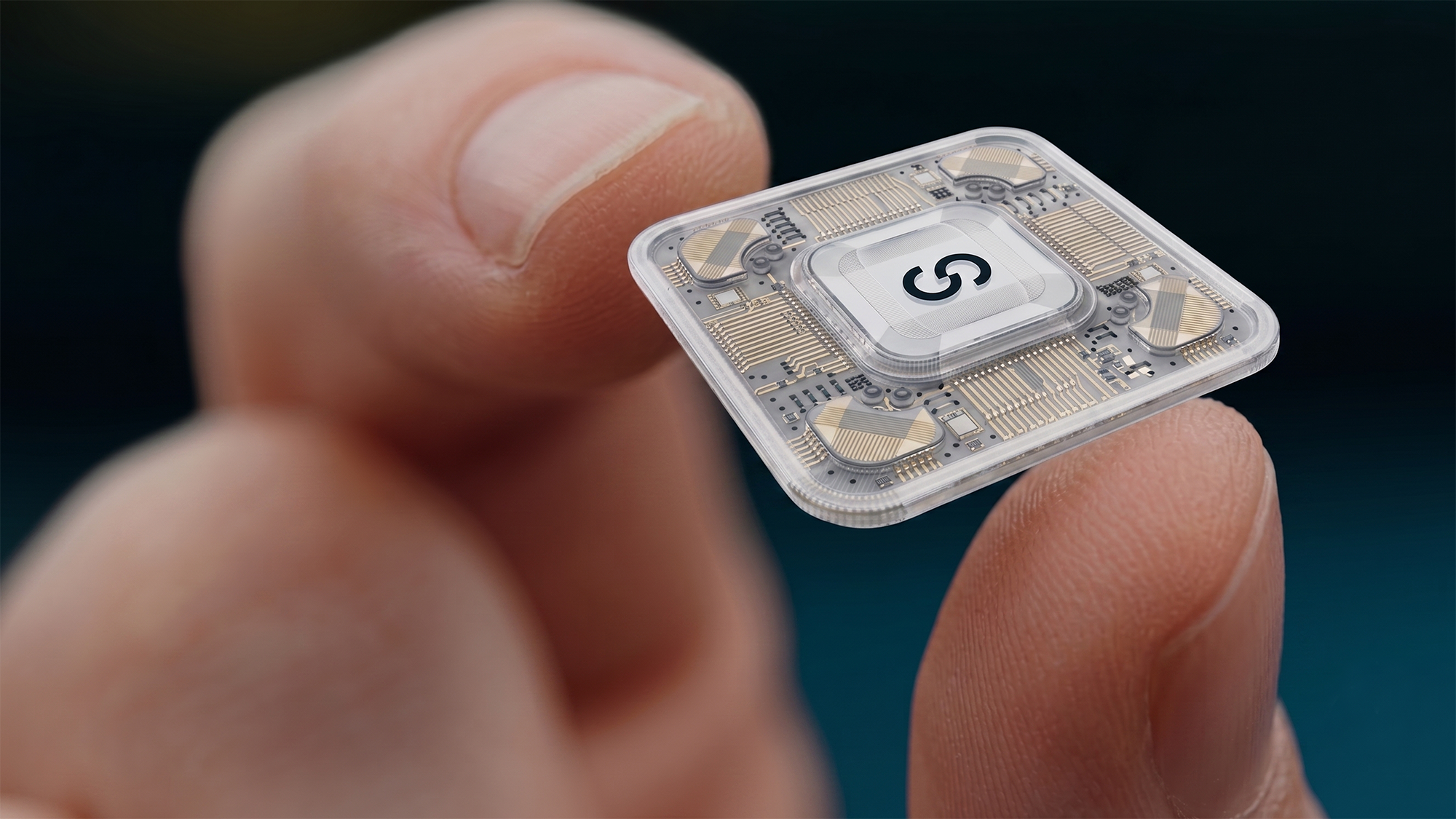
German startup Saxon Q has launched what it describes as the world's first portable quantum computer based on nitrogen-vacancy centers in synthetic diamonds to exceed 10 qubits. The rack-mounted system operates at room temperature and connects to standard alternating-current power, removing the cryogenic cooling infrastructure required by superconducting quantum processors. The company currently offers configurations up to 128 qubits, with 512-qubit systems slated for delivery next year and a roadmap targeting 10,000 qubits after 2030.
Nitrogen-vacancy qubits rely on a defect in the diamond lattice where a nitrogen atom neighbors a carbon vacancy. The electron spin of the nitrogen atom serves as the quantum bit, controllable via laser and microwave pulses. Historically, scaling such systems beyond a handful of qubits has been difficult due to low yield in creating consistent nitrogen-vacancy centers. Saxon Q reports a materials breakthrough: co-implanting sulfur atoms during diamond growth lifts the chemical potential, supplying electrons and increasing the yield of negatively charged nitrogen-vacancy centers.
Professor Marius Grundmann, co-founder of Saxon Q and experimental physicist at Leipzig University, told Live Science the company's latest single-qubit gate fidelity reached 99.98% as of July 22, with earlier figures cited at 99.92% before error correction. These numbers are said to be comparable to state-of-the-art results from other platforms such as IBM and MIT, though Live Science noted it could not independently verify the claims and no peer-reviewed publication demonstrating a functional NV quantum computer above 10 qubits existed prior to this announcement.
The system's room-temperature operation and rack-mounted form factor are presented as practical advantages for edge-computing scenarios — such as autonomous vehicles or robotics — where cloud latency is unacceptable. Grundmann described the device as a multiuser, multitasking, multicore quantum computer accessible over a network. However, research indicates superconducting qubits generally operate faster than NV centers, and the trade-off between gate speed and network latency remains unquantified.
Scaling beyond the current 512-qubit target presents a hardware challenge: Saxon Q's diamond chips presently accommodate only eight or 16 qubits each. Reaching hundreds of thousands or millions of qubits will require integrating hundreds or thousands of qubits onto a single array, a feat not yet demonstrated. The company has shared a technical white paper but has not yet published peer-reviewed benchmarking data comparing its NV architecture directly with other quantum modalities.
The debut marks a milestone in making quantum hardware physically accessible outside specialized labs, but the field awaits independent validation of fidelity, coherence times, and algorithmic performance at scale. Whether diamond-based NV systems can compete with superconducting, trapped-ion, or neutral-atom platforms on a cost-per-qubit and speed basis remains an open question.
Engineers build world's first portable diamond-powered quantum computer — it works at room temperature and can be plugged into an outlet
This is an independent summary. The complete reporting, supporting context and any primary documents remain with Live Science.