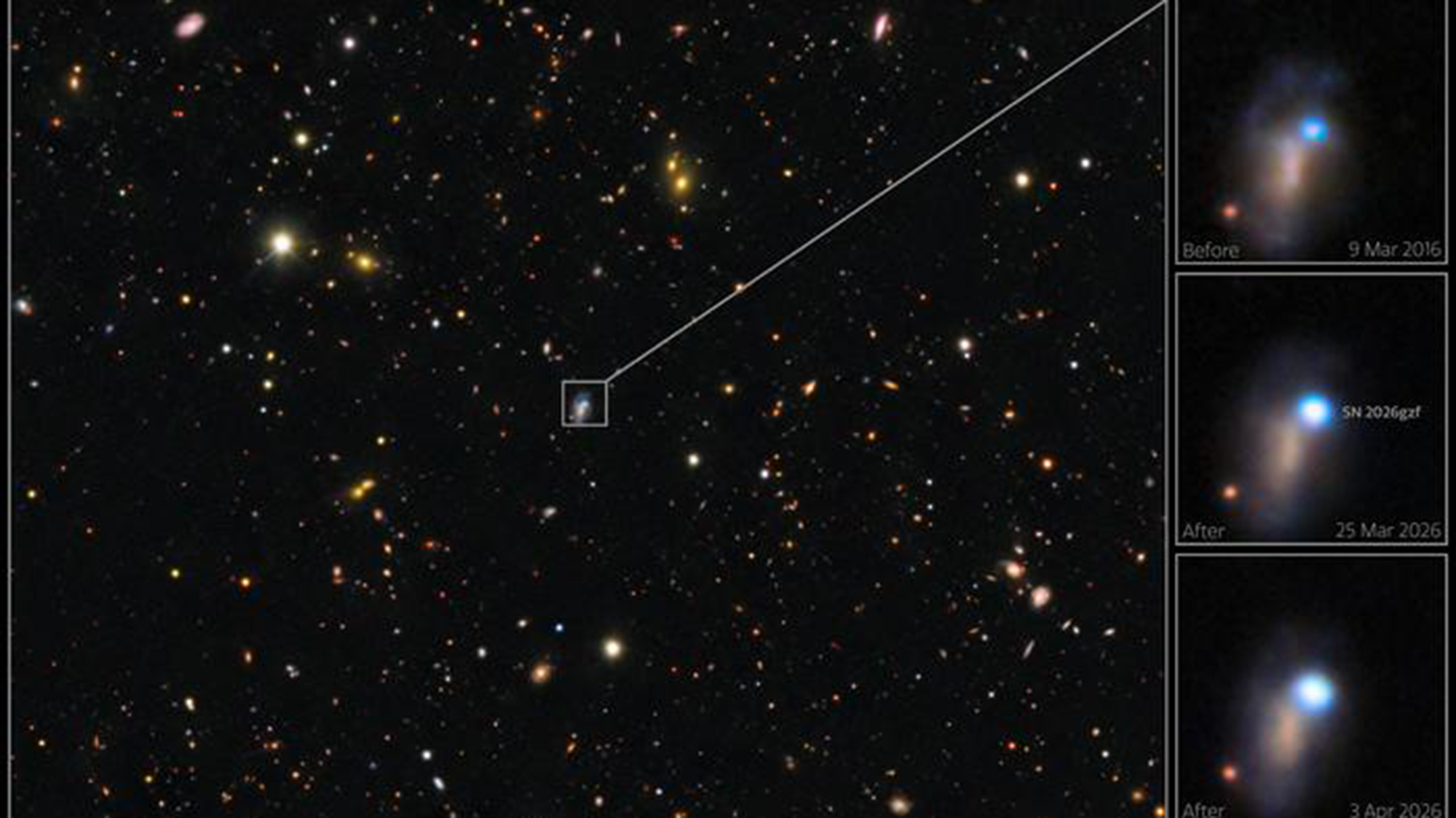
A coordinated network of telescopes captured the earliest moments of a supernova explosion 500 million light-years away in March 2026. China's Einstein Probe space telescope first detected an X-ray flash, triggering rapid follow-up by ground-based observatories within the hour.
The Vera C. Rubin Observatory in Chile, which began its 10-year sky survey in late June, happened to be monitoring the COSMOS Deep Drilling Field when the explosion occurred. Its wide-field camera recorded the event's evolution alongside the Dark Energy Camera on the Víctor M. Blanco 4-meter Telescope.
Researchers confirmed the "shock breakout" — the first light emitted as the explosion's shock wave reaches the stellar surface — in two papers published July 14 in The Astrophysical Journal Letters. This is only the second time in 20 years that a shock breakout has been observed in such detail, as these events typically last only seconds to hours.
The supernova was classified as a Type Ic broad-lined (Ic-BL) event, typically associated with jets moving near light speed and gamma-ray bursts. However, this explosion presented surprises: its shock breakout was the faintest seen in this class, and no gamma-ray bursts were detected despite sensitive follow-up searches.
Astrophysicist Brendan O'Connor of Carnegie Mellon University suggested the jet may have been "choked" by the star's surface or surrounding circumstellar material. The Dark Energy Spectroscopic Instrument on the Mayall Telescope at Kitt Peak confirmed the classification through spectroscopic follow-up.
Archival data from the Dark Energy Camera revealed a "blue source" at the explosion site years before the event, providing rare pre-explosion information about the star system. A team led by Jillian Rastinejad of the University of Maryland used Gemini North and South telescopes to map the surrounding material structure.
The progenitor star was approximately 20 times the mass of the Sun and classified as a Wolf-Rayet star that had lost most of its hydrogen early in life. Before exploding, it periodically ejected massive chunks of hydrogen and helium, creating visible shells that generated the initial X-ray shock.
Gokul Srinivasaragavan, a doctoral researcher on Rastinejad's team, noted this marks the first mapping of a stripped star's pre-explosion environment. The Rubin Observatory's decade-long survey is expected to reveal millions more transient events, enabling statistical studies of whether all stripped stars share similar pre-collapse behavior.
A star 20 times the size of the sun died in a supernova — and telescopes around the world joined forces to watch it
This is an independent summary. The complete reporting, supporting context and any primary documents remain with Live Science.