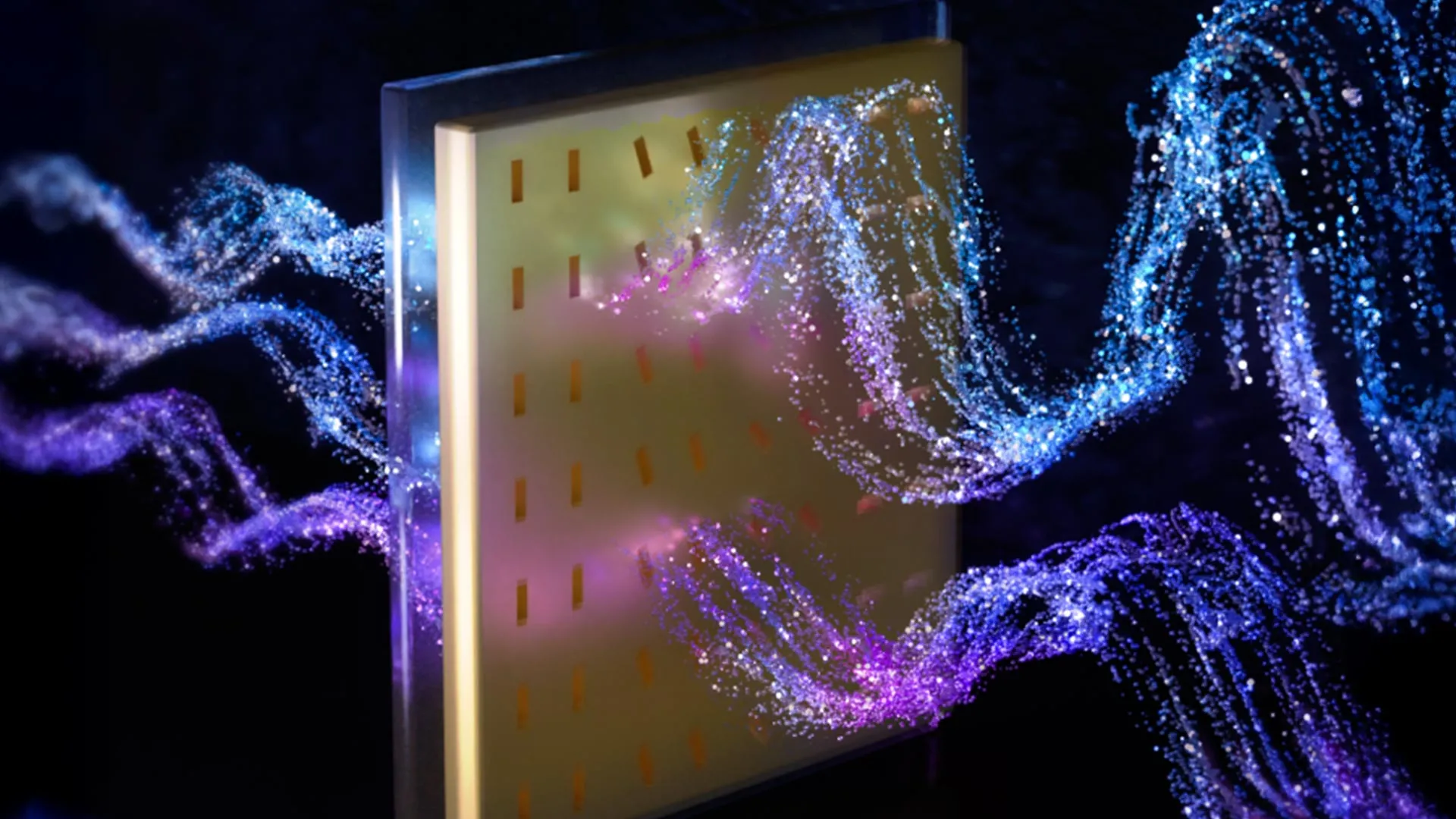
Physicists at Louisiana State University have fabricated the first quantum material that can identify and transport different quantum states of light at room temperature. The study, published in Nature, describes an ultrathin gold film patterned with hundreds of microscopic slits that together function as an artificial crystal.
Most quantum materials require cooling near absolute zero to suppress atomic vibrations that destroy fragile quantum effects. The LSU team circumvented this limitation by engineering a "quantum statistical plasmonic metacrystal" from the ground up rather than searching for a naturally occurring substance.
The researchers deposited a thin gold layer on a glass chip and used focused ion beams to cut hundreds of nanoscale slits, each acting as a meta-atom. By precisely controlling the size, shape, and spacing of these structures, they dictated how the material responds to incoming light.
The metacrystal detects subtle quantum statistical differences among photon streams — distinctions that normally require complex, cryogenically cooled detectors and millions of measurements. It then routes each quantum state along a separate path through the crystal while preserving the coherence that carries quantum information.
Lead author Omar S. Magaña-Loaiza described this as "robust transport" of quantum states without cryogenic cooling. The team also observed "quantum statistical bands" analogous to electronic band structures in semiconductors, but governing the movement and statistics of quantum light instead of electrons.
The design provides a general blueprint for a new family of room-temperature quantum materials. Potential applications include quantum computing, secure communication, advanced sensing, and solar energy, where the material's ability to guide light with fewer losses might improve photovoltaic conversion efficiency.
The researchers plan to test the metacrystal in solar cells to determine whether it can increase the share of sunlight converted into electricity. Funding came from the U.S. Department of Energy, Office of Basic Energy Sciences.
This tiny gold crystal could bring quantum technology out of the deep freeze
This is an independent summary. The complete reporting, supporting context and any primary documents remain with ScienceDaily.