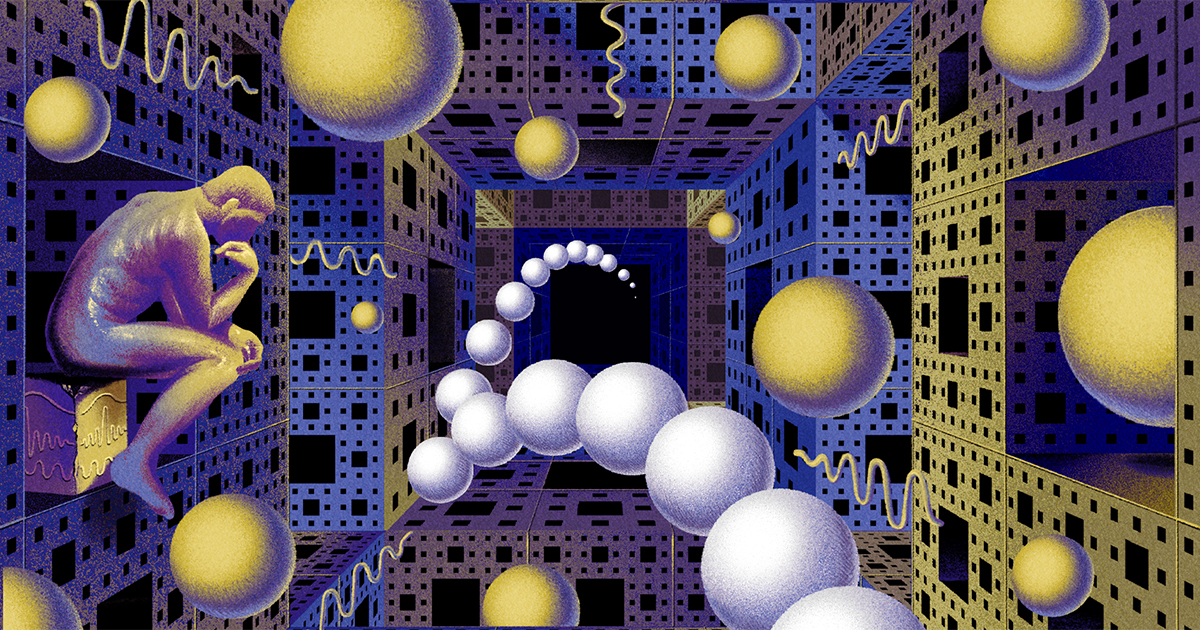
In 2016, mathematician Semyon Dyatlov, with key ideas from Jean Bourgain, proved the fractal uncertainty principle for one-dimensional fractals. The principle states that a function and its Fourier transform cannot both be concentrated on porous, fractal-like sets. This result provided a mathematical tool to show that quantum particles, which behave like waves, cannot remain trapped on the intricate fractal paths that classical chaotic objects sometimes follow.
Extending the proof to higher dimensions proved far more difficult. A 2016 workshop convened by Dyatlov and Bourgain ended with attendees, including mathematician Frédéric Naud, concluding the problem was likely unsolvable. The central obstacle was that in two or more dimensions, standard fractals such as the Sierpiński carpet contain straight lines, which violate the principle because a line and its Fourier transform are both fractal-like.
Alex Cohen, a doctoral student at MIT beginning in 2021, took on the problem after hearing Dyatlov emphasize its importance. Cohen's first step was to define a stricter condition he called "line porosity," requiring that any line drawn through the fractal must encounter many holes. This assumption excludes problematic fractals like the standard Sierpiński carpet while retaining a broad class of higher-dimensional fractal sets.
Cohen then needed to construct a specialized "damping function" to isolate individual peaks of a fractal-like function, a technique pioneered in the one-dimensional proof. After struggling with existing methods, he received unpublished notes from Bourgain, shared by Dyatlov, which suggested using complex analysis to build a more flexible mathematical object. This insight allowed Cohen to construct the necessary damping function and complete the proof.
Cohen posted the proof online in May 2023 and published it in the Annals of Mathematics in 2025. The work became his thesis and led to an assistant professorship at New York University at age 25. Peter Sarnak of the Institute for Advanced Study called it a "foundational result" and a remarkable achievement for a doctoral thesis.
The higher-dimensional principle has already been applied by other mathematicians to study wave behavior in chaotic systems. It provides a rigorous mathematical distinction between quantum and classical chaos, confirming that waves cannot be confined to fractal trajectories in the same way particles can. Cohen later learned the complex-analysis method he used was known from the 1960s Beurling-Malliavin theorem, though he said believing it was a unique insight gave him the confidence to persist.
Graduate Student Proves a Quantum Uncertainty Principle for Fractals
This is an independent summary. The complete reporting, supporting context and any primary documents remain with Quanta Magazine.