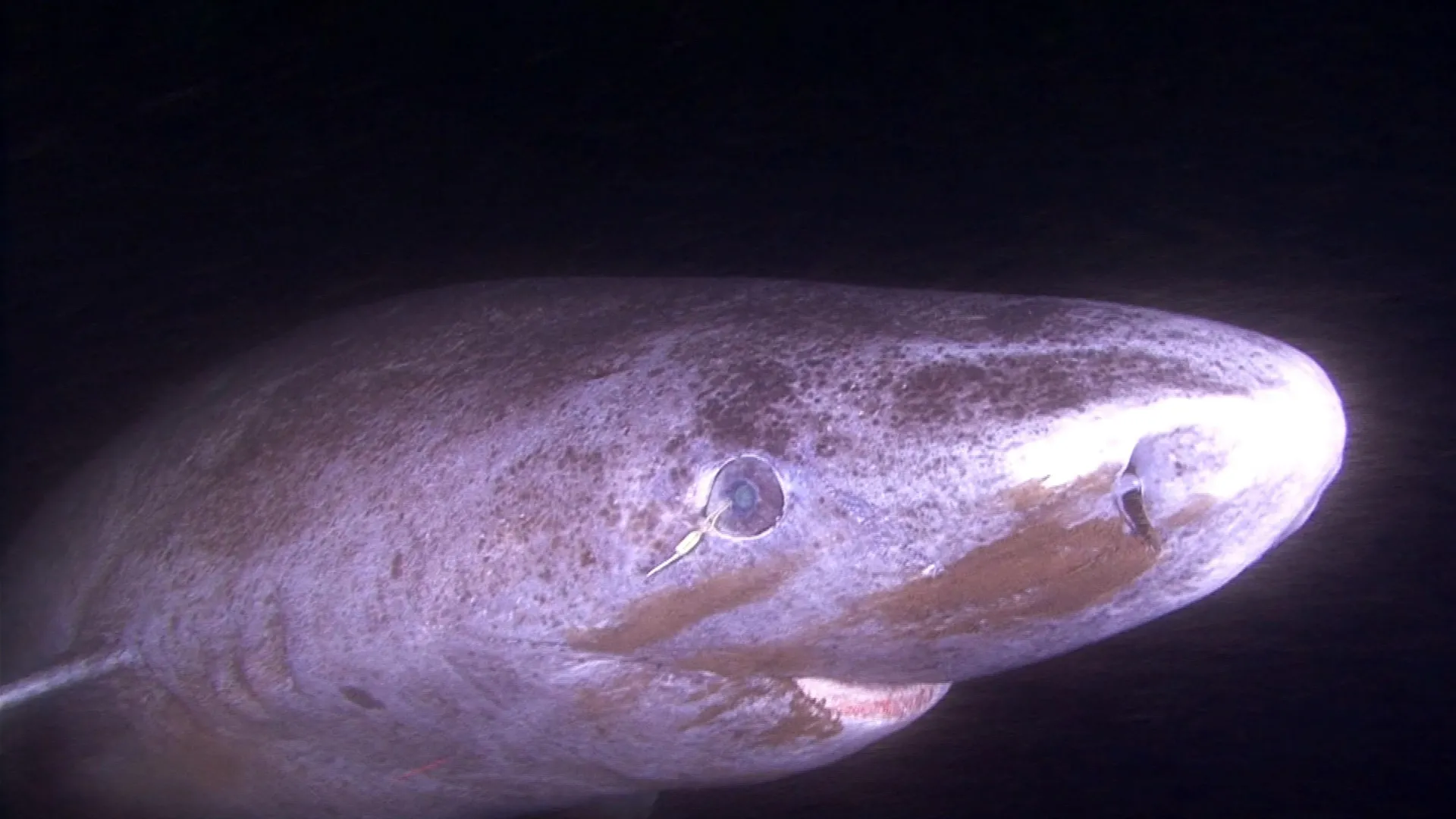
Greenland sharks, the longest-living vertebrates known to science with lifespans reaching 400 years, maintain healthy retinal tissue without the degeneration typically associated with aging. A study led by University of California, Irvine associate professor Dorota Skowronska-Krawczyk and published in Nature Communications examined eyes from sharks caught between 2020 and 2024 near Disko Island, Greenland.
Despite living in dim Arctic depths and often hosting parasites directly on their eyeballs, the sharks showed no evidence of retinal cell death. The visual pigment rhodopsin remained active and was tuned to detect blue light, an adaptation suited to the faint illumination of deep Arctic waters.
The findings challenge long-held assumptions that Greenland sharks are functionally blind due to their parasitic infestations and dark habitat. Video footage analyzed by the researchers shows the sharks actively tracking light with their eyes, indicating functional vision.
UC Irvine Ph.D. student Emily Tom performed histological analyses on the baseball-sized eyeballs, which required developing new handling techniques far beyond standard mouse models. The preserved tissue revealed retinal structure and protein activity consistent with much younger animals.
The research team, including collaborators from the University of Basel, University of Copenhagen, Indiana University South Bend, and Virginia Institute of Marine Science, suggests DNA repair mechanisms may underlie this extraordinary preservation of eye tissue across centuries.
Skowronska-Krawczyk notes that understanding how Greenland shark eyes resist age-related decline could eventually inform strategies for preventing human vision loss from conditions such as macular degeneration and glaucoma. However, she emphasizes that the work remains at a basic discovery stage.
Federal funding uncertainty has raised concerns about continuing this line of research, though the team remains committed to investigating the molecular mechanisms that allow visual tissues to remain functional over extreme timescales.
This shark can live 400 years. Its eyes barely seem to age
This is an independent summary. The complete reporting, supporting context and any primary documents remain with ScienceDaily.