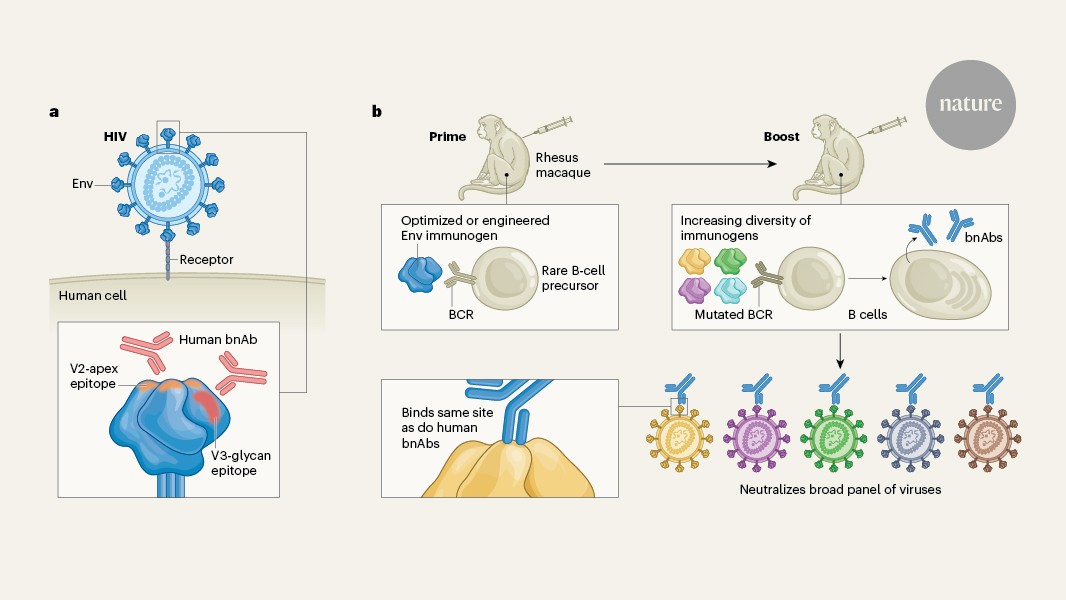
Three studies published in Nature demonstrate that strategically designed vaccine regimens can prime rare B cells in non-human primates to produce broadly neutralizing antibodies against HIV. The research, conducted by separate teams led by Guenaga, Marchitto, and Steichen, represents a coordinated preclinical advance toward an HIV vaccine.
The studies focus on the HIV envelope protein's apex region, a conserved viral target that is difficult for the immune system to reach. Each team used a stepwise vaccination approach, starting with engineered immunogens designed to activate specific naive B cell precursors and then guiding their maturation through sequential boosting.
In the Guenaga study, vaccination generated broadly cross-neutralizing antibodies targeting the Env apex. The Marchitto team showed that enhanced B cell priming could induce broadly neutralizing antibodies against the same region. Steichen and colleagues reported that their regimen elicited broadly neutralizing antibodies in primates.
These antibodies are significant because they can neutralize a wide range of HIV strains, overcoming the virus's extreme genetic diversity, which has been a primary obstacle to vaccine development for decades. The work builds on previous research identifying the necessary B cell lineages and the structural requirements for antibody binding.
The studies collectively validate a germline-targeting strategy, where the initial vaccine component is engineered to bind the unmutated ancestors of broadly neutralizing antibodies. Subsequent boosts then shepherd the antibody evolution toward breadth and potency.
While the results are confined to non-human primate models, they establish a proof of concept for a vaccination pathway that could be translated into human clinical trials. The convergence of three independent lines of evidence strengthens the case for this approach.
Researchers note that significant hurdles remain, including the complexity of manufacturing multi-step regimens, the durability of antibody responses, and the need to confirm safety and efficacy in humans. The studies do not claim a finished vaccine but rather a defined immunological pathway.
The findings were highlighted in an accompanying News & Views article by S. Gnanakaran of Los Alamos National Laboratory and Cynthia A. Derdeyn of the University of Washington, who contextualized the advance within the broader history of HIV vaccine research.
HIV vaccines guide rare immune cells to make broadly neutralizing antibodies
This is an independent summary. The complete reporting, supporting context and any primary documents remain with Nature.