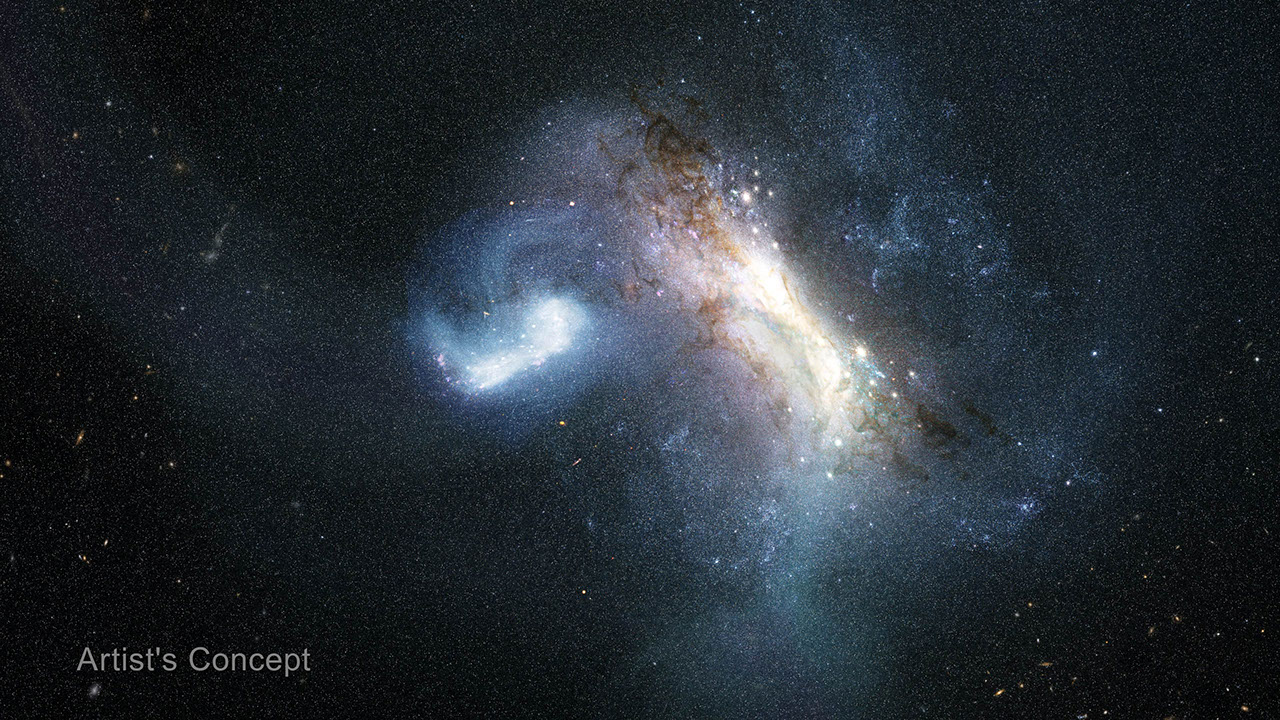
NASA's Hubble Space Telescope has uncovered definitive evidence of a major merger between the early Milky Way and a dwarf galaxy designated LKH, occurring approximately 11.8 billion years ago. The findings, published in Nature Astronomy, extend the reconstructed merger history of the Milky Way by 1.8 billion years beyond the previously confirmed Gaia-Sausage-Enceladus event.
Researchers analyzed Hubble observations of 39 globular clusters within the inner 20,000 light-years of the galaxy, using the telescope's high resolution to measure precise ages and metallicity — the abundance of elements heavier than helium — for each cluster. Combined with kinematic data from the European Space Agency's Gaia mission, the data revealed a distinct third population of clusters.
These clusters are older than those acquired during the Gaia-Sausage-Enceladus merger roughly 10 billion years ago, but younger than clusters formed natively in the Milky Way. The team concluded they originated in a separate dwarf galaxy containing roughly 500 million solar masses in stars, a significant fraction of the young Milky Way's mass at the time.
The dwarf galaxy was named Low-energy-Kraken-Heracles (LKH) in recognition of three prior studies that had hypothesized an early major merger. Lead author Davide Massari of the Astrophysics and Space Science Observatory of Bologna noted that the discovery shows stars born in external galaxies contributed to the Milky Way's earliest phases, contrary to models suggesting only in-situ formation.
Globular clusters serve as cosmic archaeological sites because they preserve some of the oldest stars in the galaxy, including those accreted from merging systems. Hubble's sensitivity allowed the team to distinguish the LKH population by age and metallicity regardless of metal content, confirming a distinct origin.
The researchers plan to continue analyzing unstudied globular clusters with Hubble to characterize all massive mergers across the Milky Way's cosmic history. Co-author Fernando Aguado-Agelet of the University of Vigo and University of La Laguna emphasized that these observations target clusters never studied before.
Hubble, a joint project of NASA and the European Space Agency, has operated for over three decades. The telescope is managed by NASA's Goddard Space Flight Center, with science operations conducted by the Space Telescope Science Institute in Baltimore.
Hubble Solves Merger Mystery From Milky Way’s Early Years
This is an independent summary. The complete reporting, supporting context and any primary documents remain with NASA.