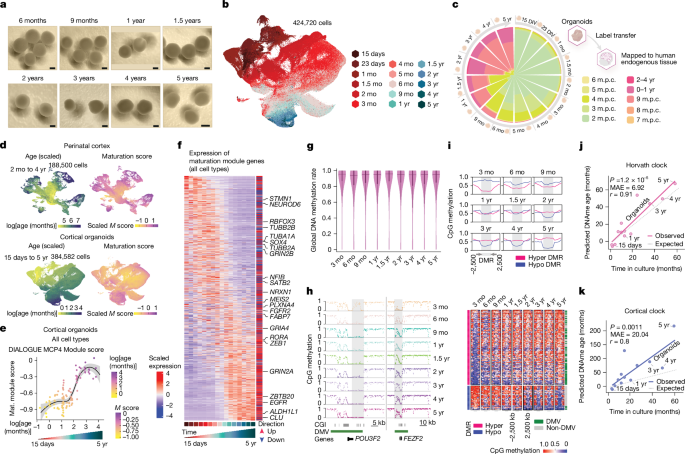
Researchers have maintained human brain organoids in culture for five years, extending the viability of excitatory neurons beyond previous limits. The organoids were grown under optimized conditions that allowed them to continue maturing far longer than typical protocols, which usually capture only early developmental stages.
Using gene-expression modules derived from human brain tissue, the team found that the organoids age transcriptionally in a cell-type-specific manner over years in culture. Whole-genome methylation profiling showed that the predicted epigenomic age of the organoids correlates precisely with the time they spent in vitro and parallels epigenetic aging observed in living human brains.
In a further experiment, the researchers created chimeric organoids by mixing neural progenitors of different ages. Old progenitors rapidly produced late neuronal fates, bypassing the generation of earlier neuronal types, indicating that progenitors retain a memory of the time they have spent in culture.
The findings demonstrate that human brain organoids can continue to mature and record the passage of time over multiple years, providing a model for studying prolonged human brain development that is difficult to replicate in animal systems.
The work establishes that extended culture does not simply arrest development but allows organoids to progress through molecular aging programs that mirror in vivo timelines.
Limitations include the absence of vascularization, immune cells, and sensory input, which may affect how fully the organoids recapitulate all aspects of brain aging.
The study was published in Nature on August 19, 2026.
Human brain organoids record the passage of time over multiple years
This is an independent summary. The complete reporting, supporting context and any primary documents remain with Nature.