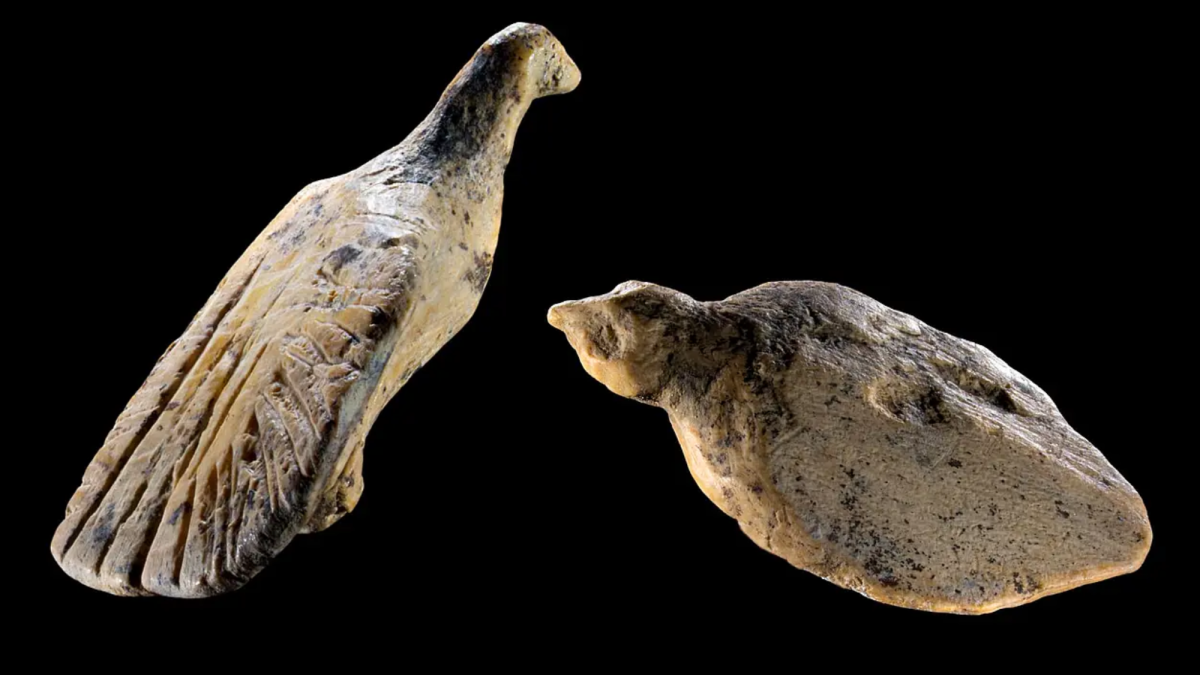
Archaeologists excavating Hohle Fels Cave in southwestern Germany have recovered two bird figurines carved from mammoth ivory. The artifacts were found in 2025 in sediment layers attributed to the Aurignacian period, roughly 40,000 years old.
Each figurine measures less than half an inch, making them unusually small compared to the one-to-four-inch range typical for this period. They were discovered less than five feet apart, suggesting they may have been made by the same carver.
One piece is complete and appears to depict a brooding bird. The other is incomplete and shows a bird with outstretched wings, possibly in flight, landing, or engaged in courtship.
Nicholas Conard of the University of Tübingen, who led the excavation, said the carvings demonstrate that the earliest artists in Europe were skilled ivory workers capable of rendering delicate motifs in miniature. He noted the figurines include specific, unique features that reflect detailed observation of living birds.
Researchers propose that one bird may represent a ptarmigan, a grouse species common in the region then and now. The second could be another grouse relative or a bird of prey.
Stefanie Kölbl, managing director of the Museum of Prehistory and Ice Age Art in Blaubeuren, said the finds underscore the long-standing presence of diverse birdlife around the cave and nearby Lake Schmiechen, which remains a bird sanctuary today.
The figurines will be on display at the Blaubeuren museum until April 2027. Their precise cultural meaning remains unknown, with possibilities including personal talismans or group symbols.
Ice Age bird figurines discovered in German cave
This is an independent summary. The complete reporting, supporting context and any primary documents remain with Popular Science.