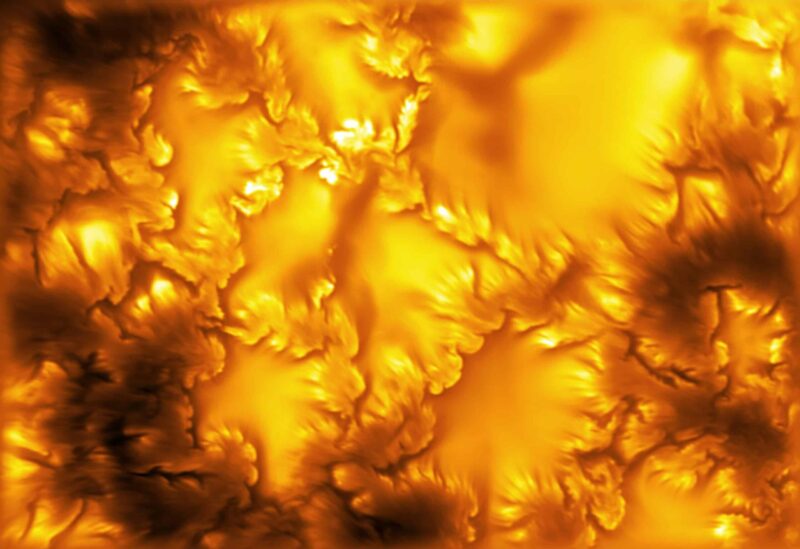
The Daniel K. Inouye Solar Telescope in Hawaii has produced the highest-resolution images of the Sun's visible surface to date. The observatory, operated by the National Solar Observatory, used its 4-meter primary mirror and advanced adaptive optics to resolve features as small as roughly 30 kilometers across.
The images show the solar photosphere in unprecedented detail, revealing a pattern of bright granules separated by dark lanes. Within these granules, researchers identified small-scale instabilities and rapid brightness fluctuations that had not been clearly observed before.
These instabilities appear as tiny, short-lived bright points and vortex-like structures within the granular cells. Scientists say the features are consistent with magnetic flux tubes and convective motions that could transport energy from the solar interior into the atmosphere.
The observations may help address a long-standing question in solar physics: why the Sun's surface is heated to about 5,800 degrees Celsius while the overlying corona reaches millions of degrees. The newly resolved instabilities could represent a mechanism for injecting energy into the magnetic field that threads the solar atmosphere.
The Inouye Solar Telescope began science operations in 2022 after nearly a decade of construction and commissioning. Its location at Haleakalā Observatory, at an altitude of about 3,000 meters, provides exceptionally stable daytime seeing conditions critical for high-resolution solar imaging.
Researchers plan to combine these visible-light images with simultaneous spectroscopic and polarimetric data to measure magnetic field strength and plasma velocities at the same spatial scales. The goal is to build a more complete picture of how small-scale dynamics drive large-scale solar activity.
The data set from this observing campaign will be made available to the international solar physics community for further analysis. Scientists expect the resolution and diagnostic capabilities to improve further as additional instruments come online at the facility.
Highest-resolution images of the sun’s surface here!
This is an independent summary. The complete reporting, supporting context and any primary documents remain with EarthSky.