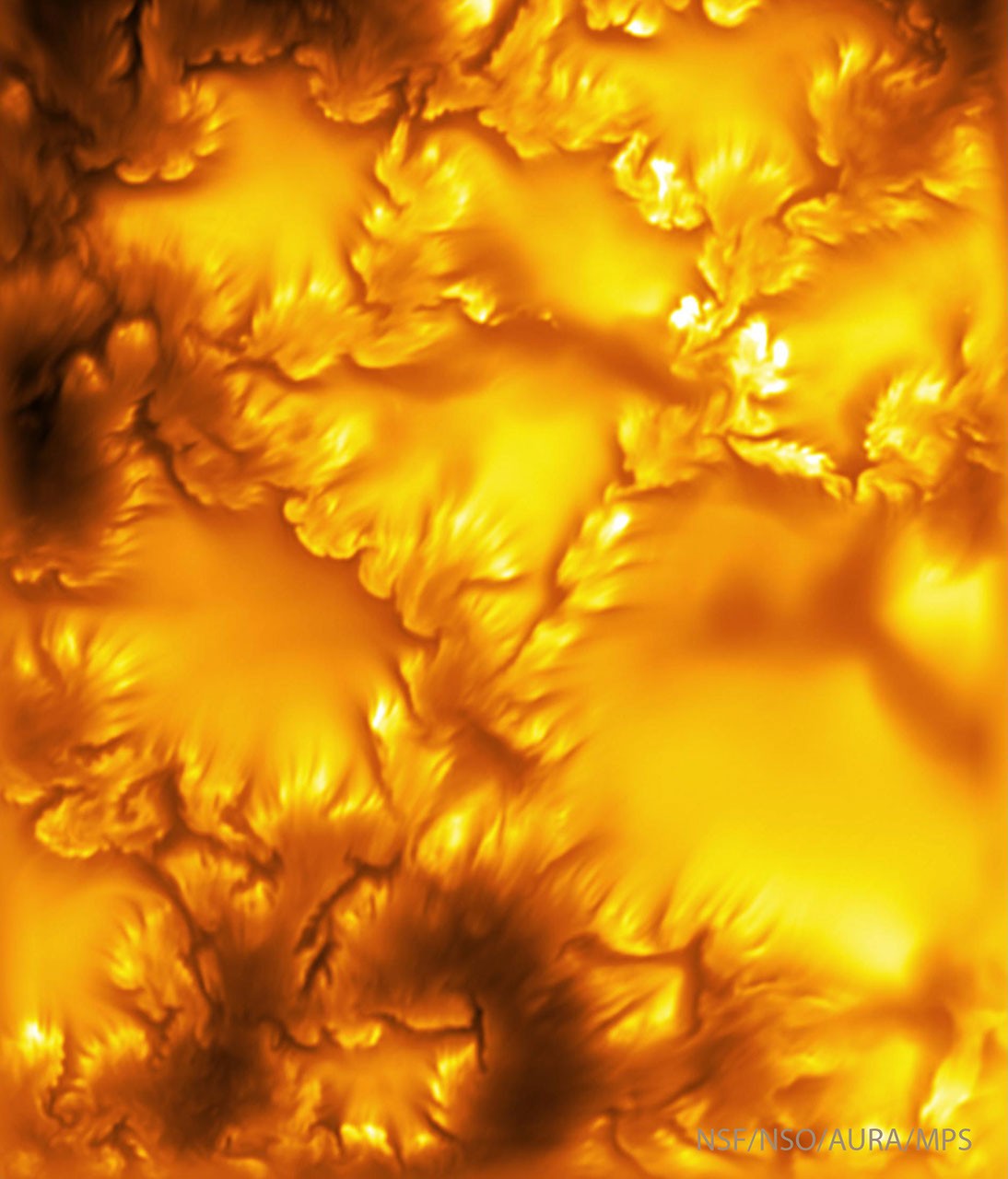
The Daniel K. Inouye Solar Telescope in Hawaii has produced the highest-resolution visible-light image of the Sun to date, according to NASA's Astronomy Picture of the Day for August 6, 2026. The false-yellow image, originally captured in deep blue light, spans a region roughly the radius of Earth while resolving details as small as city-sized features.
The image reveals smooth tops of evolving solar granules — convection cells where hot plasma rises and cooler plasma sinks — along with flower-like structures at their boundaries. At the edges of these structures, researchers identified multiple instances of Kelvin-Helmholtz instability (KHI), a fluid dynamic process that generates waves and swirls when two adjacent streams flow past each other at different velocities.
In this case, the interacting streams are variable flows of solar magnetic plasma. While KHI had long been hypothesized to occur on the Sun, it had not been directly confirmed until these recent observations. The instability appears as distinct streaks and swirls along the granule boundaries, visible due to the telescope's unprecedented spatial resolution.
Scientists anticipate that future research will investigate how KHI contributes to the transport of energy and magnetic fields in the solar atmosphere. One key question is whether the instability plays a role in heating the solar corona, which reaches temperatures far exceeding that of the visible surface.
The Inouye Solar Telescope, operated by the National Solar Observatory (NSO) under the Association of Universities for Research in Astronomy (AURA) with funding from the National Science Foundation (NSF), began operations in 2022. Its 4-meter primary mirror and advanced adaptive optics enable diffraction-limited imaging of the solar surface.
The image was processed and released through a collaboration involving NSF, NSO, AURA, the Max Planck Institute for Solar System Research (MPS), and the Inouye Telescope team. The APOD entry was authored by Robert Nemiroff, Jerry Bonnell, Cecilia Chirenti, and Keighley Rockcliffe.
APOD: 2026 August 6 – New Sharpest Image of the Sun Uncovers Instability
This is an independent summary. The complete reporting, supporting context and any primary documents remain with NASA.