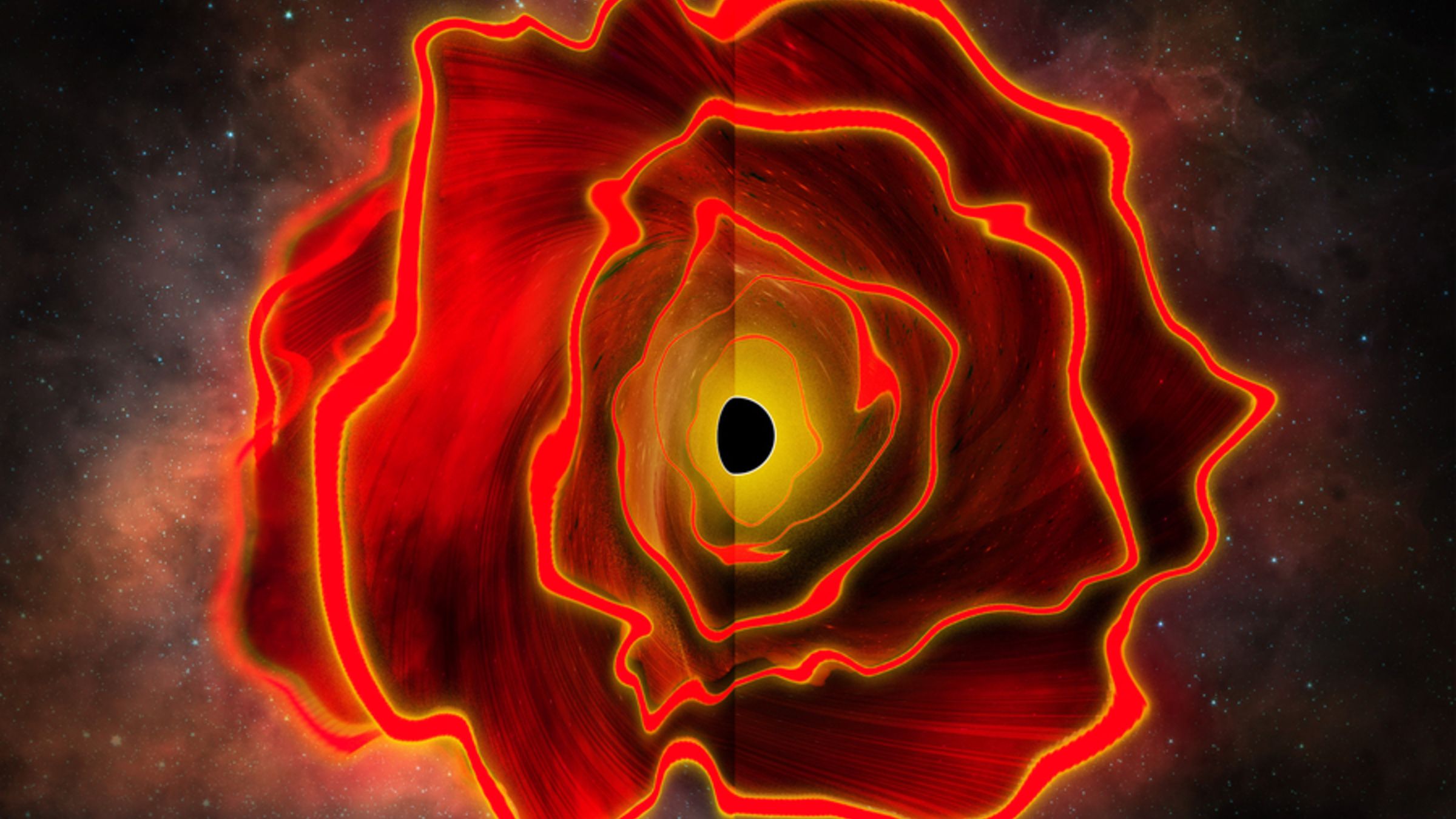
Astronomers using the James Webb Space Telescope (JWST) have identified the most promising candidate yet for a "black hole star," a hypothetical cosmic object consisting of a dense gas cloud superheated by a central supermassive black hole. The object, designated MoM-BH*-1, was detected by the telescope's Miracle or Mirage (MoM) survey. Its light was emitted roughly 660 million years after the Big Bang, when the universe was about one-twentieth its current age.
The object appears roughly the size of our solar system and shines approximately 100 billion times brighter than a typical star. Researchers reported the findings in a study published August 12 in the journal Nature. Study lead author Rohan Naidu, an astronomer at the University of Hawaii, described the object as "truly singular in so many ways."
MoM-BH*-1 exhibits a striking ruby hue, redder than many other known "little red dots" (LRDs)—a class of hundreds of bright, distant objects discovered by JWST since 2023 that are too massive to be ordinary stars but too dim to be full galaxies. The object's spectrum shows a deep Balmer break, indicating missing wavelengths of light. This suggests the light passes through an extremely dense shell of gas composed almost purely of hydrogen and helium, rather than dust.
Simulations run by the research team indicated that the only plausible scenario for such a dense, star-like gas cloud is the presence of a hidden black hole. The team estimates the central black hole weighs up to 100,000 solar masses, qualifying it as supermassive. In this model, the black hole's rapid spin and intense gravity pull in matter so quickly that it shoots out energy beams, superheating the surrounding gas cloud and replacing the role of nuclear fusion found in normal stars.
The black hole star hypothesis may solve a key puzzle regarding LRDs: why these objects do not emit the high-energy X-rays and gamma rays typically associated with quasars. The dense gas cocoon could theoretically block this high-energy radiation, masking the black hole's presence. Researchers suspect many LRDs may actually be mini-galaxies with black hole stars at their cores, formed when such stars collided with primordial stellar clusters.
Images suggest MoM-BH*-1 could collide with a neighboring galaxy in roughly 100 million years, though the light from that event has not yet reached Earth. Naidu noted the object might already reside within a larger galactic structure but outshines its host galaxy. The team cautions that significantly more research is needed before scientists can confidently link all LRDs to black hole stars.
This discovery follows a previous candidate, nicknamed "the Cliff," identified last year by many of the same authors. However, MoM-BH*-1 is farther away and older, making it more valuable for understanding how such objects form in the early universe. The study involved researchers from MIT, the Institute of Science and Technology Austria, and other institutions.
Black hole star? Solar-system-size 'dot' from the early universe is our best evidence yet of a brand-new type of cosmic object
This is an independent summary. The complete reporting, supporting context and any primary documents remain with Live Science.