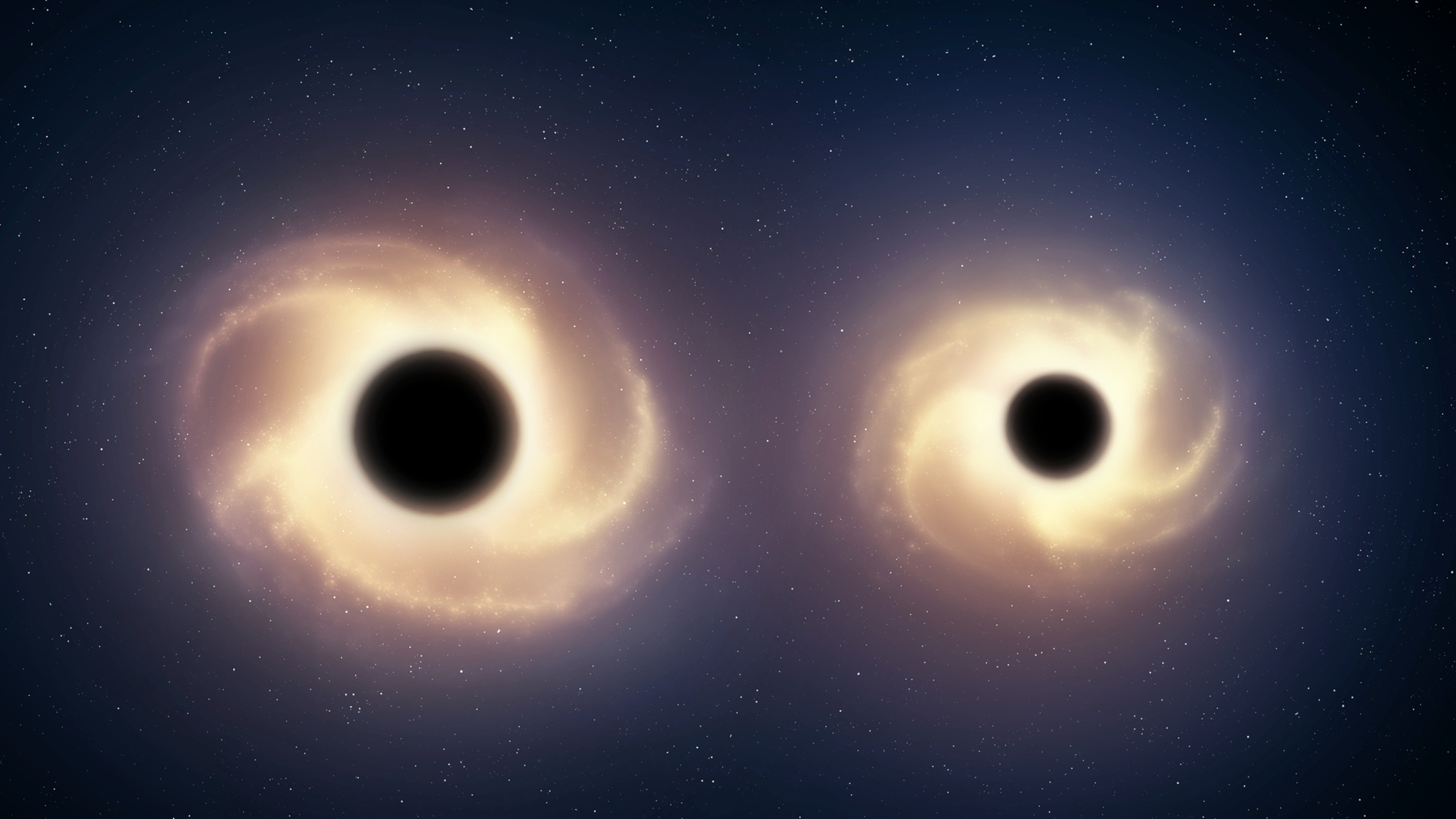
Astronomers have identified the closest confirmed pair of actively feeding supermassive black holes in the early universe, a system designated LID-1166. Observed as it existed roughly 1.3 billion years after the Big Bang, the two black holes are separated by about 4,900 light-years (1.5 kiloparsecs) within a merging galaxy. The finding, reported in a study accepted for publication in Nature Astronomy, marks the first time such a close-separation dual black hole system has been confirmed at this cosmic epoch.
The system first appeared as a bright X-ray source in the Chandra COSMOS Legacy Survey but remained invisible in deep Hubble Space Telescope images. To resolve the source, researchers led by Hyewon Suh of the International Gemini Observatory/NSF NOIRLab used the James Webb Space Telescope's Near-Infrared Spectrograph (NIRSpec) and the Atacama Large Millimeter/submillimeter Array (ALMA) in Chile. JWST's NIRSpec revealed two distinct, compact sources at the expected separation, while ALMA detected substantial reservoirs of cold gas associated with each object.
Both sources show spectral signatures of gas orbiting at high velocities, confirming they are active galactic nuclei powered by accreting supermassive black holes. Study co-author Roberto Decarli of the Italian National Institute for Astrophysics noted that the presence of gas around each nucleus indicates they reside in the centers of two galaxies currently merging, rather than representing a single black hole ejected from its host. Independent astrophysicist Anna Trindade Falcão of NASA's Goddard Space Flight Center described the detection as "meaningful evidence" for a genuine dual system, though she recommended further follow-up to exclude the possibility that the second signal is residual glow from the primary nucleus.
Previous dual black hole candidates at similar or earlier cosmic times have been separated by tens of thousands of light-years or more. LID-1166 is the first confirmed case where the pair is close enough to be in the late stages of a galaxy merger, a phase predicted by theory but difficult to observe because the nuclei are typically buried in dense gas and dust. Decarli emphasized that resolving this stage was only possible with JWST's infrared imaging and spectroscopic capabilities, as ground-based observations at these wavelengths are severely limited by atmospheric absorption.
The discovery addresses a long-standing puzzle: how some supermassive black holes grew to enormous masses so quickly in the early universe. Models suggest rapid growth requires large inflows of gas funneled to the galactic center, a process accelerated during galaxy mergers. If both merging galaxies host massive black holes, their combined accretion and eventual coalescence could further speed mass assembly. Studying systems like LID-1166 provides direct observational evidence for this theorized pathway.
Researchers caution that the population of such close, obscured dual black holes remains largely hidden. While theory predicts they should be common, confirming their existence requires the combination of high-resolution infrared spectroscopy and submillimeter imaging that JWST and ALMA uniquely provide. The LID-1166 detection represents a first step toward characterizing this missing population and refining models of early black hole and galaxy co-evolution.
James Webb telescope just spotted the oldest, closest pair of black holes in the early universe
This is an independent summary. The complete reporting, supporting context and any primary documents remain with Live Science.