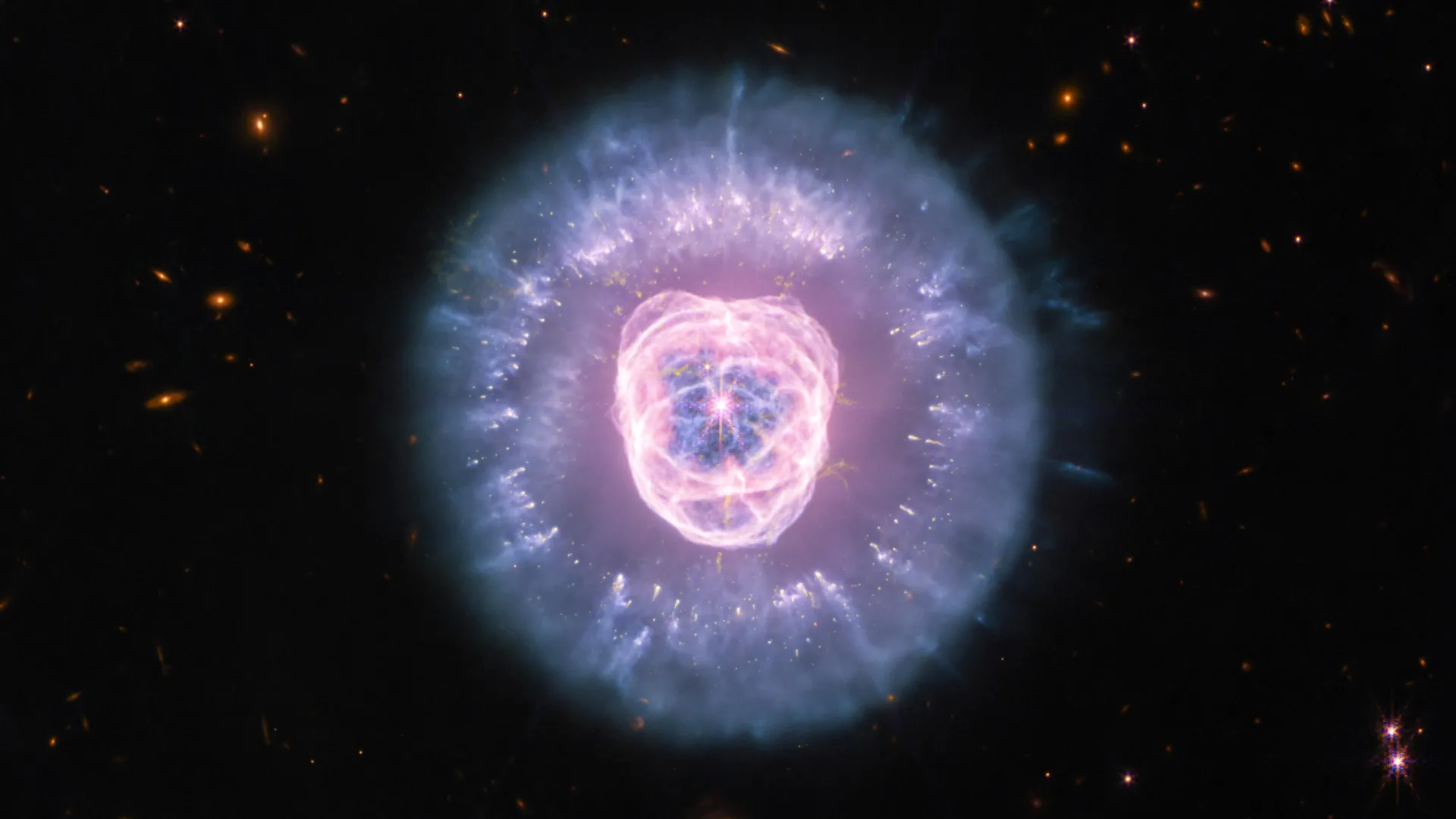
The James Webb Space Telescope has produced a new composite image of NGC 2392, a planetary nebula nicknamed the Lion Nebula, using its Near Infrared Camera and Mid Infrared Instrument. The nebula lies several thousand light-years away and formed from the outer layers of a Sun-like star that shed its envelope as nuclear fusion ceased in its core.
At the center sits a hot, oxygen-rich white dwarf — the stellar remnant that appears as a small button nose in the lion-shaped structure. Intense ultraviolet radiation from this white dwarf ionizes the surrounding gas, creating a glowing bubble that forms the nebula's recognizable face while simultaneously destroying dust in its path.
Webb's infrared view penetrates dust that obscures visible-light observations, revealing dense clumps of dust that have survived the white dwarf's radiation. These clumps appear as comet-like tails within the nebula's inner dust shell, which corresponds to the lion's mane, and they shield material behind them from the full force of the stellar radiation.
The Hubble Space Telescope imaged NGC 2392 in visible light in 2000, establishing its distinctive lion-like morphology. Webb's higher-resolution infrared data now show the same overall structure but with far greater detail on the distribution of dust and ionized gas, allowing astronomers to study how the nebula's complex rings and shells are arranged.
Planetary nebulae such as NGC 2392 represent a brief, late stage in the evolution of low- to intermediate-mass stars. The expelled gas and dust continue to expand and change; researchers estimate the Lion Nebula will fully disperse in approximately 10,000 years, a short interval on astronomical timescales.
The white dwarf's radiation drives the nebula's ongoing transformation, pushing material outward and shaping the intricate patterns of rings and shells commonly seen in these objects. Astronomers are still working to understand why the swept-up gas forms such complicated arrangements rather than smooth shells.
Webb is an international partnership among NASA, the European Space Agency, and the Canadian Space Agency. ESA contributed the NIRSpec spectrograph and half of the MIRI instrument, and provided the Ariane 5 launch service. The new observations add a detailed infrared snapshot to the long-term record of this nebula's evolution.
James Webb captures a cosmic lion sculpted by a dying star
This is an independent summary. The complete reporting, supporting context and any primary documents remain with ScienceDaily.