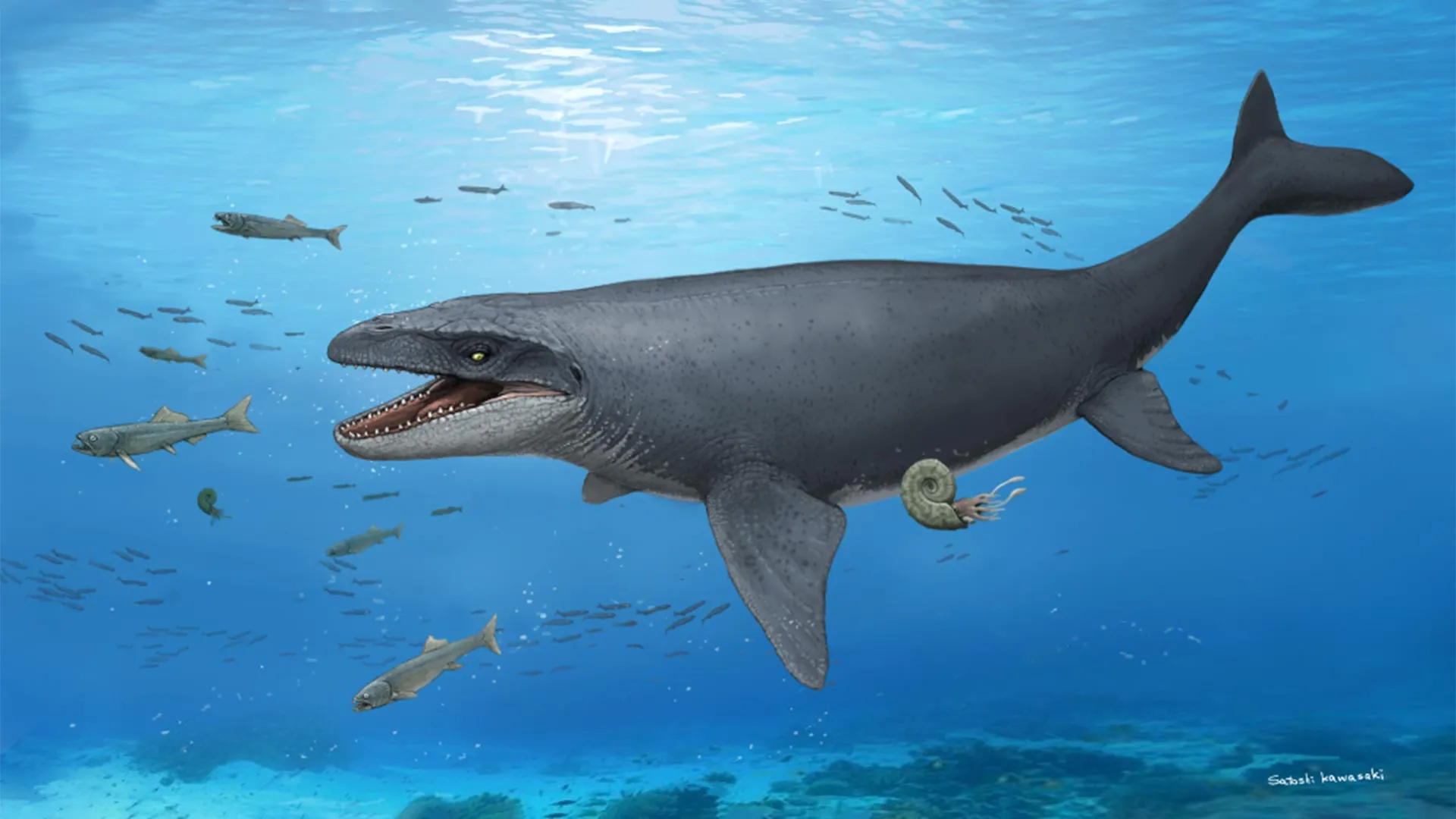
Fossils collected in Osaka Prefecture between 1990 and 1992 have yielded four previously unrecognized mosasaur bones after researchers revisited unprepared rock stored at the Natural History Museum in Kishiwada City. The specimens were originally found in Sobura, Kaizuka City, and preserved for decades before recent preparation revealed the new material.
Among the discoveries is a premaxilla, the frontmost bone of the upper jaw, which represents the first confirmed example of this element in a Japanese mosasaur fossil. When the fossils were first collected, limited comparative material made precise identification difficult, but expanded global mosasaur research since the 1990s enabled the team to recognize the bone.
The research team also examined a basisphenoid, a bone near the braincase, and found distinctive anatomical features not documented in known mosasaurs. These include short horn-like projections and the absence of a ventral median groove, a combination of traits that differs from previously described species.
The unusual morphology raises the possibility that the remains belong to a species new to science, though the researchers emphasize that additional study is required to confirm this hypothesis. The findings were presented at the 177th Annual Meeting of the Palaeontological Society of Japan in June 2026.
The project involved collaborators from Okayama University of Science, Tokyo City University, the University of Tsukuba, and the Natural History Museum, Kishiwada City. Their work demonstrates how reexamining long-stored museum collections with updated comparative knowledge can yield significant paleontological insights.
Mosasaurs were large marine reptiles that lived worldwide during the Late Cretaceous, approximately 98 to 66 million years ago. This discovery may contribute to a clearer understanding of marine ecosystems in the northwestern Pacific during that period.
A 30-year-old fossil was hiding bones from a mysterious ancient sea monster
This is an independent summary. The complete reporting, supporting context and any primary documents remain with ScienceDaily.