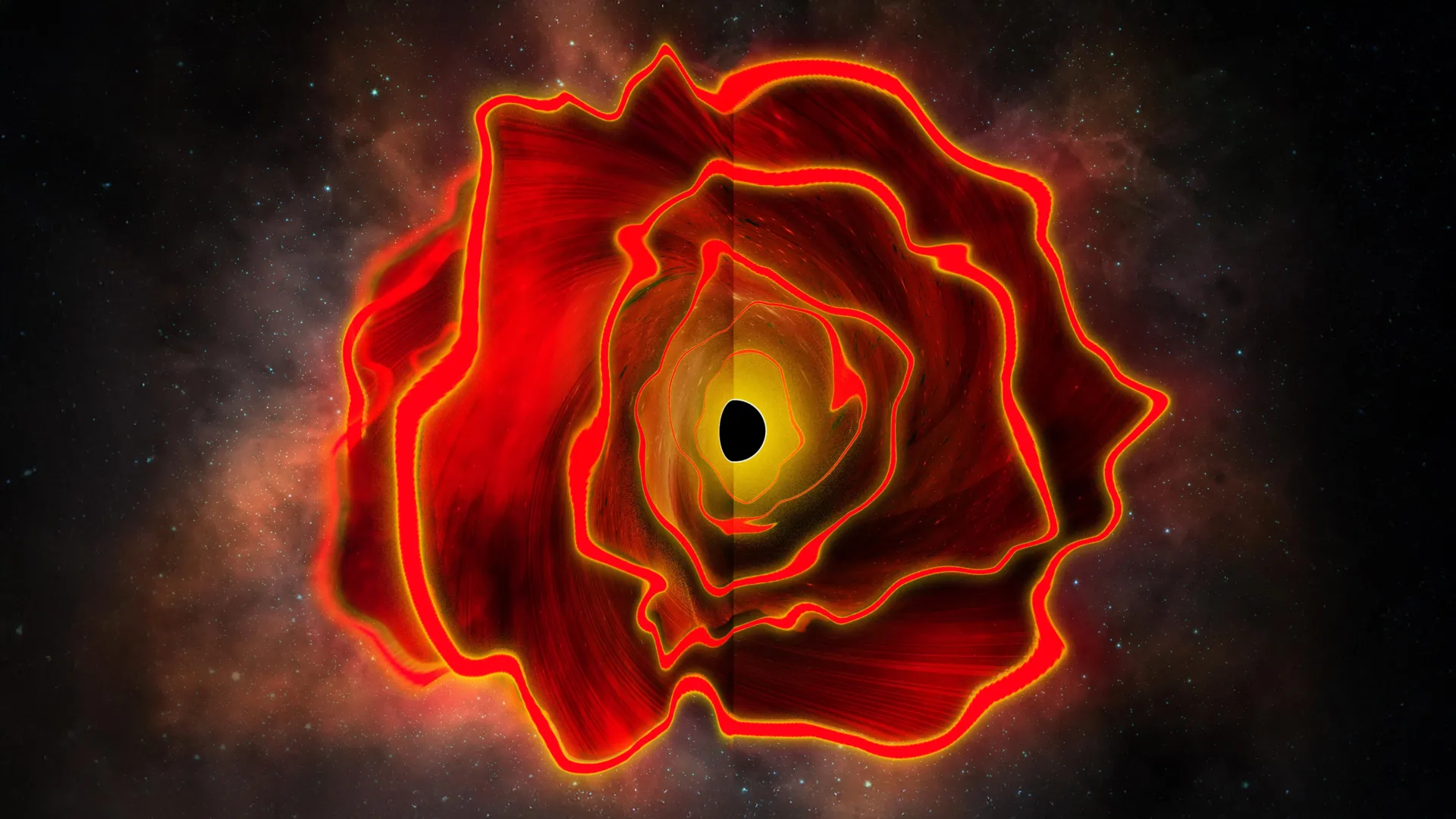
Astronomers from MIT and collaborating institutions have reported the discovery of an unusually bright red object in the early universe, observed with NASA's James Webb Space Telescope. The source, designated MoM-BH*-1, dates to a few hundred million years after the Big Bang and appears as a compact red dot in deep-field images.
The object emits roughly 100 billion times more energy than any known star could produce through nuclear fusion. Its spectrum shows a record-breaking Balmer break — a sharp drop in light at certain wavelengths — and contains almost no elements heavier than hydrogen and helium.
Researchers led by Rohan Naidu, a NASA Hubble Fellow at MIT's Kavli Institute, propose that the source is a previously unobserved type of object: a black hole of about 100,000 solar masses surrounded by an extremely dense, extended envelope of hydrogen gas roughly the size of the solar system. The black hole's accretion would power the extraordinary luminosity, while the dense gas cocoon produces the observed spectral features.
The team arrived at this interpretation after simulating multiple astrophysical scenarios. Models with only hydrogen gas, but no dust, could reproduce the red color and deep Balmer break if the gas was dense enough to resemble a stellar surface. Adding an accreting black hole of the inferred mass provided the best match to the observed brightness.
The discovery emerged from the 'Mirage or Miracle' (MoM) survey, which was designed to identify the earliest galaxies. The researchers initially mistook the object for an extremely bright early galaxy before its unusual spectral properties prompted deeper analysis.
If confirmed, this 'black hole star' could help explain the population of 'little red dots' that appear ubiquitously in JWST deep-field images but vanish in later cosmic epochs. The team suggests many of these dots may share the same basic structure, with MoM-BH*-1 representing a case where the central engine outshines its host galaxy entirely.
The study was published in Nature on August 12, 2026, and supported by MIT, NASA, and the Space Telescope Science Institute. The interpretation remains a model-dependent inference; direct confirmation of the black hole and its envelope will require further observations.
JWST spots a bizarre “black hole star” 100 billion times brighter than a star
This is an independent summary. The complete reporting, supporting context and any primary documents remain with ScienceDaily.