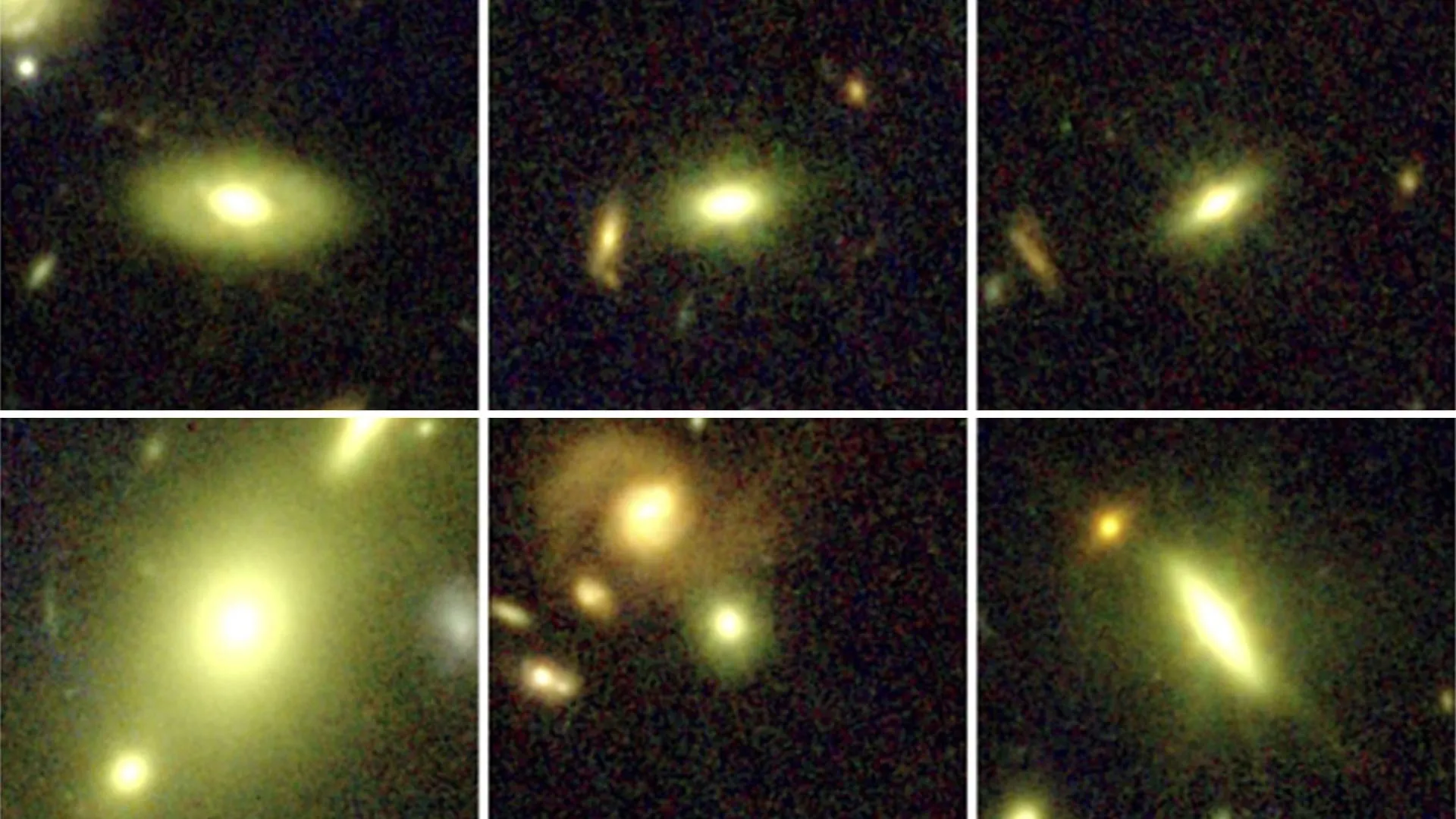
An international team using the James Webb Space Telescope has found that nine massive, mature galaxies that stopped forming stars billions of years ago likely contain far more low-mass stars than previous models assumed. The researchers combined JWST spectra with earlier ground-based data from the Very Large Telescope to separate the light of faint, small stars from the dominant glow of bright, massive stars. This technique allowed the first reliable estimate of the relative numbers of low-mass versus high-mass stars in galaxies at such distances.
The results, published in Nature Astronomy, indicate that these galaxies are three to four times more massive than earlier calculations suggested. One galaxy, which formed less than 1.5 billion years after the Big Bang, could be up to four times more massive than previously thought. The finding challenges the long-standing assumption that stars form in roughly similar proportions across different galaxies and cosmic epochs.
Joel Leja of Penn State, a coauthor of the study, said the discovery sharpens an existing tension in cosmology: JWST has repeatedly revealed unexpectedly massive and mature galaxies shortly after the Big Bang, and adding substantially more stellar mass to those systems makes the discrepancy with current formation models even larger. Theories must now account for how such enormous numbers of small stars could have appeared so early.
Lead author Chloe Cheng, a recent doctoral graduate of Leiden University, compared the bright stars to skyscrapers that hide a far more numerous population of low-mass stars, like houses concealed between them. Coauthor Martje Slob, a doctoral candidate at Leiden University, emphasized that measurements of this kind were impossible until JWST provided spectra of sufficient quality and new analysis techniques were developed to detect the subtle signatures of faint stars.
Mariska Kriek of Leiden Observatory, who led the research, noted that the hidden mass in low-mass stars has consequences beyond galaxy formation. Because many planets orbit low-mass stars, the revised stellar populations could imply that more planets formed in the early universe than previously assumed. The team plans to apply the same method to galaxies from even earlier periods to push observations closer to the emergence of the first stars and galaxies.
JWST finds early galaxies may be 4 times more massive than thought
This is an independent summary. The complete reporting, supporting context and any primary documents remain with ScienceDaily.